Drabble Tackles Mortality

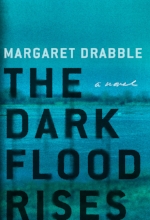
The Dark Flood Rises     Margaret Drabble     (2016)

By taking her title and epigraph from DH Lawrence’s “The Ship of Death,” Margaret Drabble alerts readers that there’s going to be a lot about mortality in this book.
Drabble’s novels over the past fifty-plus years have often related to the period of life that she is in at the time of the writing. Since she’s now in her late 70s, The Dark Flood Rises features mostly characters who are advanced in age. It’s an ensemble cast, with Fran Stubbs as the one whose interior musings we learn most about.

Fran, who works as a consultant on housing for the elderly, is seventy-something but doesn’t want to retire. She still drives all around Britain inspecting housing facilities and attending conferences. Drabble takes us inside Fran’s head, where we hear her extended thoughts on architecture and traffic, on Vikings and soft-boiled eggs. Given her profession, Fran can’t help but have her attention directed to the subjects of old age and death quite frequently. In addition to Fran, we also meet an extended circle of her colleagues, family, friends, and friends of friends, who have an assortment of ailments and personal losses. Most live in Britain, but some are expats living off the coast of Spain in the Canary Islands, a popular tourist and retirement destination for Britons.

The plot of The Dark Flood Rises is somewhat diffuse but nevertheless engrossing, as Fran helps out her bedridden ex-husband, her son (whose girlfriend has died suddenly), and friends in various states of ill health. Drabble describes Fran as living “in the world of obituaries now, in the malicious crepuscular light of memorial services.” (178) Meanwhile, elderly Britons in the Canary Islands are surrounded by picture-postcard delights, but the clock ticks for them also. All these characters are drawn in detail as they turn to drugs or alcohol or denial or opera or religious ritual or adaptive technologies to ease their situations. This summary makes the novel sound grim and macabre, but it actually has many comic incidents:  Fran getting her car stuck in a muddy field, her ex-husband trying to seduce his young caregiver, her friend Josephine teaching an adult education class.

Along the way we get magnificent tours of the English landscape and extended historical observations about the Canaries. The language is very rich, as you might expect from Drabble. Her cumulative adjectives are especially impressive—for instance, “the flowing sunlit electric-green weed-fronded depths of the slowly flowing water” or “the faded painted peeling pale blue of the woodwork.”

Bubbling below the surface narrative of The Dark Flood Rises, alarming destructive forces on a planetary level reflect the grappling of individuals with transience. Flood waters inundate Britain, perhaps due to global climate change. Hordes of refugees fleeing the Middle East and Africa point to failures of political systems. Volcanic and seismic activity in the Canary Islands seem to indicate that Earth itself is groaning tectonically. Is the apocalypse near? Are people too obsessed with their own petty concerns—or even with major humanitarian issues—to notice? Is it better to over-prepare for death or to under-prepare? Is a lingering death or a sudden death preferable? In The Dark Flood Rises, life churns on, but disaster lurks in the rivers and under the mountains.

Readers over the age of about 50 will likely appreciate The Dark Flood Rises most. However, for readers at all stages of life, it’s an excellent examination of the vagaries of aging, set against the large-scale environmental and ethical challenges that humanity faces.
A Lighthearted Side of Scotland

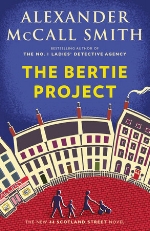
The Bertie Project     Alexander McCall Smith     (2016)

The universe of readers of novels in English divides into those who can’t stand Alexander McCall Smith and those who can’t wait for the next installment from him. I’m in the latter camp.

The Bertie Project is the eleventh book in McCall Smith’s 44 Scotland Street Series (see list below). Interestingly, the chapters of all the 44 Scotland Street books have first appeared in serialized form in the Scottish newspaper The Scotsman. This publishing approach constrains McCall Smith’s chapter length and requires that each chapter have a cliffhanger, although the cliff is usually more like a small berm in your backyard.

Scotland Street is a real thoroughfare in Edinburgh, but #44 is fictional. In this multi-family building of flats, which are kind of like American condos, McCall Smith follows the lives of the inhabitants. Some of them are ordinary citizens, like Pat MacGregor (a young art student who goes to work in a gallery) and Stuart Pollock (a statistician with the Scottish government) and Domenica MacDonald (a wise anthropologist). Others are caricatures so inflated that the reader marvels that they don’t simply burst. These include Bruce Anderson (a twenty-something narcissist obsessed with personal care products), Irene Pollock (a domineering mother obsessed with the writings of Melanie Klein), and the identical triplet sons of Matthew and Elspeth Duncan.

Even when some of these denizens of 44 Scotland Street move to other residences, McCall Smith keeps an eye on their activities. And over the course of the series, Cyril, a beer-swilling dog with a gold tooth, moves into 44 Scotland Street. McCall Smith skewers affectation wherever he finds it.

The star of the entire 44 Scotland Street Series is undoubtedly Bertie Pollock, who starts out as a precocious five year old and ages very slowly toward seven. I seldom laugh out loud when I’m reading a novel, but pronouncements from young Bertie can be so hilarious that I have to stop reading to wipe the tears of laughter from my eyes. Bertie is forced by his shrew of a mother, Irene, to take lessons in Italian and saxophone and yoga. He’s dressed by her in pink overalls that embarrass him. He’s hauled off to psychotherapy sessions even though his mental health is excellent. I keep hoping that someone will rescue poor, sweet Bertie. McCall Smith dangles that possibility in front of his readers repeatedly throughout the series, notably in The Bertie Project.

Here’s one of McCall Smith’s descriptions from The Bertie Project:  “Why could Bertie not be left alone to grow up in the way that suited him? He was, after all, a particularly appealing little boy, free from any discernible character defects, obliging, gentle, and, most remarkably, utterly without guile . . . He described the world exactly as he saw it; he expressed in a completely open way the thoughts that went through his mind; if asked what he was doing or thinking he answered in a way that concealed nothing, held nothing back.” (168)

I can’t tell you too much more about The Bertie Project without spoilers. Bertie and his family are prominent. Bruce the Narcissist acquires a new girlfriend, an Australian. Matthew and Elspeth have nanny troubles.

As if a many-stranded plot with a large cast of characters isn’t enough for the 44 Scotland Street novels, McCall Smith adds complaints about the grim Scottish weather, encomiums to his beloved city of Edinburgh, digs about Glasgow, analyses of Scottish visual arts, criticisms of bad grammar, digressions on the history of Scotland, and opinions on the tensions between Scotland and England, both medieval and modern. I find most of these tangential peregrinations amusing, the one exception being the story line about Scottish nudist societies . . .  In any case, as you embark on each chapter, you never know where you’ll end up.

Maybe the unpredictability is why some people hate McCall Smith’s novels, or maybe some readers dislike his sense of Scottish superiority. My Scottish heritage probably biases me toward the books, because I also enjoy the other McCall Smith series set in Edinburgh: the thirteen Isabel Dalhousie novels. Isabel is a philosopher who edits a journal on applied ethics and solves local mysteries. She’s also an unintentional cougar. Watch for my blog post on this series in the future.

McCall Smith’s best known novels are The No. 1 Ladies’ Detective Agency Series, seventeen charming books set in Botswana and starring detective Precious Ramotswe. Two other McCall Smith series are Corduroy Mansions and Portuguese Irregular Verbs; these are less successful, I think, but worth reading if you’re a true fan.

Check out Alexander McCall Smith to determine if you're a fan or a detractor! Here are all the books in the 44 Scotland Street Series: 44 Scotland Street (2004), Espresso Tales (2005), Love Over Scotland (2006), The World According to Bertie (2007), The Unbearable Lightness of Scones (2008), The Importance of Being Seven (2010), Bertie Plays the Blues (2011), Sunshine on Scotland Street (2012), Bertie’s Guide to Life and Mothers (2013), The Revolving Door of Life (2015), The Bertie Project (2016).


Zadie Smith's Latest

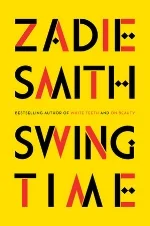
Swing Time     Zadie Smith     (2016)

Two young girls meet at dance class in 1980s London, both poor, both with one white parent and one black parent. Tracey is a preternaturally talented dancer, but the other girl, the unnamed narrator of the novel, is not. The girls watch videos of old movies to study dance technique, and Swing Time, the 1936 musical starring Fred Astaire and Ginger Rogers, is one of their favorites.

We follow the diverging lives of Tracey and the narrator as the novel skips back and forth in time over twenty-plus years, with issues of race and class always at the fore, always presented frankly.  I got pulled into caring for these two characters with the brilliant scenes of childhood and adolescence, as the friends are finding their life paths in the cultural excitement of late-20th-century Britain. Tracey, flashy and outspoken, becomes a professional dancer, albeit in the chorus line. The narrator, reserved and sensible, goes to university and then lands a job as a personal assistant to a famous globetrotting singer-dancer named Aimee. The supporting cast is strongly delineated, with the mothers of the two friends playing major roles. The mother-daughter relationships are depicted with a clarity that can make you squirm.

We know from the start of the novel that the narrator will suffer some major career and personal setback, so part of the tension in the narrative is watching how she will arrive at that outcome. The details play out in West Africa, where the pop star Aimee decides to splash a portion of her wealth on humanitarian projects that, predictably, go awry.

At this point, when the story moves to Africa, my eyes started to glaze over as I tried to read. After the superb London chapters, I found the descriptions and dialogue in the African part of the plot boring: a white pop star sweeps into an impoverished black village for brief visits while her mixed-race assistant handles the details of the distribution of largesse. If the novel hadn’t ventured back to Britain once in a while, I would have abandoned it.

What was wrong with me? I was reading a novel by Zadie Smith, the acclaimed author of White Teeth. How could I find the African segments boring? Did I need to drink more caffeine before reading?

After I trudged to the last page of Swing Time, I decided to look up a few reviews to see if I was missing something. I don’t usually read book reviews by others before writing my own, but I was perplexed. Almost all the reviewers gave Swing Time raves (including Annalisa Quinn for NPR and Taiye Selasi for The Guardian). Michiko Kakutani (for the New York Times) praised the London sections of the novel but called the African sections “perfunctorily rendered” and “formulaic and predictable.” Aha! Kakutani, the Supreme Goddess of Book Reviews, had exactly the same take that I had about those scenes in Africa!

If you decide to read Swing Time, skim over the chapters set in Africa. The true heart of this novel is in its exploration of friendship. Friends can comfort or exasperate you. They can protect or betray you, and they can swing back and forth between these extremes. But you need friends to be a whole person. The characters in Swing Time show us these truths.

An Australian Lighthouse

The Light Between Oceans     ML Stedman     (2012)

I rejected this novel for several years, put off by the gloomy plot summary on the dust jacket. But I’m trying to review more books by authors from the UK, Canada, Australia, and New Zealand. ML Stedman, the London-based author of The Light Between Oceans, was born and raised in Western Australia, so the book seemed to fill this slot nicely.

The plot, briefly: In the 1920s, a lighthouse keeper and his wife, on a remote island off the coast of Western Australia, find a dead man and a live infant in a boat that washes ashore. Desperate for a child of her own, the wife insists that they keep the baby girl rather than report the shipwreck. The husband reluctantly agrees. The complicated consequences of this decision play out over the following years, on the island and in the town on the mainland, a hundred miles away by sea.

The Light Between Oceans teeters right on the precipice of melodrama. By “melodrama” I mean writing that relies on overwrought emotions, ridiculous coincidences, and cardboard characters. Emotions do flow over the top at times, as the lighthouse keeper struggles with his code of conduct and as battles for custody of the baby escalate. (I don’t think it’s a spoiler for you to know that there are custody battles. As soon as the baby arrives, at the beginning of the book, the reader senses that trouble looms.)

There are definitely questionable coincidences in The Light Between Oceans, including the arrival of the boat baby right after the wife has suffered a stillbirth, plus several subsequent chance encounters that stretch credibility. I also questioned the logic of some of the narrative. For example, the supposed grandparents of the baby wait eighteen months to see her. I think it more likely that they or other relatives would have gone out to the island now and then, on the supply boat that made the trip four times a year. The sea passage was rough, but it was a day’s journey, hardly much for Australians accustomed to vast distances between their cities. And the lighthouse couple could have adopted a child. The orphanages of Australia were full, so it doesn’t seem reasonable that they would have been denied adoption because of their location. They could also have easily received a stack of newspapers on the supply boat from the mainland. Ah, but newspapers might have changed their decision about the baby and destroyed the premise of the story.

What saves The Light Between Oceans, then, from tipping totally into melodrama? Australia and the Australians. Stedman’s descriptions of Janus Rock (the lighthouse island) and Point Partageuse (the mainland town), both fictional, are mesmerizing. The sub-tropical flora and fauna form a backdrop to the story: jacaranda and karri trees, animals like skinks and quokkas. The details of lighthouse maintenance in the days before automation are fascinating. I can see the brilliant light shining out across the waters and feel the sharp winds of this isolated spot where the Great Southern (Pacific) Ocean and the Indian Ocean come together, often violently. I get tugged into the loneliness as well as the freedom of this wild, gorgeous place on earth.

And the Australians, still staggering from the devastating casualties of World War I, come alive in Stedman’s writing. In fact, World War I accounts for much of the emotion in the book. The lighthouse keeper, a decorated veteran of the Western Front, sustained no major physical injuries but has horrific memories and survivor’s guilt. He takes the lighthouse job, even though he’s a university-educated engineer, to get away from civilization and calm his mind. The actions of several other characters are also motivated by after-effects of the war, such as grief at the loss of sons and animosity toward citizens with German surnames.

The extreme examinations of conscience and weighing of alternatives that the characters go through could be seen as melodramatic, but I take these as reflecting the historical period of the novel. Most people in the 1920s adhered at least externally to the religious dictates of the culture, and as a result, some were troubled by over-zealous contemplation of their failings. Add in the effects of PTSD (called “shell shock” during World War I), and you’ve got a lot of authentic anguish.

In the final chapter, which serves as a kind of epilogue, Stedman spins her story out to the year 1950, taking the characters past another world war and showing the long-term consequences of their decisions back in the 1920s. I enjoyed this wrap-up, but others may find it excessive, in the category of “too much information.”

My final verdict on The Light Between Oceans: it’s worth reading. If, like me, you get attached to fictional characters, it may bring you to tears. 

Postscript: I have not seen the movie version of The Light Between Oceans. It got mixed reviews.

Summer 1976, England

The Trouble with Goats and Sheep     Joanna Cannon     (2015)

When I noticed that The Trouble with Goats and Sheep was set in England in the summer of 1976, I had to read it. I spent that summer traveling around England, doing research on medieval manuscripts housed at several university libraries there. Librarians, proprietors of bed-and-breakfasts, and strangers on the train all wiped their brows and commented to me on the exceptionally hot, dry weather. I did notice that the rain that usually greens up the countryside was absent, but the temperatures didn’t seem excessive to me—in the high 80s Fahrenheit during the day.

I now realize that I was accustomed to summers in the midwestern US and that I was immured all day in British libraries with thick stone walls, so the nationwide lack of air conditioning wasn’t too burdensome. In retrospect, we know that the summer of 1976 was Britain’s hottest in at least 350 years—even hotter than recent toasty summers.

So heat permeates Joanna Cannon’s The Trouble with Goats and Sheep. Instead of the typical overcast skies and intermittent showers, the sunshine is relentless. Here’s a sample of Cannon’s descriptive powers:  “Evening had tempered the sun, and a wash of gold folded across the living room. It drew the sideboard into a rich, dark brandy and buried itself in the pleats of the curtains.” The heat and drought make the characters a little bit crazy: “The bonds which held things together were destroyed by the temperature . . . but it felt more sinister than that.”

In this summer of 1976, several mysteries unwind on “the Avenue,” a block of English suburbia. First, Mrs Creasy has disappeared. Grace and Tilly (both age ten) decide to figure out where she went and why she left. They are also searching for God, because the local vicar has said that people are like sheep and God is like a shepherd who gathers lost sheep. Grace, who narrates some chapters in first person, expresses skepticism at whether God, at the Last Judgment, can tell His beloved sheep from the goats, whom He plans to cast away into eternal punishment.

Other mysteries in the novel are connected to a house fire on the Avenue back in 1967; fragments of these old, smoldering mysteries are revealed to the reader in flashbacks. Lesser mysteries about individual characters also emerge. Why is Brian Roper still under the thumb of his harridan mother? Does Dorothy Forbes have Alzheimer’s or is she just badgered too much by her husband? Why is Tilly so sickly?

The action in The Trouble with Goats and Sheep moves very slowly; I got annoyed at having the plot doled out in such tiny tidbits. But character development is more important than plot here, since the reader, like God, has to know how to separate the sheep from the goats. We dive deep into the individual secrets in each house on the Avenue, with dialogue that’s witty and occasionally acerbic.

Some of the characters eat more sweets (Britspeak for candies), both generic and brand name, than is good for them. Since I’m not familiar with the British sweets market, I may be missing a specific authorial implication, but I’m guessing that the sugariness in those middle-class homes is barely coating the paranoia and cruelty of the residents. As a reader, you can wander in and out of the sweltering, stuffy kitchens on the Avenue. You can peer out the windows with the nosy neighbors. But don’t be taken in by the surface sweetness. Nastiness lurks.


A Cure for Loneliness

Our Souls at Night     Kent Haruf     (2015)

Right in the first chapter of Our Souls at Night we know the premise: One evening in May, elderly widow Addie Moore asks elderly widower Louis Waters if he would come to her house occasionally and spend the night, not for sex but for conversation and companionship. Addie and Louis are neighbors in the fictional small town of Holt, Colorado, and both are intensely lonely. She has a son, and he has a daughter, but these adult children live hours away.

Addie and Louis embark on their conversational adventure, scandalizing the townsfolk but finding joy in each other’s company. Through their dialogue, which forms the core of this book, we learn about their family histories, their disappointments, their secret pleasures. When Addie’s son and daughter-in-law have marital and business troubles, their young son comes to stay with Addie for the summer. Addie and Louis are able to cheer up this forlorn grandchild with unpretentious entertainments, but, alas, the magic of their summer together doesn’t last.

All you punctuation geeks out there should be aware that author Kent Haruf uses no quotation marks in his writing. This practice causes reader confusion once in a while, but I think I understand Haruf’s motives. The text as it appears on the page is exceedingly spare and unadorned, just as the narrative is simple and stripped down. We get the essence of the story, the bare essentials, which nevertheless say plenty about issues like friendship, trust, love, and family duty. Every single word of Our Souls at Night seems carefully chosen to enhance the whole book.

Haruf depicts small-town America deftly in this novel. (At 179 pages, I’d say that it’s more of a novella.) He doesn’t stereotype the characters or sentimentalize their relationships. Rather, he creates complex, fallible people trying to make sense of their lot in life. Addie and Louis carve out their own version of happiness in spite of setbacks; readers can tuck their story away as a tutorial in how to cope with old age and the inevitability of mortality.

This understated jewel of a book is one you should not miss.

Sadly, Kent Haruf died in 2014, shortly after completing Our Souls at Night. His previous novels (all set in Holt, Colorado) include a loose trilogy (Plainsong, Eventide, and Benediction), Where You Once Belonged, and The Tie that Binds, plus the photobook West of Last Chance (with photographer Peter Brown).


Women of the American Century

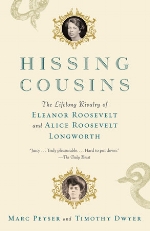
Hissing Cousins: The Untold Story of Eleanor Roosevelt and Alice Roosevelt Longworth        Marc Peyser and Timothy Dwyer     (2015)

In 2014, I watched all fourteen episodes of Ken Burns’s PBS series The Roosevelts: An Intimate History, which focused on the lives of Theodore Roosevelt, Franklin Delano Roosevelt, and Eleanor Roosevelt. I learned a great deal about the history of the United States, including the background to such significant events as the building of the Panama Canal, the establishment of the National Parks, the passage of New Deal legislation, and the American involvement in World War II. But even more captivating was the insight into the personal lives of these three towering public figures.

More family secrets are revealed in Hissing Cousins, a dual biography of Eleanor Roosevelt (1884-1962) and Alice Roosevelt Longworth (1884-1980). Alice, the daughter of President Theodore Roosevelt (TR), lived in the White House in her youth (1901-1909) and became the celebrated “Princess Alice.” Eleanor was TR’s niece, who married her distant cousin Franklin Delano Roosevelt (FDR) and herself moved into the White House as First Lady during his presidency (1933-1945).

Although Alice and Eleanor played together as children and saw each other socially throughout their lives, they differed radically in their political beliefs and in their personalities. Alice was a Republican, flamboyant, sharp-tongued, and dedicated to influencing the course of history through back-door methods. Eleanor was a Democrat, introverted and slower to speak, but she was a reliable sounding board for FDR on many issues, and she found a strong public voice in advocating for civil rights nationally and human rights internationally.

Quoting letters, diaries, and other biographies, authors Marc Peyser and Timothy Dwyer have put together a highly readable story of the two women, who were constantly in the media limelight. I knew quite a bit about Eleanor’s life, but I had not heard of Alice, who was a superstar of the tabloids and newsreels throughout much of her long life. Hissing Cousins cleverly interweaves the stories of two women who helped shape American politics and policies in the first half of the twentieth century, albeit with vastly differing approaches.

Alice and Eleanor both endured tremendous sadness in their family lives. Alice’s mother died shortly after giving birth to her. Both of Eleanor’s parents died when she was a child—her father as a result of alcoholism. Alcoholism afflicted many members of both families, and battlefield deaths in both World War I and World War II took the lives of brothers and cousins. Both Alice and Eleanor had philandering husbands.

Peyser and Dwyer tell their story in lively style, though they veer into cattiness occasionally. For example, in describing the difficult life of Alice’s brother Kermit, they write, “By the late 1930s, Kermit’s shipping business, his marriage, and even his morning meals were on the rocks.” When Alice’s step-mother died in 1948, they write that “the loss of the only mother she had ever known was real, even for a woman who believed that mourning was about as useful as voting for a Democrat.” Such comments do perk up the text—and are in keeping with Alice’s often cutting comments in her letters, newspaper columns, and autobiography—but they’re still in bad taste.

That small quibble aside, Hissing Cousins is a good addition to the history of the American Century. The authors try not to take sides or to pit the two women against each other, though I do sense some bias of affection toward Eleanor. Alice and Eleanor are presented as flawed but brilliant women who made their marks in the halls of power.  


Chinese American Metafiction

The Fortunes     Peter Ho Davies     (2016)

Peter Ho Davies has crafted a heartbreaking metafictional novel about the experience of being Chinese American. I was skeptical at first about the designation of “novel,” since the dust jacket details four separate sections, each with distinct characters, set in various time periods over the past 150 years. Perhaps, I thought, this is another book of short stories, like Davies’s two previous collections. By the time I’d finished reading The Fortunes, however, I could see that it is a novel, with the sections linked in hundreds of intricate ways. It may even be that the first three sections of the novel are intended as the fictional work of the fictional main character in the fourth section, hence the “metafictional” designation. Got all that?

It plays out in this way. The first section, “Gold: Celestial Railroad,” is about Ah Ling, a half-Chinese, half-white immigrant to California during the building of the railroads in the 1860s. First as a laundry worker and then as servant to Charles Crocker, a railroad baron, Ah Ling is thrust into controversies over Chinese labor on the Central Pacific Railroad. Throughout this section, the longest of the book, Ah Ling struggles with his identity, his relationship to other Chinese Americans, and his place in the emerging society of the American West.

Next, in “Silver: Your Name in Chinese,” we meet Anna May Wong, a Chinese American actor in the early days of Hollywood. Wong is portrayed as holding her own in an industry that blatantly discriminates against Asian Americans, routinely casting white actors to play Asian characters. Wong gets lesser roles as temptresses or discarded mistresses. Off camera she takes on numerous white lovers, both male and female.

Moving ahead in time to 1982, the section titled “Jade: Tell it Slant” recounts the story of Vincent Chin, an unarmed man who was beaten to death with a baseball bat by two Detroit auto workers angered by the rise of Japanese auto manufacturing. They thought Chin, a Chinese American, was Japanese. The narrator in this section is a friend of Chin’s who fled the scene and feels guilty about it even thirty years later. Since I live in southeast Michigan, I’m very familiar with this crime and with the lack of punishment for the perpetrators. Still, I found the grisly descriptions of Chin’s death hard to read. It’s small comfort that the Vincent Chin case brought to the public’s attention the racist attitudes toward Asian Americans in our nation.

Finally, in “Pearl: Disorientation,” we meet Chinese American John Ling Smith in the present day. Smith (who has a white father and a Chinese mother) and his wife (who is Irish American) are in China to pick up a baby they are adopting. We learn that Smith has begun to write a historical novel about the Chinese workers on the transcontinental railroad. He’s also made a start on books about Anna May Wong and the Vincent Chin case, but he hasn’t completed any of these projects. He feels vaguely guilty that he holds a university teaching position.

Aha—this is where the reader sees some metafictional possibilities. Maybe the preceding sections of The Fortunes are actually John Ling Smith’s unfinished attempts to make sense of the Chinese American experience in the United States. The first three sections of the book, after all, feature historical characters, albeit in fictional scenarios. Smith is totally fictional, but his fictional character is grappling with the same issues of racial discrimination and cultural assimilation that Ah Ling and Anna May Wong and Vincent Chin faced.

Davies doesn’t pull any punches in depicting the racist attacks on Chinese Americans, both verbal and physical. I was taken aback by the huge number of offensive epithets, jokes, and fake accents that Asian Americans endure—about the folds of their eyes, the size of their genitals, and the tone of their skin. The most extreme attack is the brutal murder of Vincent Chin.

The connections that Davies creates between the four sections of his novel astonished me at every page. The word “jade” comes up as the color of the water that Chinese immigrants see on their journey across the Pacific Ocean, as the cigarette holder of Anna May Wong, as the elephant charm on a neck chain that Vincent Chin is wearing when he dies, and as the trinkets that adoptive parents buy when they are in China to pick up their babies. Elephants (real and toy) keep appearing, as do bamboo cages and baskets. Railroad cars trundle in and out of the stories. In 1860s California, the bones of dead railroad workers are carefully sent back to China; in circa-2000 China, John Ling Smith marvels at the unearthing and reconstruction of the Terra Cotta Army, part of a necropolis for an ancient Chinese emperor. We’re told that Smith attended college at Caltech, having been rejected by Stanford; the historical figure Leland Stanford, who founded Stanford University, appears in Ah Ling’s story. The linkages go on and on.

Every person interacting with society must grapple at least occasionally with questions of identity, class, and status. Chinese Americans also carry the weight of one of the great cultures in the history of the world. Davies’ characters straddle East and West; read this novel to see how they handle it.  

Two Irish Tales

Tender     Belinda McKeon     (2015)     PLUS     Solace     Belinda McKeon     (2011)       

The tradition of sad stories in Irish literature crosses genres and includes both literary and popular writing. To mention a few, there’s Samuel Beckett’s bleak, darkly tragicomic dramas; Sean O’Casey’s depressing presentations of the working classes; and Maeve Binchy’s early novels that turn on the repressive structures of family and religion. Belinda McKeon stands firmly in this Irish tradition with her two novels, Solace and Tender.

In Tender, the more recent book, we meet Catherine Reilly and James Flynn, two friends in their late teens living in Dublin. Catherine is a student of English and art history at Trinity College, and James is an aspiring photographer, just back in Ireland from an apprenticeship in Berlin.

The year is 1997, and this fact is key to understanding the novel. The years from the mid-1990s to the mid-2000s were the period of the Celtic Tiger, a boom time when the Republic of Ireland had tremendous economic growth that transformed it quickly from one of the poorest countries in Europe to one of the wealthiest. Young people from Ireland’s rural areas thronged the cities, especially Dublin, to wallow in the new consumerist culture. Jobs were plentiful, and the longstanding Irish commitment to excellent education meant that these young people were ready for them.

The 1997 Dublin social scene depicted in Tender is heady (and even more beer-fueled than it was in the 1970s, when I lived in Dublin). But still, underlying all the mad gaiety is that Irish melancholy, the unhappiness that results from the clash of modern education and capitalism with hidebound religious beliefs and agricultural life. A term of contempt that is flung around constantly in Tender is “culchie,” the Irish slang word for an unsophisticated person from outside the Dublin area.  Americans might use a word like “hick” or “bumpkin.”

In a nation where contraceptives were illegal until the 1980s, Irish families used to ostracize daughters who were pregnant out of wedlock. In 1997, young adults don’t need to be as concerned with unintended pregnancy, but their parents are still having trouble accepting the sexual activities of their offspring, especially if those activities are between people of the same sex. Some of the cruel prejudices of Ireland’s past have not faded.

In Tender, Catherine’s inner voice is a prime narrator, and this voice of hers can overwhelm the reader at times with meandering and eventually obsessive thoughts. Well, the master of stream-of-consciousness writing was James Joyce, so there’s another Irish tradition for you. My advice to readers is to keep wading through the middle of Tender, because the final sections of the book move much more quickly. Summarizing the action of the novel is a line from poet Ted Hughes that crops up repeatedly: "What happens in the heart simply happens."

The urban/rural divide we see in Tender is even more apparent in McKeon’s first novel, Solace, which to my mind is a better piece of writing. Solace was written four years before Tender but is set after the Celtic Tiger boom years have turned to bust. Economic hardship has set in.

For the Solace character Mark Casey, a PhD student in literature at Trinity College, the drug of choice is more likely to be cocaine than alcohol. His struggles with the older generation center on filial obligations rather than on sexual mores. Mark’s father wants him to come home to help with the family farm, but Mark’s life is in Dublin, writing an elusive dissertation and pursuing an equivocal affair with Joanne, who is training to be a lawyer. The plot thickens when it turns out that Joanne is the daughter of a man with whom Mark’s father has a longstanding and bitter feud. After a terrible accident, the surviving characters must settle their differences as they reassemble their lives.

In both Tender and Solace, McKeon’s Ireland is a radiant place. She doesn’t choose sides in the battle between the rural and the urban life, and she doesn’t demonize Ireland’s rural inhabitants. Take, for instance, her portrayal of County Longford, the birthplace of characters in both novels and also McKeon’s own birthplace. Longford is quite ordinary countryside, mostly flat bogland in the middle of the island nation. It’s not one of the counties close to Dublin, nor is it one of the dramatically scenic coastal counties in the west of Ireland. But McKeon’s descriptions in both novels give Longford a pastoral sweetness, a sunny agrarian purity.

As for the great city of Dublin, Trinity College is in the center of all that Georgian architecture and all those rowdy pubs. The streets that were familiar to Leopold Bloom are still highly walkable, and McKeon shows us the sights and the citizens. Go along for the walk.

A Trip Across Texas

News of the World     Paulette Jiles     (2016)

Before the news of the world arrived on little screens, it came in newspapers. But in North Texas in 1870, even newspapers were scarce, and some people couldn’t afford them or didn’t have sufficient reading skills to get through the articles.

Enter Captain Jefferson Kyle Kidd, who makes a meager living by giving public readings from newspapers. At age 71, Captain Kidd is tall and distinguished looking. A veteran of two wars who has also lived through the Civil War, he has the skills to survive traveling around rough and tumble Texas. Native tribes are still violently resisting the incursions of white settlers, and brutal Reconstruction policies have led to anarchy out on the dusty plains and hill lands.

After a newspaper reading in the North Texas town of Wichita Falls, Captain Kidd is asked to take on the task of delivering a ten-year-old orphan to her aunt and uncle, way down in South Texas, near San Antonio. This orphan has been redeemed from the Kiowa Indians, who had abducted her four years previously, when they slaughtered the rest of her family. The Captain is an honest and kindly man, the widowed father of two adult daughters, so he agrees to make the perilous trip.

The girl, who was named Johanna by her biological parents, has been thoroughly acculturated into Kiowa ways. She can’t speak English, but she makes her displeasure at being removed from her Indian family clear with acts of sabotage at the start of the journey. As the Captain and Johanna travel southward, the Captain realizes that the skills Johanna learned while living among warriors can come in handy on the dangerous trails.

This novel could have become a sentimental version of the American journey narrative, so I ventured past Chapter One warily. I was rewarded with Paulette Jiles’s spare prose that beautifully evokes the frontier, and also with her intriguing conjectures about the psychology of victims of abduction, both during and after their captivity. In an author’s note, Jiles directs readers to The Captured, a nonfiction book by Scott Zesch, which recounts the struggles of some of the children actually abducted by Plains Indians during the nineteenth century. I had not been aware of this page of American history.

I was intrigued by Jiles’s representation of the way Captain Kidd teaches Johanna English, with a little German thrown in, since her birth family was German American. As Johanna becomes more and more adept at English, the phonetic transcriptions of the bright child’s pronunciations change. Jiles values words—spoken words, unspoken words, cruel words, kind words, English words, Kiowa words.  

News of the World reminded me very much of the 2014 movie The Homesman, which is set on the Northern Plains in the same era and involves a similar journey. News of the World and The Homesman share a grittiness, and both explore the fragility and complexity of the human mind. Unlike the movie, however, News of the World takes us forward in time in the final chapter, offering a glimpse of the characters’ future, after the denouement of the central story. When I’ve become attached to fictional characters, I want to see how their lives play out, and this last chapter left me fully satisfied.

Family Sagas: Three Reviews

Review #1

Commonwealth     Ann Patchett (2016)

I can accord all the usual accolades to Patchett, who deftly spins a saga covering fifty years of a family that she admits is somewhat like her own—it doesn’t matter exactly how much. Commonwealth is a set of interconnected novelettes about the affairs, divorces, and remarriages of the older generation and the resultant dysfunctions visited upon them and their children in California and Virginia. The characters are wonderfully crafted, the scene-setting is vivid, and the pacing is energetic. But there’s a serious flaw in this book that I simply cannot get past (spoiler coming). One character, who has a clearly known allergy, dies from anaphylaxis. Patchett repeatedly presents Benedryl tablets as the antidote that the character should have ingested, possibly because these tablets have other roles in her story. In fact, the death could have been prevented only if epinephrine (in an EpiPen) had been administered quickly. This is not a footnote in the novel but rather a defining event. Is Commonwealth still worth reading? Yup. But I’ve warned you.

Review #2

The Turner House     Angela Flournoy (2015)

For a comprehensive examination of the decline of the great city of Detroit, read the classic nonfiction text, The Origins of the Urban Crisis:  Race and Inequality in Postwar Detroit by Thomas J. Sugrue. For an intimate portrayal of the effects of that crisis, read The Turner House by Angela Flournoy. I’m pretty familiar with Detroit. Flournoy has captured the city in its gritty bleakness of the early 2000s as well as, through flashbacks, in its manufacturing glory of the mid-twentieth century. Her angle in is the varying fortunes of the African American Turner family, with thirteen children who were born in the better days and are aging in the dying urban landscape. Although the cast of characters is huge, Flournoy keeps the plot manageable by developing primarily the stories of the oldest and youngest of this clan. The house that the Turners grew up in is depicted lovingly, as an organism in decline. The Turners are African Americans, but The Turner House is about working class Detroiters of any race or ethnicity who are trying to maintain family bonds through tough times.

Review #3

The House at the Edge of Night     Catherine Banner (2016)

Like Shakespeare’s island in The Tempest, Catherine Banner’s island of Castellamare is a tiny Mediterranean refuge for shipwrecked souls, a place of implausible coincidences and occasional magic. Banner follows a family on Castellamare throughout the twentieth century and into the twenty-first, starting each section with a local legend that sets the tone for her archetypal, folkloric characters. The titular House at the Edge of Night is a bar and gathering place for the island community. Readers watch as the succeeding generations of Amadeo Esposito’s family take on the management of the bar, through periods of prosperity and depression, war in the surrounding world, and conflict in the village. Although the novel has a dreamlike, wistful quality, Banner treats serious issues such as clan loyalty, sibling discord, political clashes, and the rival demands of career and family. 

Spot-On Graphics

Sequential Drawings: The New Yorker Series     Richard McGuire     (2016)

Although I have no credentials at all as an art critic, I’m recommending this art book to you. At my local library, it’s been classified as a “graphic novel,” and that designation is apt. This is highly accessible art, in the form of little drawings that appeared in the midst of text in The New Yorker magazine between the years 2005 and 2015. Artist Richard McGuire is one of many artists whose graphic work has been used to break up intimidating pages of words in the magazine.

You may not be familiar with the format of these drawings, called “spot illustrations” or “spots” or “vignettes.” Before the digital era, when the staff of print magazines were setting up pages of text, they often used spots to accompany stories or to fill space. Luc Sante, in his introduction to Sequential Drawings, tells us that “digital composition has largely eliminated the physical need for spots . . . The New Yorker’s spot is no longer a stopgap but an attraction in its own right.” The New Yorker has separate spots that illustrate the themes of individual articles, but the sequential spots, scattered throughout the magazine, are a different breed and are especially appealing to me.

Indeed, when I attack an issue of The New Yorker, I flip through the entire magazine looking solely at the sequential spots—trying hard not to look at the cartoons, which I save for later. In recent years, The New Yorker has assigned the spots for each issue to one artist, making the sequential aspect possible. Sequential spots are unrelated to the text around them, but rather riff on a theme or story all their own. In the January 23, 2017, issue, for example, all the sequential spots, by Tomi Um, showed one or more persons in a protest march.

Richard McGuire has collected 29 of his sequences, including cover and front matter drawings, in this thick but tiny book. Each drawing has its own page, inviting pauses for inspection, but on my first pass through I couldn’t wait to turn the pages. Some of the sequences are collections—of wire in various shapes, of bird cages, of frozen things. Others have some level of narrative, either explicit (a harrowing ride in a “Taxi”) or implicit (a day in the life of a “Pigeon”).

Among my favorite sequences is “Scenes from a Table,” nine drawings of the four mainstays of tabletops in diners: ketchup, mustard, salt, and pepper. In one drawing, McGuire places a diner patron’s soggy teabag next to the pepper. In another, he shows the four main objects overpowered by the presence of a towering ice cream soda, complete with cherry and two straws. The four objects cower when coffee spills at their feet. In three of the spots, the ketchup bottle has its cap askew and slightly globbed; in another spot ol’ ketchup has pitiful drips down its side; in yet another it is standing upside down, presumably so that a patron can extract the last of its contents. In the final spot of this series, the four objects are partially reflected in a bowl of soup, doubling their authority.

In the sequence “Noise Upstairs,” a man reading quietly in his apartment is assaulted by various loud noises from the apartment above, depicted by giant shoes or giant mouths or giant record players. When the poor man finally gets up the courage to tap ever so lightly on his ceiling with a broom handle, he gets even more horrendous noise. The introduction to Sequential Drawings tells me that there are echoes of the German Expressionists in this sequence of drawings. That may be. I just see McGuire wordlessly but hilariously portraying the predicament of living below a boorish neighbor. 

Words cannot capture the magic of this book. I can see a case for buying it rather than borrowing it from the library. You could pass it around at a holiday gathering, to lure family members off their phones. And after everyone has had a chance to peruse the book, maybe you could carefully cut out a sequence of drawings and frame them.

This is a bonus Sunday post on the Cedar Park Blog.

An Australian Find

The Golden Age     Joan London     (2014)

I have woefully neglected Australian fiction. Before I happened on The Golden Age, the last Australian novel I’d read was Colleen McCullough’s 1977 melodramatic saga The Thorn Birds, which shouldn’t even count, because it was made into a television mini-series.

Joan London’s poignant novel The Golden Age gains its power from insightful characterizations and an unusual setting. In 1953, as polio ravages the lives of children and young adults around the world, two afflicted adolescents (Frank Gold and Elsa Briggs) meet in a polio rehabilitation center in Perth, Western Australia.

The repurposed building retains the name it had when it was a pub: The Golden Age. The author tells us in a special note that this was the name of an actual children’s polio convalescent home in the 1950s. For me, The Golden Age conjures up many appropriate images. The young patients are like ancient, wise souls—in their “golden years”—because of the life-threatening illness that they’ve survived. Frank and Elsa have a golden opportunity for friendship and love, having been placed in this rehabilitation center even though they’re both older than the other residents. The light in Perth—known for its sunny climate—has a gilded quality that London renders strikingly in descriptive passages.

London anchors her story in real-life events of the period, including the visit of the young Queen Elizabeth II to Perth in 1954. The narrative also includes powerful flashbacks to Budapest during World War II, where Frank and his parents barely survived the Holocaust before emigrating as refugees to Australia in 1947.

But the interior lives of Frank and Elsa, of their parents, and of the head nurse at The Golden Age are the heart of the novel. Here is Frank’s father, Meyer, describing his life as a refugee:

“It was like this. Budapest was the glamorous love of his life who had betrayed him. Perth was a flat-faced, wide-hipped country girl whom he’d been forced to take as a wife. Only time would tell if one day he would reach across and take her hand . . .” (92)

The characters in Frank and Elsa’s love story and in the interconnected sub-plots are genuine, flawed, struggling people. The thirteen-year-old Frank’s thoughts as he falls in love with Elsa build through the novel and ring true. He decides that he is a poet, and this vocation does not seem incongruous for him. He and Elsa scandalize their elders because of their youth, but, hey, Shakespeare’s Juliet was thirteen, and Romeo was probably not much older.

On a practical note, the Australian variants of English are not too intrusive for an American reader. I did look up “brumbies” (free-roaming feral horses), “ute” (utility vehicle), “chooks” (chickens), and “dunny” (outhouse), but context supplied enough meaning even in these cases. At first I was irritated by London’s frequent use of sentence fragments, which give a jerky, rough feel to some of her paragraphs. A few chapters in, however, I began to see this style as perhaps reflecting the erratic, lurching gait of the recovering polio patients, who are portrayed tenderly but with no mawkishness. Or perhaps the fragments express the tentativeness of many of the characters—those who don’t know what to say to polio patients, those who are refugees in a foreign land, those who have been hurt by love.

The Golden Age won several awards in Australia, including The Prime Minister’s Award for Fiction. It deserves more international attention.

PD James & Mysteries

Talking About Detective Fiction     PD James      (2009)

PD James, the esteemed British author of detective fiction, put together this slender nonfiction book in 2009, a few years before her death in 2014.

In it, she sweeps through the history of the genre, going back as far as Wilkie Collins’s The Woman in White (1859); taking her time with Arthur Conan Doyle (1859-1930); explaining the Golden Age of detective fiction in the period between the two world wars; and devoting a long chapter to four women writers of the twentieth century (Agatha Christie, Dorothy L Sayers, Margery Allingham, and Ngaio Marsh). James then dissects the writing process for detective fiction, examining settings, viewpoints, characters, and plots.

At the outset, she spends some time defining her subject:

“The detective story . . . is differentiated both from mainstream fiction and from the generality of crime novels by a highly organized structure and recognized conventions . . . There must be a central mystery, and one that by the end of the book is solved satisfactorily and logically, not by good luck or intuition, but by intelligent deduction from clues honestly if deceptively presented.” (9-10)

James does touch on related fiction, including thrillers, but her emphasis is on the classic works of detective fiction. She knows this subject intimately, having produced fourteen books in the Adam Dalgliesh series, two books in the Cordelia Gray series, and several standalone novels.

How does an author write a detective novel that becomes a classic? James thinks it’s primarily by creating a vivid and distinctive world that the reader can enter. Here she  comments on what are called “cozy” mysteries, set in an English village:

“Detective novelists have always been fond of setting their stories in a closed society, and this has a number of obvious advantages . . . An English village is itself a closed society, and one which, whether we live in a village or not, retains a powerful hold on our imagination, an image compounded of nostalgia for a life once experienced or imagined and a vague unfocused longing to escape the city for a simpler, less frenetic and more peaceful life.” (135-136)

I was pleased that, more than once in this book, James mentions what she calls “the fair-play rule.” This is the convention of detective fiction that the author cannot ever let the detective in the story know more about the mystery than the reader knows. For example, the author cannot have the detective step aside and speak privately with another character in a dialogue that is not revealed to the reader. Authors break the fair-play rule more often than you’d expect, and I growl whenever I see this transgression in a mystery that I’m reading.

Talking About Detective Fiction reads like you’re having a conversation with PD James, but you have the advantage of being able to flip to a discussion of a favorite author—for me, the section on Dorothy L Sayers. James presents the views of Sayers’s admirers and detractors, but she respects Sayers’s Gaudy Night as “one of the most successful marriages of the puzzle with the novel of social realism and serious purpose.” (112)

I was also eager to read James’s analysis of historical detective fiction. She finds this subgenre especially difficult for the writer, since the setting must be so carefully researched. She mentions among the successful authors of historical fiction Anne Perry and Peter Lovesey (Victorian England), Ellis Peters (medieval England), Lindsey Davis (ancient Rome), and CJ Sansom (Tudor England). Although I call the subgenre “historical mysteries,” I agree with her picks.

I wished for an index to Talking About Detective Fiction, but at least it does have descriptive chapter titles. Lovers of mysteries, especially classic British mysteries, will enjoy it.

Old Money, New Money

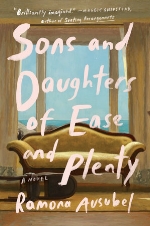
Sons and Daughters of Ease and Plenty   Ramona Ausubel     (2016)

Ramona Ausubel seems to have several goals for her novel Sons and Daughters of Ease and Plenty. She’s trying to explain what it feels like to be a rich kid who’s not comfortable with riches. She’s narrating a deep love between an Old Money kid and a New Money kid, contextualizing them in their families. She throws in a Great American Road Trip. There are some off the wall sub-plots, like the re-enactments of pre-Columbian Native American life. And there are the quirky elements, like the character who’s a giant, and the fawn that happens to die in a suburban back yard at a critical point in the plot.  

Fern and Edgar Keating and their three children are closing out a wonderful summer at their beach house on Martha’s Vineyard, all shimmering seas and sandy toes and billowing sails. Suddenly, they receive news that Fern’s Old Money, on which they live lavishly, is totally gone. Fern and Edgar have always hated the money; Edgar has even written an anti-capitalist novel. But they know of no other way to survive. Each freaks out in a separate way, but the consequence is that they unintentionally leave their nine-year-old daughter and six-year-old twin sons alone in their huge brick Colonial house in Cambridge, Massachusetts, for several days.

If you think that this sounds like the 1990 Christmas movie Home Alone, you’re right. But it’s a little more believable because the year is 1976, when kids walked to school by themselves and wandered their neighborhood by themselves.

The novel shifts back and forth between the 1976 existential family crisis and the period 1965-1970, when Fern and Edgar met, fell in love, and dealt with the Vietnam War. For Americans who came of age during that war, all aspects of life were shaped by the draft notices, the transport planes to Southeast Asia, the flag-draped coffins on the nightly news, the maneuvering of exemptions for a few, the protests, the beleaguered veterans.

Although Ausubel gets much of the Vietnam-era tone right, she falters on the details. As just one example, in 1966, Fern’s brother, Ben, could have had an exemption from the draft for attending college. Everyone knew this, and any male high-school graduate even marginally qualified for college enrolled. Nervous parents, especially wealthy ones, made sure of this. If an author creates a fictional universe, historical fact doesn’t have to be part of the game. But if an author anchors her story in an actual universe, wrong details are jarring.

I appreciate the magic realism in Ausubel’s tale. After all, the wealthy can seem permanently glittered over with fairy dust. But the mysterious appearances of pie slices at many roadside diners can seem forced in a plot that’s grounded in quotidian family life. And Ausubel doesn’t wrap up a number of sub-plot forays. What really happened with that kiss in the darkened girls’ bathroom? Did Edgar go back to the family business or not? Did anybody call Animal Control about that dead fawn in the back yard? 

Ausubel has some lovely metaphors, tossed off seemingly casually. And her descriptors—of window molding or hair style or suit jacket—are apt but always spare enough to keep the plot bounding along. I turned the 306 pages with enthusiasm, anxious to know what happened to Fern and Edgar and the gang. In the end, though, this good novel lacked the full power that I think Ausubel was capable of.  

Books in Brief, Part 1

I start reading about twice as many books as I finish, and that’s after I’ve narrowed the list of books that I even start. (I eliminate thrillers and science fiction, for example.) I like a plot that I can hang on to, and I don’t like extreme violence. A few years ago I swore I’d never read another novel set in World War II because they were all so grim. Then along came All the Light We Cannot See by Anthony Doerr in 2014, and I decided that extraordinary novels set in World War II would be okay.

My Books in Brief posts are about books that I gave up on or just skimmed through. These are not necessarily badly written books! Many are bestsellers that got stellar reviews from reviewers whom I respect. But I did not read these titles in their entirety, and in my posts, I’ll tell you why. You may decide that you want to dash out to your nearest library or book shop to get a copy!

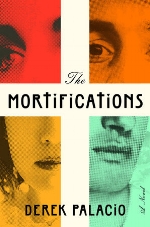
The Mortifications     Derek Palacio     (2016)

This complex tale about a Cuban-American immigrant family, set in the 1980s, has well-drawn characters and some lovely language, especially when the author is describing Cuba, to which some members of the family return. Palacio commingles realistic and mythic elements in an odd way in this novel, but that was not why I stopped reading. At about the halfway point in the 308 pages, the deep sadness of the story was making me too miserable. I skipped to the end to see how the plot tied up. The ending was sad, too. I should have guessed this from the title.

Pond     Claire-Louise Bennett     (2016)

Bennett positions her book somewhere between prose poetry and stream-of-consciousness. After the first few pages, I jumped around in the chapters (are they chapters?) trying to find threads of a cohesive plot, but I failed. The dust jacket says that Pond is “suffused with the almost synesthetic intensity of the physical world as we remember it from childhood.” I like descriptions of everyday experience, but I could not stick it out inside the brain of the young woman narrator for 195 pages. I prefer poetry that’s more distilled.

Vinegar Girl: The Taming of the Shrew Retold     Anne Tyler     (2016)

I’ve enjoyed several of Tyler’s past books, most recently A Spool of Blue Thread (2015), but Vinegar Girl was a disappointment. The book is one of a series of novels, by different modern novelists, based on the plots of Shakespeare plays. I was fine with a modern adaptation or rewriting of Shakespeare, who himself reworked the stories of other authors. What caused me to send this book back to the library after two chapters was the lifeless dialogue. Tyler usually spins out highly believable language, but the characters in Vinegar Girl were not coming alive for me through their words.

The Vacationers     Emma Straub     (2014)

Emma Straub gets a lot of press for her breezy novels and is held up as comparable to Anne Tyler. I don’t see it. In 2012, I tried a couple of chapters of Straub’s Laura Lamont’s Life in Pictures but found the reconstruction of 1920s Hollywood unconvincing. Giving Straub another chance, I quickly skimmed The Vacationers. It reads like the script of a sit-com, with a few witty zingers but not much depth to the plot or the characters, who are New Yorkers on vacation in Mallorca. Despite some glowing reviews of Straub’s next offering, Modern Lovers (2016), I don’t plan another foray.

A Great Reckoning     Louise Penny     (2016)

This is the twelfth book in the Canadian mystery series starring Chief Inspector Armand Gamache. I’ve read a couple of the previous titles in the series. I loved the setting (present-day Québec, Canada), the well-developed characters (especially Gamache and his family), and the plots (intricate). I gave up on this series solely because Louise Penny’s style of writing in sentence fragments drove me crazy. If you can handle that herky-jerky movement in every paragraph, these are terrific mysteries.

The Book That Matters Most     Ann Hood     (2016)

I didn’t make it past page 40 of this 358-page book, about a middle-aged woman joining a book club to get over her divorce. I’m not opposed to books about book clubs or books about people who read a lot of books. I read a lot of books myself, and I did read and review the Swedish novel The Readers of Broken Wheel Recommend. However, in those first 40 pages of The Book That Matters Most, the dialogue is strained and the interior monologues are trite. I can’t imagine that it gets better.

Two Tudor Mysteries

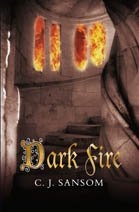
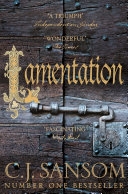
Dark Fire     CJ Sansom     (2004)     PLUS    Lamentation     CJ Sansom     (2014)

Matthew Shardlake is the subject of ridicule on two fronts. He’s a lawyer, so he’s the butt of jokes about acquisitive lawyers. And he has a hunchback, so he gets crude comments about his physical disability. He’s trying to keep up with the everyday demands of his legal practice in London, that great center of political intrigue, when a high-level government official draws him into a time-pressured investigation of a dangerous new military weapon. And it’s also the hottest summer anyone can remember.

In some ways, not a lot has changed since the year 1540.

Dark Fire is the second in the series of historical mysteries by British historian and former lawyer CJ Sansom. We’re  in Tudor England, with Henry VIII on the throne, unhappily married to the fourth of his six wives. Thomas Cromwell is his chief minister, seeking to keep both his job and his head. Our hero, Shardlake, is in Cromwell’s camp, supporting the reformer against those who want to restore Catholicism to England. But Cromwell is about to be executed, and the novelist knows that his readers know this—or if they don’t, they can read his Historical Note at the back of the book.

In first-person narrative, Shardlake takes us along on his frantic mission, twisting through the streets of London and back and forth on the mucky Thames, sweating profusely and reeling from the reek of rubbish and ordure. He’s pretty peeved that Cromwell has coerced him into taking this dangerous assignment, by helping him on an unrelated criminal case. Shardlake is also terrified by the numerous attempts on his life; his many narrow escapes do become implausible, but mysteries are often like that. The book has numerous sub-plots, as Shardlake tries to satisfy Cromwell’s demands, carry on with his own legal cases, maintain his household, and possibly pursue romance.   

The mysterious weapon, Dark Fire or Greek Fire, is a petroleum-based liquid that’s propelled out of a metal device to quickly engulf a target in flames. As an ethical man, Shardlake is conflicted about the moral implications of the use of Dark Fire. His pursuit of the formula and of the flame-throwing equipment sends him into the secretive and fantastical world of Renaissance alchemy—a tough place for a man of logic and reason to find himself.

The cast of characters in Dark Fire is large, including both historical and fictional people, and corruption among the court toadies is rampant. Through the diverse characters he creates, the novelist explores Tudor-era prejudices that still trouble humankind: anti-Semitism, Islamophobia, disability discrimination, and intra-religion persecution. His treatment of these issues blends into his narrative, so it doesn’t come off as heavy-handed.

I was surprised to see Sansom’s fairly positive portrayal of Thomas Cromwell in this novel. Dark Fire was published five years before Hilary Mantel’s award-winning novel Wolf Hall (2009) rescued Cromwell from the opprobrium of history with a detailed portrait of his rise to power. Mantel and Sansom both seem to be saying that history should not be reduced to simplistic good-guys-vs-bad-guys pronouncements. The historical figure Thomas Cromwell and the fictional character Matthew Shardlake are juggling a dozen balls at once, struggling to stay alive, to build their personal careers, and to act for the good of the nation.

Since Dark Fire was such a fine historical mystery, I decided to read the most recent volume in Sansom’s series, Lamentation. This sixth installment of the Shardlake stories is a slower read than Dark Fire, and it wades deeper into religious and political controversies. I relish the dissection of dogmas and doctrines in Tudor England, but if you aren’t interested in the Tudors’ ever-shifting definition of “heresy,” you may find Lamentation somewhat dismal.

The mystery in Lamentation centers on a possibly heretical religious book, handwritten by the queen and stolen from a locked chest in her private chambers. The queen is Catherine Parr, Henry VIII’s sixth and last wife, who must get nervous in the night about the fact that four of her five predecessors were either divorced or beheaded by Henry. Queen Catherine calls upon our hero, Matthew Shardlake, to make discreet inquiries to find the secret book, to keep her from burning at the stake.

The queen’s book did actually exist, but its theft is fictional, as are the ensuing murders and escapades in taverns and dungeons and wherries all over London town. As in Dark Fire, most of the characters in Lamentation have been invented by Sansom. The pleasures of this novel lie in the interaction of the fictional characters with actual figures in Henry VIII’s court during the final year of the king’s life, 1546-1547. Throughout the text, Sansom points gently to the chaos that we know is waiting at the door when Henry dies: the throne passing to his underage son, King Edward VI (Protestant), then to his daughter Queen Mary I (Catholic), then to his daughter Queen Elizabeth I (Protestant). Sansom even gets in a few non-explicit predictions about the execution of King Charles I, which will occur a century later.

Sansom’s historical references are, to my knowledge, accurate, and only a very few anachronisms of speech creep in to his dialogue. The subplots are engaging, and the scenes of sixteenth-century London, in both the palace and the gutters, are constructed well. So if you like wallowing in convoluted royal intrigue, jump right in.

Here are all the books in CJ Sansom’s Matthew Shardlake series so far: Dissolution (2003), Dark Fire (2004), Sovereign (2006), Revelation (2008), Heartstone (2010), Lamentation (2014).

This book review is a bonus Sunday post!

Biographies of the Inklings

The Fellowship:  The Literary Lives of the Inklings     Philip Zaleski and Carol Zaleski     (2015)

Confession:  I find JRR Tolkien’s mythopoeic masterpiece The Lord of the Rings too dark. CS Lewis’s Chronicles of Narnia, which have enchanted generations of children, hammer the Christian allegory too hard for my taste. Charles Williams’ Arthurian poems in Taliessin Through Logres are impenetrable. As for Owen Barfield, I’d heard of him only vaguely as an odd writer on anthroposophy, of which I’m not a devotee.

So why did I check out from the library a 644-page biography of these four authors?  Because Lewis’s scholarly book The Allegory of Love had enormous influence on me when I was a student of medieval literature. Lewis validated the Middle Ages as producing serious literary works, not just pieces of antiquarian interest—if you were willing to learn its tenets and culture. And my copy of Tolkien’s edition of Sir Gawain and the Green Knight, my favorite Middle English work, has been thumbed so often that it’s falling apart. His glossary for that text, and for Fourteenth Century Verse and Prose, were indispensable when I worked as a lexicographer with the Middle English Dictionary.

I thought that I might skim the Zaleskis’ book The Fellowship for bits on the relation of Lewis and Tolkien and on the context of their era at Oxford. I ended up gobbling the story of the Inklings whole, fascinated by the Zaleskis’ ability to selectively include minute detail and still maintain readability for chapter after chapter, decade after decade of the tumultuous twentieth century. The Fellowship follows the Inklings before, during, and after two world wars and innumerable academic skirmishes. The dates of the four principal Inklings reveal the scope: Lewis (1898-1963), Tolkien (1892-1973), Williams (1886-1945), and Barfield (1898-1997).

The bulk of the biography is dedicated to these four Inklings, whom the Zaleskis have wisely selected for their literary prominence. I was bemused at first about the inclusion of Barfield, since he didn’t seem to write much in the 1930s and 1940s, when the other Inklings were prolific. It turns out that, to make a living, Barfield had to spend decades toiling as a lawyer, finding little time for his own pursuits. Finally, in 1957, he was able to move into semi-retirement and spend the rest of his very long life probing issues of consciousness.

The Zaleskis had to draw a circle around the core of the Inklings, who held weekly discussions for thirty years, but other members and hangers-on enter into the narrative, too. I hadn’t expected that Lewis’s older brother Warren, called “Warnie,” would be a part of the extended group. Warnie, who struggled with alcoholism throughout his life (1895-1973), was a respected historian in his own right and assisted his brother on both practical and intellectual fronts.

Even Dorothy L. Sayers (1893-1957) comes in for several mentions, although as a female she would not have been invited to join the Inklings. Sayers, who’s a favorite of mine, produced both scholarly works on Dante and popular murder mysteries (the Lord Peter Wimsey series).

Neville Coghill (1899-1980) and JAW Bennett (1911-1981) were other distinguished medievalists associated with the Inklings at one time or another. In fact, a fascination with the medieval period was a hallmark of much of the writing of the Inklings. As the Zaleskis tell us, “Their great hope was to restore Western culture to its religious roots, to unleash the powers of the imagination, to reenchant the world through Christian faith and pagan beauty.” The fields they plowed were fantasy and epic, allegory and myth, philology and theology—all rooted in the past. In 1954 Lewis gave a controversial lecture at Cambridge called “De Descriptione Temporum” (“On the Description of Eras”), in which he argued that the divisions of history into Antiquity, the Dark Ages, the Middles Ages, and the Renaissance are artificial, ignoring the continuities of Western culture. Lewis saw a much more significant break from this culture, which he revered, in the early nineteenth century, with the beginnings of modernism.

Lewis was much sought after as a speaker on ethics who was able to convey complex philosophical principles and Christian religious doctrines in simple language. I hadn’t known that he presented many well-received lecture series on the radio for the BBC, especially during World War II. The account of Tolkien’s literary life also held some surprises for me. He didn’t create Middle Earth solely as a parallel universe in which to situate his non-human characters. His larger goal was to construct an entire British mythology, comparable to that found in medieval Scandinavian literatures.

The Inklings were astonishingly hard-working and well-read, fluent in dozens of ancient, medieval, and modern languages. Yet they all had unsuccessful books, difficulties in their family lives, and crises of faith. This biography doesn’t spare the reader their blunders, their arguments, and their occasional pigheadedness. So, while fans of The Hobbit or of Perelandra will find plenty of background on the genesis of the Inklings’ writings, they’ll also find the brilliant—and flawed—Inklings in The Fellowship

Manhattan 1952/2016

The Dollhouse     Fiona Davis     (2016)

By chance, I’ve been reading and reviewing a number of novels set in New York City lately. If you’re weary of fictional trips to Manhattan, you may want to skip to another blog post. If you’re up for one more saunter down those fabled sidewalks, here we go.

In The Dollhouse, Fiona Davis jumps back and forth between the years 1952 and 2016 to draw fictional portraits of women who live in the same building in New York City, separated by sixty-four years. The building, depicted on the book’s cover, is real. The Barbizon Hotel for Women, built on the Upper East Side in 1927, was home to generations of young females pursuing careers as editors, models, and secretaries. After the hotel was converted to condos in 2005, one floor was set aside as rent-controlled apartments for long-time residents, and this is where 1952 meets 2016.

Darby McLaughlin is the main 1952 character, fresh out of high school and freshly arrived at the Barbizon from Defiance, Ohio, to attend the famed Katherine Gibbs Secretarial School, with tuition paid by her deceased father’s life insurance proceeds. The innocent and awkward Darby gets caught up in a plot of sex, drugs, and bebop, centering around a sleazy jazz club.

Rose Lewin is the main 2016 character, a former local television news star in her mid-thirties, now working for an Internet news startup. At the beginning of the novel, the sophisticated and savvy Rose is living in her boyfriend’s condo in the Barbizon. She’s soon facing both personal and professional crises, as she decides to research and write about the octogenarian women in the Barbizon, who came of age in a distant, almost mythical, era.

The narrative of The Dollhouse is slow to accelerate. I looked forward to the 2016 chapters as I cringed my way through the 1952 chapters, in which Darby is ridiculed and deceived by her hallmates at the Barbizon. The pace picks up when the modern-day Rose becomes obsessed with the events of 1952 and unlayers a key mystery, using reportorial tactics that she knows are unethical.

Darby and Rose are convincing characters, as are several of the supporting cast. The descriptions of Rose’s boorish young boss, Tyler, are trenchant. In one meeting with Rose, “he held a pen under his nose as if it were a mustache, curled up his lip to support it without any hands.” Tyler performs this maneuver while making misogynist comments about Rose’s writing project. Less successful is the depiction of Jason Wolf, a potential love interest for Rose. Jason appears in the story too fortuitously and is too much of a hunk.

Sylvia Plath keeps popping up in The Dollhouse, too. She actually lived at the Barbizon during the summer of 1953 when she was an intern in New York City, and she refers to the hotel in The Bell Jar. This association becomes a running joke in The Dollhouse, as Rose assures one interviewee after another that she is not writing another story about Plath.

The Barbizon itself has a central role in The Dollhouse, titled for the name that young men in New York presumably gave the building back in the day. It’s possible that Fiona Davis chose her title also as an echo of Ibsen’s The Doll’s House, the controversial 1879 drama about the place of women in the home and in society. Davis wades in to the continuing controversy. Is Rose too dependent on the approval of the men in her life? Does Darby make too many sacrifices for the men (and women) in hers? Are teenaged girls always a little crazy? Can their fathers rescue them with (a) kindness or (b) tough love? Are 2016 women different from 1952 women in substance or only in terminology? And is their place in American society really much different?