Two Mysteries in One

 Magpie Murders     Anthony Horowitz     (2017)

Anthony Horowitz was the screenwriter for one of my favorite British television series, Foyle’s War, so I was pleased to see his name as the author of a book—and a double mystery at that.

This is the way it works:  Magpie Murders is a mystery novel that bestselling fictional author Alan Conway submits to his fictional publisher in contemporary England. It’s supposed to be the ninth book in the series of cozy mysteries set in a quiet English village in the 1950s, with German-Greek Atticus Pünd as the brilliant detective. If you think that this sounds a lot like Agatha Christie’s Hercule Poirot, you’re right. Horowitz inserts an amazingly accurate simulation of a mystery from the golden age of British detective fiction into this novel. (For my blog post on golden-age British mysteries, click HERE.)

Surrounding the text of the Atticus Pünd mystery is another mystery. Susan Ryeland is Alan Conway’s editor. She speaks in first-person narrative, describing her love of the detective genre:  “Whodunits are all about truth: nothing more, nothing less. In a world full of uncertainties, is it not inherently satisfying to come to the last page with every i dotted and every t crossed? The stories mimic our experience in the world. We are surrounded by tensions and ambiguities, which we spend half our life trying to resolve, and we’ll probably be on our own deathbed when we reach that moment when everything makes sense. Just about every whodunit provides that pleasure.” (183-184)

Susan Ryeland sits down to read Alan Conway’s manuscript starring Atticus Pünd, only to find that it’s missing the last chapter or chapters, the essential resolution of the knotty plot that has all the requisite red herrings and suspicious characters. Reading along with Susan, I shared her chagrin at this situation, wanting to know how Pünd resolves the case. Ryeland’s search for the missing ending of the Pünd mystery leads her to another mystery, in the present day, involving Conway himself. Taking on the role of amateur sleuth, she uncovers the modern-day prototypes for the characters in the Pünd mystery. She also discovers innumerable wordplays and hidden references in the Pünd mystery. Never fear:  Horowitz does eventually provide satisfying conclusions for both the Pünd mystery and the Conway mystery.

I found the 1950s Pünd mystery a better story than the present-day Conway mystery, but keep in mind that I’m a stalwart fan of golden-age English cozies. The two mysteries are intertwined pleasingly, and the Conway mystery has a surprisingly violent end, but both are ultimately rewarding to the reader, going beyond just clever. Within the Conway mystery, Horowitz also provides reflections on the nature of publishing and the relations between editors and authors.

I’ll leave you with another quote from Horowitz, speaking through Susan Ryeland: “Why is it that we have such a need for murder mystery and what is it that attracts us—the crime or the solution? Do we have some primal need of bloodshed because our own lives are so safe, so comfortable?” (70)

A Southeast Asian Story

Miss Burma     Charmaine Craig     (2017)

Craig.jpg

The dust jacket for Miss Burma tells us that novelist Charmaine Craig is a “descendant of significant figures in Burma’s modern history.” And Craig’s dedication for the book is to the memory of her mother, Louisa, and of her grandparents Ben and Khin. These three are major characters in Miss Burma, so right from the start, I was wondering how much of the story is factual—how much Louisa, as a participant in historic events, told Charmaine directly. Obviously, the novelist had to invent many lines of dialogue in order to create 355 pages.

Charmaine Craig’s grandmother Khin was from the minority ethnic group in Burma called the Karen (kah-REN). Her grandfather Ben (or Benny) was born into a Jewish family in Burma but raised partly in India when he was orphaned. When Benny marries Khin, he decides to identify with the Karen people. The novel follows Khin and Benny’s family through a tumultuous period in Burma’s history, as the country becomes a battleground between the British and the Japanese in World War II and then as civil war among ethnic factions causes further devastation in the following decades. Benny becomes a leading member of the Karen resistance to the majority Burmese. A key event in the narrative is the beauty contest in 1956 in which Khin and Benny’s mixed-race daughter Louisa is crowned Miss Burma. We get Benny’s thoughts at this event: “From the looks of it, these people were prepared to adore whichever girl, of whichever origins, became their queen. Perhaps beauty alone had the power to transfigure people so. And yet, Benny reminded himself with a shudder, there was something insidious about beautifying the country’s image by means of a girl, whatever her background, for somewhere in the darkness beyond the delta, innocent people continued to be shot and killed.” (226)

Louisa herself is sometimes ambivalent about the struggle of the Karen people. We learn that she had “this feeling that it was wrong for anyone to claim exclusive rights to a corner of the earth—wrong for no other reason than that everyone was passing. . . . She was suddenly sure that Burma’s most beautiful feature was its multiplicity of peoples.” (318)

A little Burmese history is helpful if you decide to read this novel. Burma won its independence from Great Britain in 1948. After years of civil war, the current military regime took power and changed the name of the country to Myanmar, though it’s still known as Burma in some political circles. Probably the best known figure in Myanmar is Aung San Suu Kyi, who is now State Counsellor. Her father, Aung San, is portrayed as a character in Miss Burma. Like many other nations, Burma has long been struggling with how to bring diverse ethnic and tribal peoples together. How do you decide on proper representation? Do you set up a separate territory for every minority group? What if territory is disputed? How do you address differences of language and religion? How do you end state-sanctioned genocide and community-based thuggery?

As Charmaine Craig lays out the case for better treatment of the minority groups in Burma, she can get somewhat preachy, and the segments in which she graphically describes brutal guerilla warfare are grim. I preferred the chapters in which she explores the personal relationships of the characters and their ethnic identities, against a backdrop of national chaos, in the lush landscape of Burma. Miss Burma is for readers who like delving into history that’s less well known in the US, especially those who are intrigued by southeast Asia.

Pregnancy & Pear Trees

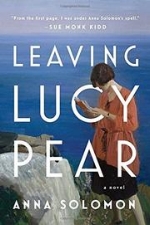
Leaving Lucy Pear     Anna Solomon     (2016)

It seems to me that about half the novels that I read have at the heart of the plot a single woman with an unintended pregnancy. Granted, I read a lot of historical novels, and historically the pregnancy of an unwed woman was a cause of anxiety, grief, distress, secrecy, scheming, and crime.

In the novel Leaving Lucy Pear, Beatrice Haven is the young single woman with an unintended pregnancy. She leaves her newborn daughter in a pear orchard in Cape Ann, Massachusetts, on a night when she expects that pear thieves will be present to find the bundle. All this is revealed in the prologue, set in 1917. The main action of the story occurs a decade later. Unbeknownst to Beatrice, the baby has been named Lucy Pear and has been raised by Emma Murphy, the mother of a large, impoverished Irish American family. Beatrice, who is from a wealthy Jewish family in Boston, continues to be tormented by her act of abandoning her child and spends much of her time at the home of the uncle who owns the pear orchard. The lives of Beatrice and Emma intertwine in complex ways as the plot works toward resolution of some, but not all, of the issues raised about motherhood, womanhood, sexuality, and family ties. 

The setting of the North Shore in Massachusetts is significant. This rocky peninsula between Boston and New Hampshire is rich with literary associations, from Nathaniel Hawthorne to TS Eliot. The time period is also significant, with the political backdrop of the Prohibition era and the controversial 1927 executions of Sacco and Vanzetti, professed anarchists who were accused of robbery and murder. Weaving in and out of the narrative of Leaving Lucy Pear are threads about the temperance movement, liquor smuggling, anarchism, communism, industrialization, labor unions, and social class. 

Anna Solomon’s writing is delicate and introspective. There are many sentences like this: “When she looked at him, her cheeks wrinkled and red from where her sleeves had pressed into them, her eyes pinned him to his chair.” (235) As a reader, I wanted to find out the next component of the plot, but I also wanted to linger on scenes in which character traits are revealed by family members discussing domestic matters. 

Beatrice abandons her baby so that she can move on with her life, go to Radcliffe, and perhaps become a concert pianist. But her plan falters, and that may have been the best outcome for her. Late in the novel, a minor character pronounces, “’Most people want to be extraordinary. Make a mark in the world. But for what? In my experience it’s the extraordinary people what aren’t happy, always expecting something better than they get. Whenever anything at all happens to me, I tell myself it’s happened to everyone else, too. It’s actually very comforting.’” (313-314)


Novels about Paintings, Part 2

The Last Painting of Sara de Vos     Dominic Smith     (2016)

As I read this novel, I assumed that the title painting, the last painting of Sara de Vos, was At the Edge of a Wood. The creation of this fictional work of art is placed in 1636, as de Vos is grieving the death of her only child, a daughter, from the plague. The painting shows a dark-haired girl in the foreground, barefoot in the snow, watching a group of skaters on the frozen river beyond. It’s dusk in winter in the Netherlands, so the quality of light is otherworldly.

According to novelist Dominic Smith’s complex story, At the Edge of a Wood has been owned by the de Groot family for more than three hundred years, and it’s considered by some to have caused bad luck for the owners. Marty de Groot, the owner we meet in Manhattan in 1957, certainly hasn’t suffered financially, but Marty’s law career is stalled, and he and his wife are unable to have children.

Also in 1957 but in Brooklyn, the novelist introduces us to Ellie Shipley, an Australian graduate student in art history at Columbia University. She’s trying to finish her PhD dissertation about female painters of the Dutch Golden Age, and she does art restoration work to support herself. Along comes a commission, not to restore but to copy a painting by (wait for it) a female painter of the Dutch Golden Age: At the Edge of a Wood. Ellie wades in, not so much for the money as for the technical and artistic challenge of reproducing a stunning painting. This is, of course, forgery.

Forty-odd years later, in 2000, Ellie is an esteemed art historian and curator in Sydney, Australia. As she’s gathering paintings on loan from around the world for an exhibit, it becomes apparent that both the original At the Edge of a Wood and the copy she painted will be arriving in Sydney. The forgery will be revealed, and since Ellie is the only person who could have painted the copy, she sees her comfortable life crumbling before her.  

The book moves back and forth effortlessly among three settings:  The Netherlands 1636-1649 (dark, burgher-ruled); New York, 1957-1958 (shiny, jazz-filled); and Sydney, 2000 (sunny, cosmopolitan). The characters of Sara de Vos, Marty de Groot, and Ellie Shipley—all drawn convincingly—move through these settings and through their interconnected lives.  

Novelist Smith does an excellent job of rendering visual art in words, and not only in the passages where he describes paintings. References to the light in a scene come in frequently. For example, here is Ellie on the subway in New York City: “She always has the sensation of being swallowed by the roaring dark of the first tunnel, her ears popping and the sudden appearance of her reflection on the blackened windowpane like some hangdog daguerreotype from another century.“ (208) And here is Marty, in his office at night after committing a terrible deed: “He’s never been up here at night and there’s a sensation of being fortified behind glass, of something solid between him and the mercantile canyons of the city. The office buildings are phosphorescent through the darkness, effulgent with a smoky light that reminds him of dry ice.” (249).

By the end of the novel, you’ll know what the last painting of Sara de Vos actually was. I’ll leave you with this summation of the plot: “You carry grudges and regrets for decades, tend them like graveside vigils, then even after you lay them down they linger on the periphery, waiting to ambush you all over again.” (262)

15th-Century Mysteries: Part 2

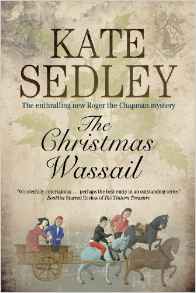
The Roger the Chapman Series     Kate Sedley     (1991 to 2013)

Before reading this post, you may want to check out my essay “Reading Medieval Mysteries” in the Portfolio section of this website. It has a sidebar on the Brother Cadfael novels of Ellis Peters, set in the twelfth century. But moving on to the end of the medieval period . . . 

Roger the Chapman is an itinerant purveyor of small household goods and haberdashery in late fifteenth-century England. He tells his tales in first-person narrative, looking back, as an old man, on the adventures of his youthful travelling days. This narrative voice gives an immediacy to the novels, and I find Roger’s voice quite believable. 

The first couple of entries in this series have some weaknesses, with tangents about, for example, how to full cloth, but the series quickly picks up speed, with less didacticism and more challenging convolutions of plot. Roger is an engaging, burly fellow with a large backpack who tramps all around the country—and even to France—to unravel mysteries. His wanderlust allows him to get involved in murders near and far and even to work as an agent for the nobility. Still, he always returns home to Bristol, in southwest England.

Roger has a complicated family history, and the secondary characters such as his wife and his mother-in-law are well developed over the course of the series. If you start with a title later in this series, you’ll still catch on, since author Kate Sedley does a good job of filling in her readers about Roger’s family connections.

Sedley doesn’t affect fake medievalisms but still conveys a sense of the period. I especially enjoyed The Christmas Wassail, in which the murders are set against the festive late medieval celebrations of the Twelve Days of Christmas.

Kate Sedley is the pen name for Brenda Margaret Lilian Honeyman Clarke, who has written numerous other novels under different names. Here are the twenty-two books in her Roger the Chapman Series:  Death and the Chapman (1991), The Plymouth Cloak (1992), The Hanged Man aka The Weaver’s Tale (1993), The Holy Innocents (1994), The Eve of Saint Hyacinth (1995), The Wicked Winter (1995), The Brothers of Glastonbury (1997), The Weaver’s Inheritance (1998), The Saint John’s Fern (1999), The Goldsmith’s Daughter (2001), The Lammas Feast (2002), Nine Men Dancing (2003), The Midsummer Rose (2004), The Burgundian’s Tale (2005), Prodigal Son (2006), The Three Kings of Cologne (2007), The Green Man (2008), The Dance of Death (2009), The Wheel of Fate (2010), The Midsummer Crown (2011), The Tintern Treasure (2012), The Christmas Wassail (2013).

Novels about Paintings, Part 1

A Piece of the World     Christina Baker Kline     (2017)

Baker Kline.jpg

Novels that prominently feature a painting (fictional or real) are not a new idea. In 1891, Oscar Wilde published The Picture of Dorian Gray, a horror story about a portrait that ages while the subject of the portrait remains youthful—but gets nastier. More recently, Tracy Chevalier’s Girl with a Pearl Earring takes a different tack. In her 1999 novel, Chevalier imagines a life story from the actual portrait of an anonymous young woman. In this case, the art work, by the seventeenth-century Dutch artist Johannes Vermeer, is real, hanging in the Mauritshuis in The Hague. The fictional story by Chevalier evokes the period of the painting’s creation beautifully. (See the Vermeer portrait here.)

Christina Baker Kline’s A Piece of the World has an approach similar to that of Chevalier. Baker Kline conjures up a fictional memoir by the subject of Christina’s World, a 1948 painting by the American artist Andrew Wyeth that hangs in the Museum of Modern Art in New York City. In this case, some facts about the actual subject, Christina Olson, are known. Olson really was descended from one of the judges at the Salem Witch Trials of the late seventeenth century. She was born in 1893 and lived on a farm near Cushing, Maine, suffering all her life from a disability that affected her ability to move her limbs. In 1939, she became friends with Andrew Wyeth, who summered in Maine and frequently painted her, her brother, and scenes from their farm. As Olson grew older, she became more disabled and moved from place to place by crawling. In his painting Christina’s World, Wyeth places Olson on the ground, with her back to the viewer, clawing the soil as she twists to look at her farmhouse, which is up a hill from her. (See the Wyeth painting here.)

Beyond the historical facts, Baker Kline weaves a fictional life, narrated by a fictional Christina Olson but quite believable. (The only parts of the narrative that I found somewhat strained were the dialogues between Wyeth and Olson.) Baker Kline invents a full life for Olson, from her birth until the unveiling of Wyeth’s expressive painting of her. The onus of disability for those in rural areas and without access to current medical treatments is clear. (For another novel about disability, see my review here.)

Christina Olson and her family live a life of austerity, particularly during the Great Depression, without electricity or running water in their house. Their daily existence is like that of a pioneer family in the nineteenth century. Baker Kline describes their chores in detail:  the stoking of the wood burning stove, the lighting of the kerosene lamps, the hand harvesting of the blueberries. These activities, and the grim farmhouse, attracted the eye of Wyeth, who painted a vanishing way of life with its surrounding stark landscapes. It strikes me that A Piece of the World has many characteristics of a Laura Ingalls Wilder novel, albeit set in Maine and written for adults.

As I was reading A Piece of the World, I turned frequently to the reproduction of the painting Christina’s World bound into the back of the book. This tender novel about a woman’s simple life complements Wyeth’s haunting work of art.

Two Books by Strout

Anything Is Possible     Elizabeth Strout     (2017)

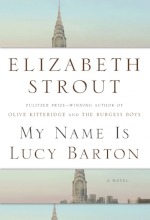
My Name is Lucy Barton     Elizabeth Strout     (2016)

Before you read Elizabeth Strout’s 2017 short story collection, Anything Is Possible, you might want to check out her 2016 novel, My Name Is Lucy Barton. The two books are interconnected and can be read as a cohesive whole.

In My Name Is Lucy Barton, Lucy is a writer in New York City in the 1980s, with a husband and two young daughters. When Lucy is hospitalized for many weeks with a mysterious illness that arises after an appendectomy, her estranged mother travels from rural Illinois to her bedside. The two women reach an uneasy peace with each other, especially as they tell stories about the folks back home, in the (fictional) Amgash, Illinois, a depressed rural area that’s a two-hour drive from Chicago.

In Anything is Possible, set in a recent time period, we meet many of the characters mentioned in My Name is Lucy Barton, both in Amgash and in other locales:

  • Pete Barton, Lucy’s reclusive and oddly childlike brother, who still lives in the old Barton house.
  • Tommy Guptill, the friendly janitor from Lucy’s elementary school, who is now in his eighties and who keeps an eye on Pete.
  • Charlie Macauley, a Vietnam veteran with PTSD, who gets himself into a bind over a prostitute.
  • Patty Nicely, a contemporary of Lucy’s and now a high school guidance counselor, who tries to help Lucy’s difficult niece, Lila Lane.
  • Mary Mumford, the neighbor woman who left her husband of 51 years to run off to Italy with a younger man.
  • Vicky Lane, Lucy’s sister, who reminds Lucy about some of the horrors the siblings endured in their childhood.
  • Abel Blaine, Lucy’s cousin, who has built a successful business in Chicago.

Lucy herself enters the linked stories of Anything Is Possible in many ways. She’s become an acclaimed writer and has published a book that the people of Amgash can buy at the local bookstore. Chicago is one of the stops on Lucy’s tour to promote her book, so she stops in Amgash to see her siblings, Pete and Vicky, in one of the stories. Take note that the fictional Lucy’s fictional “memoir” seems to be very much like Elizabeth Strout’s novel My Name is Lucy Barton.

Strout toys with the vagaries of memory in both these books. In Anything Is Possible, we get much more detail about the childhood suffering of the Barton kids—details that were glossed over and somewhat sanitized in My Name is Lucy Barton. The other residents of Amgash are also revealed to have their share of specific miseries, including sexual abuse, mental illness, and crushing poverty. The power of money emerges as another theme. Lucy Barton, who had to scrounge in dumpsters for food as a child, lives the up-by-her-bootstraps version of the American dream when she gets into college and becomes a successful writer. Others in her small town remain impoverished. Sometimes people are poor simply because of bad luck, and money certainly does not buy happiness or stability for the characters in Anything Is Possible.

The prose in these two books is spare, with every word well chosen. The emotions are raw but presented with subtle empathy. Strout’s previous books include the Pulitzer-winning Olive Kitteridge (2008), which is, like Anything Is Possible, set up as linked short stories, and the novel The Burgess Boys (2013). Basically, read anything by Elizabeth Strout that you can get. You won’t be disappointed.

Four Novels in One

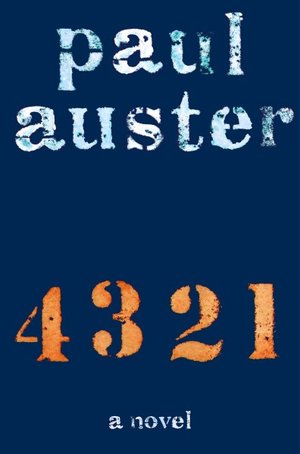
4 3 2 1      Paul Auster     (2017)

Do not read other reviews of this novel before you read the novel itself! All the reviews--except for mine!--give away too much of the plot and spoil the revelations, good and bad.

Paul Auster has created a mesmerizing series of narratives by mixing up four novels in one book. The protagonist in all four, Archie Ferguson, bears the Scottish surname that his grandfather received at Ellis Island, but he’s Jewish American, born in Newark in 1947. His life story through early adulthood plays out in four distinctly different ways, depending on choices made by Archie himself and by his family members and friends. The author doles out these four stories in segments, taking us through the phases of Archie’s young life, and he helpfully labels each segment. (There are four versions of chapter 1, four versions of chapter 2, and so forth.)

Some elements of Archie’s personality and tastes carry into multiple stories. Archie is always a good athlete, either in baseball or basketball. He’s sexually active at an early age. One of his bed partners is Amy Schneiderman, who in different versions of the story is his stepsister, cousin, or family friend. Sometimes the Archies have the same experience, as when a professor at Columbia gives two different Archies a copy of the university’s literary magazine. In all four of the narratives, Archie seems to have a preponderance of tragic, early deaths surrounding him, including death by car accident, lightning strike, brain aneurysm, and fire.

As you read 4 3 2 1, you could make a spreadsheet to keep track of all the plot elements, but I recommend that instead you let the stories flow over you. Auster’s extremely long compound complex sentences encourage this latter approach, since the words stream seamlessly down the pages, pulling you along.

4 3 2 1 is about how everyday decisions of everyday people can have long-term ramifications, both for themselves and for those surrounding them. Within the novel, Auster has the characters themselves analyze the phenomenon of choices that change lives:

“ . . . from the beginning of his conscious life, [Archie had] the persistent feeling that the forks and parallels of the roads taken and not taken were all being traveled by the same people at the same time, the visible people and the shadow people, and that the world as it was could never be more than a fraction of the world, for the real also consisted of what could have happened but didn’t, that one road was no better or worse than any other road, but the torment of being alive in a single body was that at any given moment you had to be on one road only, even though you could have been on another, traveling toward an altogether different place.”

Reading all 866 pages of 4 3 2 1 takes serious commitment. You are more likely to keep turning those pages if you enjoy novels about the 1960s in America. When I saw that Archie Ferguson was born in 1947, I immediately calculated that he would come of age in the 1960s, during the Vietnam War, when young American males were subject to the draft, and those drafted males were almost always sent to the jungles of Southeast Asia. Novelist Auster confronts this cruel fact in four different ways, and watching him do it is intriguing. Paul Auster was himself born in 1947, so he knows whereof he writes, though I would caution against reading 4 3 2 1 as a memoir or autobiography, despite the metafictional echoes of the novel’s closing pages.

One of the four Archie Fergusons, studying at Columbia University on a draft deferment, muses: "The postwar children born in 1947 had little in common with the wartime children born just two and three years earlier, a generational rift had opened up in that short span of time, and whereas most of the upperclassmen still bought into the lessons they had learned in the 1950s, Ferguson and his friends understood that they were living in an irrational world, a country that murdered its presidents and legislated against its citizens and sent its young men off to die in senseless wars, which meant that they were more fully attuned to the realities of the present than their elders were.”

Another theme that I pick up from 4 3 2 1 is the way wealth—or the lack of it—affects life choices dramatically. Here is one example, right after one of the Archies has come into some cash:

“Thousands of dollars were sitting in his account at the First National City Bank on the corner of West 110th Street and Broadway, and just knowing they were there, even if he had no particular desire to spend them, relieved him of the obligation to think about money seven hundred and forty-six times a day, which in the end was just as bad if not worse than not having enough money, for these thoughts could be excruciating and even murderous, and not having to think them anymore was a blessing. That was the one true advantage of having money over not having money, he decided—not that you could buy more things with it but that you no longer had to walk around with the infernal thought bubble hanging over your head.”

And then there’s New York City of the 1960s, conjured up by Auster with all its grit and glamor, and I can seldom resist New York novels. As one character comments, “New York is it.”

Koreans in Japan

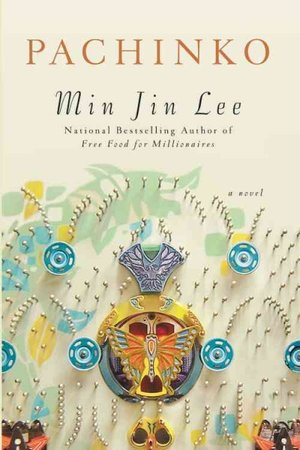
Pachinko     Min Jin Lee     (2017)

“Pachinko” is a popular Japanese slot-machine game. You may wonder, until well past the halfway point of this novel’s 485 pages, what pachinko has to do with a saga about four generations of a Korean family in the twentieth century. Have patience.

First you have to be well steeped in the story of Sunja, a poor teenager who is seduced by Hansu, an older Korean gangster, in her village in what is now South Korea. By chance, Isak, a Korean Christian minister, passes through the village. He rescues Sunja from the ignominy of an unwed pregnancy by marrying her and taking her to Japan, where he will work as a missionary. The year is 1933.

Historical events of the turbulent twentieth century constantly buffet Sunja, Isak, and their extended family and friends in Japan, where the bulk of the story plays out. Japan’s expansionist wars of the 1930s and 1940s fuel nativist sentiments in the Japanese  populace. Korean immigrants, who are “zainichi” (foreign residents), are relegated to the most menial jobs and are paid less than Japanese for the same work. Korean children born in Japan do not become citizens—they’re essentially countryless. As one character pronounces: “’This country [Japan] isn’t going to change. Koreans like me can’t leave. Where we gonna go? But the Koreans back home aren’t changing, either. In Seoul, people like me get called Japanese bastards, and in Japan, I’m just another dirty Korean no matter how much money I make or how nice I am.’“ (383)

Once Korea is partitioned into North and South in 1948, the situation gets even murkier: “After the [Korean] peninsula was divided, the Koreans in Japan ended up choosing sides, often more than once, affecting their residency status. It was still hard for a Korean to become a Japanese citizen, and there were many who considered such a thing shameful—for a Korean to try to become a citizen of its former oppressor.” (441)

A few ethnic Koreans living in Japan figure out that they can become entrepreneurs in the pachinko business, and a well-run pachinko parlor can turn a nice profit. Proceeds from pachinko parlors, plus help from that gangster Hansu, pave the bumpy road out of poverty for some characters in the novel. Other characters hide their Korean ethnicity, dressing like the Japanese, learning to speak Japanese without an accent, taking a Japanese spouse. This subterfuge is possible because the physical characteristics of Japanese people and Korean people are often very similar.

The straightforward, direct sentence style in Pachinko suits the themes of the novel, and the Korean and Japanese words in the text give the flavor of the setting without weighing down the narrative. I caught the simple ones, like “kimchi” (the Korean dish of fermented cabbage and radish) and “hanko” (a hand stamp of one’s name, used throughout East Asia). The meanings of other words were obvious from their context, but I had to look up a few as I read.

It would have been easy for novelist Lee to paint the Japanese as always the bad guys and the Koreans as always the good guys, but she does not adopt this dichotomy. Although she lays out the Japanese discrimination against Koreans clearly, her long list of characters includes both Koreans and Japanese who are deceitful and honest, talented and mediocre, wise and foolish, lazy and hardworking, compassionate and heartless, selfish and generous, prejudiced and open-minded. She pulls into her story subplots that touch on issues such as the status of minority Christians in Japan and the evolving attitude toward the place of women in the family and in the workplace over the course of the twentieth century. 

Above all, though, this is a universal story about the immigrant experience—about taking a job that’s far beneath your skill level because you don’t know the language, about being segregated into a slum area, about being subject to complicated rules that you don’t understand, about living constantly with fear. Immigrants enter a game of chance, stacked against them, much like pachinko players.

In her Acknowledgements, Lee tells us that it took her nearly thirty years to write this impressive novel. It was well worth the time.

15th-Century Mysteries: Part 1

In the Portfolio section of this website, you’ll find my essay “Reading Medieval Mysteries,” with a special sidebar on the Brother Cadfael novels of Ellis Peters, set in the twelfth century. You may want to take a look at that page before jumping forward in time to the fifteenth century for the medieval mystery series reviewed below.

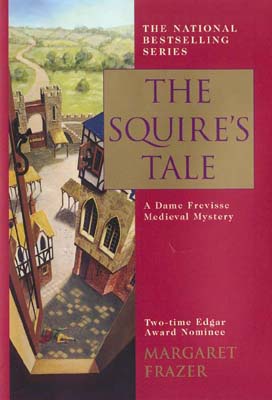
The Dame Frevisse Series     Margaret Frazer     (1992-2008)

Dame Frevisse is a nun at St. Frideswide’s, a small fictional Oxfordshire convent. She’s  a practical and clever sleuth, dealing with murders as well as with all the personality clashes and power struggles that are inevitable in a religious community. We meet Frevisse when she’s already a mature nun, dedicated to her vocation, but still struggling inwardly with sins that we would consider quite petty, such as jealous thoughts or impatience. It’s tough to be as feisty and outspoken as Frevisse when your conversation is limited by the Rule of St. Benedict to truly necessary speech. Fortunately, there are murder mysteries to be solved, so Frevisse gets permission from her Abbess to interrogate witnesses, for example. She also manages to travel quite a bit, on approved business for her convent or for her own family members.

The first six Dame Frevisse mysteries were written collaboratively by Gail Frazer and Mary Monica Pulver Kuhfeld, using the pen name Margaret Frazer. The rest of the series was written by Gail Frazer alone, still as Margaret Frazer. The series ended when Gail Frazer died in 2013. It’s worth mentioning that a character named Joliffe the Player is part of the action in four of the Dame Frevisse novels. Joliffe was then spun off in his own series of six mystery novels (by Gail Frazer) featuring a theater troupe.

The earlier novels in the Dame Frevisse series are like cozy mysteries set in an English village, with the convent standing in for the village. The pace of these novels is fast, but the quality of the construction of the central mystery varies. For a psychologically devastating one, try The Servant’s Tale; I didn’t guess the murderer at all.

Some of the later titles in the Dame Frevisse series, written by Gail Frazer alone, are more like historical novels, though always with a murder mystery for Frevisse to untangle. The series is set between the years 1431 and 1452, in the middle of the reign of the unstable King Henry VI and at the tail end of the Hundred Years’ War with France. So there are plenty of historical events that can be explored.

Dame Frevisse is cast as a fictional relative of the fourteenth-century poet Geoffrey Chaucer. To emphasize this link, the titles in the series mimic those within Chaucer’s Canterbury Tales, though the Frevisse stories bear no resemblance to similarly titled stories by Chaucer. I think that reading the series in order works best, but that’s not essential. Here are all the titles:  The Novice’s Tale (1992), The Servant’s Tale (1993), The Outlaw’s Tale (1994), The Bishop’s Tale (1994), The Boy’s Tale (1995), The Murderer’s Tale (1996), The Prioress’ Tale (1997), The Maiden’s Tale (1998), The Reeve’s Tale (1999), The Squire’s Tale (2000), The Clerk’s Tale (2002), The Bastard’s Tale (2003), The Hunter’s Tale (2004), The Widow’s Tale (2005), The Sempster’s Tale (2006), The Traitor’s Tale (2007), The Apostate’s Tale (2008).

North Woods Morality

The Hearts of Men     Nickolas Butler     (2017)

“Who knows what evil lurks in the hearts of men?”  This line from the 1930s pulp fiction radio drama The Shadow captures the theme of Nickolas Butler’s probing new novel.

The hero of The Hearts of Men is Nelson Doughty, his surname perhaps chosen by the author because it’s an archaic English word meaning “fearless” or “persistent.” We first meet Nelson in 1962 at a fictional Boy Scout campground, Camp Chippewa, in northern Wisconsin, where he is a nerdy, bespectacled thirteen year old who is constantly bullied by the other campers. He does, however, find a savior—the elderly scoutmaster who runs the camp—and also strikes up a somewhat tentative friendship with a popular, athletic older boy named Jonathan.

I cringed in horror at the cruelties Nelson endured as a teenager, but his adult life holds even further unhappinesses, in Vietnam as well as back at Camp Chippewa. I won’t spoil the plot, which unfolds over the ensuing 57 years, until the year 2019. By that year, the evil lurking in the hearts of men has intensified: “There seems an atmosphere everywhere these days in America, a malevolent vibration in the air, every citizen so quick to righteous rage, some tribal defensiveness, seeing the fault in each other's arguments, rather than some larger common field of compromise, if not agreement.” (278)

Novelist Butler unfurls the secrets of both men and women as Nelson, Jonathan, and their families seek the standards by which they’ll live out their lives. “A scout is trustworthy, loyal, helpful, friendly, courteous, kind, obedient, cheerful, thrifty, brave, clean, and reverent.” Will this Boy Scout Law serve the purpose? Or is there an Army code that one can follow? Organized religion doesn’t seem to have the answer, at least in Butler’s Wisconsin. Some of his characters have an innate sense of fairness and generosity, but many of them are seriously flawed. The men, in particular, struggle with how to define themselves as males in American society. Are you a real man if you hold your liquor, beat your kids, frequent strip clubs, and cheat on your wife?

Throughout the book, Butler tosses off similes that stop you in your tracks: “The beer is ever so cold and bright, like swallowing winter sunlight carrying a memory of summer wildflowers, resting hay.” (149) His descriptions of summer in northern Wisconsin, viewed from a car window, are perfect: “Fields and fields of waist-high Cargill corn and knee-high Pioneer soybeans, muddy barnyards of shit-splattered Guernseys and Holsteins, sun-bleached and woebegone trailer parks, falling-down barns begging for a splash of gasoline and a match, cemeteries ringed in browning arborvitae and chain-link fences, derelict stone silos, small to middling northern rivers, forests of maple and oak and red pine sliding by at fifty-five miles per hour.” (154) Similarly, I know exactly the kind of place that Butler’s characters are in when he places a scene in a supper club, a dining establishment peculiar to rural areas of the upper Midwest.

The choice of Camp Chippewa, mosquitoes and all, as a primary setting for this epic is inspired. When you’re camping in northern Wisconsin, you’re far away from the cares and distractions of city life, forced to confront elemental truths. At one point, the young Nelson comes out of the woods into a clearing, and this is what he sees:  “A star sliced loose from its berth and went scuttling out into the void, turning and turning without ever a hope of gaining traction again. I am cut loose, he thinks. And, To hell with them all.” (95)

Soviet House Arrest

A Gentleman in Moscow     Amor Towles     (2016)

For Americans who grew up during the Cold War of the 1950s and 1960s, the Soviet Union was a scary place. Only a little information leaked out about everyday life there: long lines to purchase basic necessities, people crammed ten to a room in tiny apartments, the KGB ready to pounce on any political or social dissent. So Amor Towles’s fictional foray into Moscow’s elegant Metropol Hotel in the years from 1922 to 1954 is captivating on many levels. Towles posits that high-level Communist Party officials still wined and dined themselves and foreign dignitaries, right through the Depression of the 1930s, and that ordinary Soviet citizens found small bits of happiness despite privations and surveillance. Some displayed great courage in adversity. Towles’s portrait of the fictional Count Alexander Rostov gives us a glimpse into what might have happened to one of the ousted aristocrats in the aftermath of the Russian Revolution of 1917.

In 1922, the erudite and cultured young Count Rostov is sentenced to permanent house arrest in the Metropol Hotel, just off Red Square in Moscow. This is not exile to Siberia, but if Rostov walks out the door of the hotel, he will be shot. The Count, relegated to a tiny attic room, approaches his predicament with the utmost composure. Since his own family members are all dead, he gradually fashions himself a family from the employees and guests of the Metropol. While chaos and war unfold outside the Metropol, all is grace and style inside. Count Rostov is, to me, a Russian version of Lord Peter Wimsey, from the 1930s British mystery novels of Dorothy L. Sayers. Yes, he can be snobbish at times, but he’s generous, principled, and unwaveringly loyal to his friends.

As the years of Rostov’s life tick by, Towles tosses off details about the Metropol in one witty scene after another. Pay close attention to the most minuscule of these details, which Towles is constructing carefully as he builds toward the denouement of his novel. You can easily get pulled into enjoyment of individual episodes, as friends arrive to visit Rostov, a famous actress becomes his lover, and a young girl takes him behind the scenes to secret places in the enormous hotel. Rostov comes to know every cranny of the hotel intimately, and this knowledge will serve him well as the plot whirls to a conclusion in the final hundred pages of this 462-page book.

“Sophisticated” does not begin to do justice to Towles’s writing style. Here he is describing a clock: “Suddenly, that long-strided watchman of the minutes caught up with his bowlegged brother at the top of the dial. As the two embraced, the spring’s within the clock’s casing loosened, the wheels spun, and the miniature hammer fell, setting off the first of those dulcet tones that signaled the arrival of noon.” (32)

Here he is in the hotel kitchen, describing a bouillabaisse, the ingredients assembled with tremendous difficulty in a Soviet Union with closed borders: “One first tastes the broth—that simmered distillation of fish bones, fennel, and tomatoes, with their hearty suggestions of Provence. One then savors the tender flakes of haddock and the briny resilience of the mussels, which have been purchased on the docks from the fisherman. One marvels at the boldness of the oranges arriving from Spain and the absinthe poured in the taverns. And all of these various impressions are somehow, collected, composed, and brightened by the saffron—that essence of summer sun which, having been harvested in the hills of Greece and packed by mule to Athens, has been sailed across the Mediterranean in a felucca. In other words, with the very first spoonful, one finds oneself transported to the port of Marseille—where the streets teem with sailors, thieves, and madonnas, with sunlight and summer, with languages and life.” (221-222)

I guessed some but not all of the elements of caper that caps the plot of A Gentleman in Moscow. The surprises were highly enjoyable.

A Chinese Tea Tale

The Tea Girl of Hummingbird Lane     Lisa See     (2017)

“’No coincidence, no story.’” With this quote from her mother, the first-person narrator of The Tea Girl of Hummingbird Lane, Li-Yan, begins. Remember that line as you read Lisa See’s moving tale of the collision of a traditional culture with the modern world.

In the mountainous Yunnan province in the far southwest of China live the Akha people, one of China’s tiny ethnic minorities. The Akha speak a distinctive language and practice a kind of animistic religion, involving many taboos and ritual sacrifices, guided by patriarchal village shamans. When this novel opens, in 1988, the province was even more isolated than it is today, and because of its inaccessibility the Akha people were not touched very much by such Chinese political movements as the Great Leap Forward and the Cultural Revolution. They were also exempt from China’s One Child policy because of their minority status.

Li-Yan is the daughter of a tea-growing Akha family, but she yearns for an education and an escape from her isolated village. When she has a baby out of wedlock, she refuses to allow the baby to be killed, as is the Akha tradition. Instead she makes a grueling journey on foot to an orphanage in the closest town to relinquish her daughter, who is wrapped up with a tea cake (a block of compressed tea leaves). Without revealing spoilers, I can tell you that Li-Yan’s adventures over the next twenty years bring her considerable success, mostly because her mountain’s rare tea leaves, called Pu’er, become international best sellers. But Li-Yan constantly misses the daughter she gave up and wishes she could find her.

Interspersed with the story that Li-Yan narrates are varied documents, such as letters and transcripts, relating to this daughter of Li-Yan, who is adopted as an infant by a Caucasian American couple from California and named Haley. Haley has a privileged upbringing, but she never feels fully part of American culture and longs to find her Chinese birth mother. Coincidence comes in here, as Li-Yan and Haley almost meet more than once.

Some reviewers of The Tea Girl of Hummingbird Lane found the lengthy disquisitions on the cultivation of tea trees and the processing of tea leaves onerous to read. I liked these sections, which build the background for the role of tea trading in the novel. Besides, I’m a great fan of tea. And tea is, as you might guess, part of the final coincidence that ties this novel up.

Some reviewers also criticized the author’s extensive descriptions of Akha culture. I liked these sections, too, especially the accounts of religious rituals and of the distinctive clothing of the Akha, which is rich with indigo-dyed fabrics, embroidery, and elaborate women’s headdresses. Late in the book, a character describes the Akha: “’In the West, you think the individual is supreme, but the Akha see themselves as one link in the long chain of life, adjacent to all the other links and cultures.’” (352) The contrast of the tribal Akha ways with the lifestyles in large Chinese cities and in California, where some of the action takes place, appealed to me, as did watching Li-Yan’s adaptation to totally different cultural norms. Here is Li-Yan in a large Chinese city: “I take a deep breath to fortify myself, mortar into place another brick to hide my secrets, and settle my face into what I hope is a pleasant expression.” (222)

Lisa See is a talented writer with nine published novels about Chinese and Chinese American characters. If you like The Tea Girl of Hummingbird Lane, try her 2009 novel, Shanghai Girls, next.

Love at Harvard

The Idiot     Elif Batuman     (2017)

Throughout the 423 pages of this novel, the first-person narrator, Selin, readily admits the many things that she does not know. “I didn’t know what email was until I got to college” is her first sentence, and in the following pages we find that she doesn’t know what a psychedelic poster might be, that she doesn’t know about the wars between the Ottoman Turks and the Hungarians (despite being Turkish American), that she doesn’t know what neural networking is. At age eighteen, Selin has never played squash and never had sex. When the topic of Italian films comes up, she says, “I didn’t know anything about Fellini; my mental image was of a human-sized cat.” (45)

Selin constantly juxtaposes funny lines and hilarious scenes with expression of her serious confusion about becoming a writer, which she accepts as her fate, and about falling in love, which she hasn’t expected. She’s a freshman at Harvard in the fall of 1995, just like the novelist Elif Batuman, and she skewers all of Harvard’s pretentiousness in a most delightful way, while still putting on display the intelligence of her fellow students. Despite her protestations of ignorance on many fronts, Selin is a deep thinker, probing existential questions that only a very bright adolescent would consider.

At the same time, Selin is a naïve and introverted teenager, searching for hidden meaning in her class assignments, her email exchanges with her crush, and her discussions with friends in the cafeteria. It’s not that she feels inadequate for the challenges of a Harvard education—she’s well-read and quick with analysis. But she can spot the gaps in her knowledge.

Author Batuman went on after graduating from Harvard to earn a PhD in Russian literature, so it’s not accidental that she calls her novel The Idiot. Dostoevsky’s 1869 novel of the same title stars Prince Myshkin, who is such a good and decent fellow that he’s deemed stupid by the self-aggrandizing, worldly people around him.

Dostoevsky’s novel ends in tragedy. It’s hard to say how Batuman’s novel ends, and that’s not because I’m avoiding spoilers. I’m a reader who clings to plot structure in novels, so the lack of a strong plot in Batuman’s novel bothered me as I read. But I kept reading because the dialogue is so enjoyable and the depiction of a young woman on the edge of adulthood is so perceptive.

Here is Selin, discovering that men have the advantage in life: “I was overcome by the sudden sense of Ivan’s freedom. I realized for the first time that if you were a guy, if you were some tall guy who looked like Ivan, you could pretty much stop to look at anything you wanted, whenever you felt like it. And because I was walking with him now, for just this moment, I had a special dispensation, I could look at whatever he was looking at, too.” (177)

Batuman’s The Idiot takes us through an entire year in the life of Selin, from her September arrival at Harvard through the following August, when she returns to the United States from Hungary, where she taught English for the summer. At the end, I was left wondering what the second academic year of college would hold for Selin, but I was happy to have shared her account of that first illuminating year.

Amazing Maisie Mysteries

The Maisie Dobbs Mystery Series     Jacqueline Winspear

Jacqueline Winspear has recently published the thirteenth entry in her outstanding mystery series starring Maisie Dobbs, a private investigator working in London (and abroad) in the 1920s and 1930s. If you’re a fan of historical mysteries, you should definitely get your hands on this series. It’s essential that you read the books in order from the beginning, so I’ve included the list at the end of this post.

Maisie gets her start in the detective field in a roundabout manner. At the age of thirteen she goes to work as a maid in a wealthy London household. Her employer, Lady Rowan Compton, finds Maisie reading philosophy texts in the home’s library and decides to support the girl’s education. A family friend, Dr. Maurice Blanche, who is himself an investigator, becomes Maisie’s mentor. In 1914, as she is starting her Cambridge university career, World War I commences. Maisie drops out to train as a nurse and then spends the war in France, in hospital tents right behind the front lines.

The war scars Maisie, both physically and emotionally. Her fictional experiences remind me very much of the factual story of Vera Brittain, whose bestselling 1933 memoir of World War I, Testament of Youth, is a tragic account of the casualties of that war and of the profound impact that the deaths and injuries had on families, particularly women, in England.

On the fictional side, back in London after the war, Maisie experiences  romance and despair and hardship. Following more training with Dr. Blanche, she’s ready to open her own practice as a “psychologist and investigator” in 1929. By chance, she meets Billy Beale, a veteran who had been a patient of hers in France, and ends up hiring him as her assistant.

Other recurring characters in the novels are Frankie Dobbs, Maisie’s father, a former costermonger; James Compton, son of Maisie’s first employer; Priscilla Partridge, an affluent and fashionable friend from Maisie’s Cambridge days; Simon Lynch, a brilliant physician in the war; and Detective Inspector Richard Stratton of the London police.

What I love about the Maisie Dobbs series:

  • the character of Maisie, who is a strong, intelligent, independent woman bucking a society that often doesn’t acknowledge her gifts.
  • the way that Dr. Blanche teaches Maisie to breathe slowly, observe closely, and get an intuitive sense of people and situations in her investigations.
  • the weaving into the stories of Maisie’s romantic attachments, mostly tied in some way to World War I and its aftermath.
  • the secondary plots involving Maisie’s relatives and patrons.
  • the meticulously depicted setting of Depression-era London, including everything from the bread lines to the women’s clothing.
  • the wrap-up of every case, in which Maisie goes back, after the crime is solved, to the places and people involved and seeks closure.
  • the irony of Winspear’s placing of a female detective in the period of the great classics of detective fiction. (See my post on this subject here.)

What annoys me about this series:

  • the assumption that the British nobility in the early twentieth century would actually support the education of a teenage maid in their household. I call this plot device “The Downton Abbey Propaganda,” since the same false assumption of noblesse oblige permeated that story.
  • Winspear’s breaking of the fair-play rule of detective fiction, which dictates that the author cannot ever let the detective in the story know more about the mystery than the reader knows.

I want to emphasize that, despite these two objections of mine, I’ve read and enjoyed almost all of the Maisie Dobbs novels. In This Grave Hour (2017), set at the beginning of World War II, is unfortunately the weakest of the lot, with a poorly designed mystery and repeated authorial spurning of the fair-play rule. But do read the rest of Winspear’s books, starting with the award-winning Maisie Dobbs (2003), and continuing with Birds of a Feather (2004), Pardonable Lies (2005), Messenger of Truth (2006), An Incomplete Revenge (2008), Among the Mad (2009), The Mapping of Love and Death (2010), A Lesson in Secrets (2011), Elegy for Eddie (2012), Leaving Everything Most Loved (2013), A Dangerous Place (2015), and Journey to Munich (2016).   

Living with an Anomaly

Miss Jane     Brad Watson     (2016)

In this delicate yet intense novel, Brad Watson tells the life story of Miss Jane Chisholm, who comes to terms with a serious genital birth defect. Miss Jane was born in rural Mississippi in 1915, so her case is indeed difficult, since there was no medical remedy for her condition at the time. Still, Miss Jane approaches each phase of her life with determination and optimism, despite the disappointments in love and career that are imposed by society’s reaction to her disability.

Watson’s starting point for research on this novel (as he explains on his website) was the life of his own great-aunt, who was born with a genital anomaly that was only vaguely alluded to in his family. Watson finally figured out what his great-aunt’s condition must have been, and in the novel he doesn’t shy away from explaining the physical issues, revealing pieces as the story progresses. These medical facts are usually in dialogues, with the local doctor (who attended Miss Jane’s birth and follows her case), speaking to Jane. Watson pulls the narrative out of the realm of the bizarre into normality, breaking down barriers that separate people because of their physical characteristics.

The reader comes to respect Miss Jane for her courage and to love her for her sweetness. Both as a child and as a woman, she’s beautiful in appearance. Men are attracted to her, and she must make decisions about how to handle their attentions, as she also finds ways to work around her incontinence.

The lush natural surroundings of Miss Jane and her family are described with striking language. For example, here is what Miss Jane’s mother sees as she sits on her porch, worrying about her daughter: “Late fall blackbirds swept in waves to the oaks at the yard’s edge, and their deafening, squawking, creaking calls, the cacophonous tuning of a mad avian symphony, drew the grief-borne anger from her heart, into the air, and swept it way in long, almost soothing moments of something like peace.”

I can’t help comparing Miss Jane, to Middlesex, the 2002 novel by Jeffrey Eugenides, which is a very different story about living life with a genital anomaly. In Miss Jane, the continuing advice of a kindly and knowledgeable doctor softens the suffering that Jane inevitably goes through. In Middlesex, the protagonist lacks this support.

The American South has often been a literary location for sadness, beauty, and extraordinary events under the graceful drooping Spanish moss. You’ll find those qualities in Miss Jane. And be sure to watch for the peacocks, which the author tells us (in the Acknowledgments) were added on the suggestion of his young granddaughter.


After World War II

The Women in the Castle     Jessica Shattuck     (2017)

I had sworn off reading more novels set in World War II, because there are enough global injustices in the current news. But I decided that I’d try The Women in the Castle, because it’s set primarily right after World War II. I knew by page 10 that I was in the hands of an capable writer and that I’d stick with this novel. I read it in one day, gritting my teeth through the flashbacks to horrific scenes from the war.

In the spring of 1945, as the Nazi war machine collapses, millions of people are on the move across the European continent: prisoners of war being released, Russian soldiers running amok, civilian refugees returning to ruined villages or settling in crowded camps for displaced persons. They walk unfathomable distances in all weather, beset by injuries, diseases, assaults, and starvation.

Among the roaming throngs are surviving members of the German Resistance movement. These are the men and women within Germany who did not accept Hitler’s vision for their country and who tried, numerous times but unsuccessfully, to assassinate the Führer. Jessica Shattuck tells the stories of three fictional “widows of the Resistance” as they scrape together the fragments of their lives.

Inside Germany, Marianne von Lingenfels and her three children take shelter in a crumbling ancestral castle of Marianne’s late husband, who was part of an assassination plot that led to gruesome execution for him and his fellow plotters. Marianne has made a vow to look after the families of her husband’s compatriots. She’s able to locate the widows Benita and Ania and their children and bring them to the castle, where they all lead a hardscrabble life.

This is the basis of the surface narrative in The Women in the Castle, and that narrative is full of secrets and mysteries, betrayals and senseless deaths, but also great love and kindness. The characters of the three women are distinct and deeply drawn as the plot moves back and forth in time.

The underlying story is more complex. Shattuck considers what it was like in the late 1930s to be pulled into the fascist maelstrom in Germany through something seemingly benign like the Landjahr Lager, a Nazi agricultural training and service program. She looks at how women survived World War II, particularly women in cities, where there was no access to food once all the shops had been bombed. She asks what political resistance really entailed on an individual level, in battle or in a concentration camp. She posits what it may have been like after the war for German resisters to live next door to returning Nazi soldiers—or worse, members of the SS. She explores the reactions of ordinary Germans to the incessant Nazi propaganda that covered up war atrocities. Here is a description of Ania, one of the widows in the novel:  “She knew of the horrors and she didn’t. She half knew—but there is no word for that. She knew it the way you know something is happening far way in a distant land, something you have no control over: earthquake refugees living in squalid conditions or victims in a foreign war.” (259)

I lived in Munich in 1973, one generation after the end of World War II. By then Munich had been rebuilt from rubble and was an immaculate, prosperous city with all the cultural amenities. But reminders of the war were all around in the form of the maimed bodies of many middle-aged and elderly men. No one ever talked about what had happened to the city or its inhabitants during the war. This silence of avoidance is exactly what Shattuck portrays in The Women in the Castle. With her powerful novel, I think that Shattuck is warning us that we must confront the hard truths of the past, lest we, too, be drawn into the xenophobia and bellicosity of a dictator.

An Australian Lighthouse

The Light Between Oceans     ML Stedman     (2012)

I rejected this novel for several years, put off by the gloomy plot summary on the dust jacket. But I’m trying to review more books by authors from the UK, Canada, Australia, and New Zealand. ML Stedman, the London-based author of The Light Between Oceans, was born and raised in Western Australia, so the book seemed to fill this slot nicely.

The plot, briefly: In the 1920s, a lighthouse keeper and his wife, on a remote island off the coast of Western Australia, find a dead man and a live infant in a boat that washes ashore. Desperate for a child of her own, the wife insists that they keep the baby girl rather than report the shipwreck. The husband reluctantly agrees. The complicated consequences of this decision play out over the following years, on the island and in the town on the mainland, a hundred miles away by sea.

The Light Between Oceans teeters right on the precipice of melodrama. By “melodrama” I mean writing that relies on overwrought emotions, ridiculous coincidences, and cardboard characters. Emotions do flow over the top at times, as the lighthouse keeper struggles with his code of conduct and as battles for custody of the baby escalate. (I don’t think it’s a spoiler for you to know that there are custody battles. As soon as the baby arrives, at the beginning of the book, the reader senses that trouble looms.)

There are definitely questionable coincidences in The Light Between Oceans, including the arrival of the boat baby right after the wife has suffered a stillbirth, plus several subsequent chance encounters that stretch credibility. I also questioned the logic of some of the narrative. For example, the supposed grandparents of the baby wait eighteen months to see her. I think it more likely that they or other relatives would have gone out to the island now and then, on the supply boat that made the trip four times a year. The sea passage was rough, but it was a day’s journey, hardly much for Australians accustomed to vast distances between their cities. And the lighthouse couple could have adopted a child. The orphanages of Australia were full, so it doesn’t seem reasonable that they would have been denied adoption because of their location. They could also have easily received a stack of newspapers on the supply boat from the mainland. Ah, but newspapers might have changed their decision about the baby and destroyed the premise of the story.

What saves The Light Between Oceans, then, from tipping totally into melodrama? Australia and the Australians. Stedman’s descriptions of Janus Rock (the lighthouse island) and Point Partageuse (the mainland town), both fictional, are mesmerizing. The sub-tropical flora and fauna form a backdrop to the story: jacaranda and karri trees, animals like skinks and quokkas. The details of lighthouse maintenance in the days before automation are fascinating. I can see the brilliant light shining out across the waters and feel the sharp winds of this isolated spot where the Great Southern (Pacific) Ocean and the Indian Ocean come together, often violently. I get tugged into the loneliness as well as the freedom of this wild, gorgeous place on earth.

And the Australians, still staggering from the devastating casualties of World War I, come alive in Stedman’s writing. In fact, World War I accounts for much of the emotion in the book. The lighthouse keeper, a decorated veteran of the Western Front, sustained no major physical injuries but has horrific memories and survivor’s guilt. He takes the lighthouse job, even though he’s a university-educated engineer, to get away from civilization and calm his mind. The actions of several other characters are also motivated by after-effects of the war, such as grief at the loss of sons and animosity toward citizens with German surnames.

The extreme examinations of conscience and weighing of alternatives that the characters go through could be seen as melodramatic, but I take these as reflecting the historical period of the novel. Most people in the 1920s adhered at least externally to the religious dictates of the culture, and as a result, some were troubled by over-zealous contemplation of their failings. Add in the effects of PTSD (called “shell shock” during World War I), and you’ve got a lot of authentic anguish.

In the final chapter, which serves as a kind of epilogue, Stedman spins her story out to the year 1950, taking the characters past another world war and showing the long-term consequences of their decisions back in the 1920s. I enjoyed this wrap-up, but others may find it excessive, in the category of “too much information.”

My final verdict on The Light Between Oceans: it’s worth reading. If, like me, you get attached to fictional characters, it may bring you to tears. 

Postscript: I have not seen the movie version of The Light Between Oceans. It got mixed reviews.

Summer 1976, England

The Trouble with Goats and Sheep     Joanna Cannon     (2015)

When I noticed that The Trouble with Goats and Sheep was set in England in the summer of 1976, I had to read it. I spent that summer traveling around England, doing research on medieval manuscripts housed at several university libraries there. Librarians, proprietors of bed-and-breakfasts, and strangers on the train all wiped their brows and commented to me on the exceptionally hot, dry weather. I did notice that the rain that usually greens up the countryside was absent, but the temperatures didn’t seem excessive to me—in the high 80s Fahrenheit during the day.

I now realize that I was accustomed to summers in the midwestern US and that I was immured all day in British libraries with thick stone walls, so the nationwide lack of air conditioning wasn’t too burdensome. In retrospect, we know that the summer of 1976 was Britain’s hottest in at least 350 years—even hotter than recent toasty summers.

So heat permeates Joanna Cannon’s The Trouble with Goats and Sheep. Instead of the typical overcast skies and intermittent showers, the sunshine is relentless. Here’s a sample of Cannon’s descriptive powers:  “Evening had tempered the sun, and a wash of gold folded across the living room. It drew the sideboard into a rich, dark brandy and buried itself in the pleats of the curtains.” The heat and drought make the characters a little bit crazy: “The bonds which held things together were destroyed by the temperature . . . but it felt more sinister than that.”

In this summer of 1976, several mysteries unwind on “the Avenue,” a block of English suburbia. First, Mrs Creasy has disappeared. Grace and Tilly (both age ten) decide to figure out where she went and why she left. They are also searching for God, because the local vicar has said that people are like sheep and God is like a shepherd who gathers lost sheep. Grace, who narrates some chapters in first person, expresses skepticism at whether God, at the Last Judgment, can tell His beloved sheep from the goats, whom He plans to cast away into eternal punishment.

Other mysteries in the novel are connected to a house fire on the Avenue back in 1967; fragments of these old, smoldering mysteries are revealed to the reader in flashbacks. Lesser mysteries about individual characters also emerge. Why is Brian Roper still under the thumb of his harridan mother? Does Dorothy Forbes have Alzheimer’s or is she just badgered too much by her husband? Why is Tilly so sickly?

The action in The Trouble with Goats and Sheep moves very slowly; I got annoyed at having the plot doled out in such tiny tidbits. But character development is more important than plot here, since the reader, like God, has to know how to separate the sheep from the goats. We dive deep into the individual secrets in each house on the Avenue, with dialogue that’s witty and occasionally acerbic.

Some of the characters eat more sweets (Britspeak for candies), both generic and brand name, than is good for them. Since I’m not familiar with the British sweets market, I may be missing a specific authorial implication, but I’m guessing that the sugariness in those middle-class homes is barely coating the paranoia and cruelty of the residents. As a reader, you can wander in and out of the sweltering, stuffy kitchens on the Avenue. You can peer out the windows with the nosy neighbors. But don’t be taken in by the surface sweetness. Nastiness lurks.