

These two novels have in common their satire (of novelists in the first, of influencers in the second) and their devolvement from somewhat humorous irony to gruesomeness.

The Plot Jean Hanff Korelitz (2021) The character Jacob Bonner’s first novel was moderately successful, but he struggles to come up with a good plot in his subsequent attempts at writing. Then, when he’s teaching in a low-residency MFA program in Vermont, he meets a student who, despite being obnoxious, has a brilliant idea for a plot. A few years later, Bonner learns that the student has died, without ever publishing his novel. The idea seems to be available for the taking, and Bonner takes. There are multiple levels of storytelling in Hanff Korelitz’s account of the results, and she critiques the entire community of writers as she weaves these stories. I guessed the mystery component of this novel well before the ending, but what surprised me was the grisly denouement of Bonner’s theft (or borrowing or appropriating) of that plot. Although I don’t go in for grisliness, by the time I got there it was too late to put this riveting book down. There’s a sequel to The Plot, called The Sequel, which I think I’ll skip, since sociopaths are not my favorite characters.
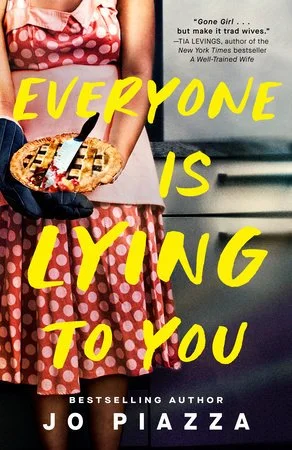
Everyone is Lying to You Jo Piazza (2025) What starts out as a novel about the phenomenal rise of female social media influencers turns dark pretty fast. Lizzie is a journalist in her thirties who hasn’t seen her college bestie, Bex, in fifteen years. Bex, who now goes by Rebecca, is a trad-wife influencer with six kids and millions of followers, posting from a ranch out West. When Bex offers Lizzie an exclusive interview, Lizzie gets drawn into a complex scenario involving the brutal murder of Bex’s husband, the disappearance of Bex and her kids, and the intrigues of other mommy-influencers. I couldn’t help but compare this novel to Caro Claire Burke’s 2026 phenomenon, Yesteryear (reviewed here), which has more pointed mockery of influencers but fewer scenes of brutality. Both Burke and Piazza position themselves as critics of the trad-wife lifestyle, the monetization of which by influencers often hides the cruelty behind the cameras.