

Plant This, Not That: Over 200 Native Swaps for a More Sustainable, Pollinator-Friendly Garden Elise Howard (2026)
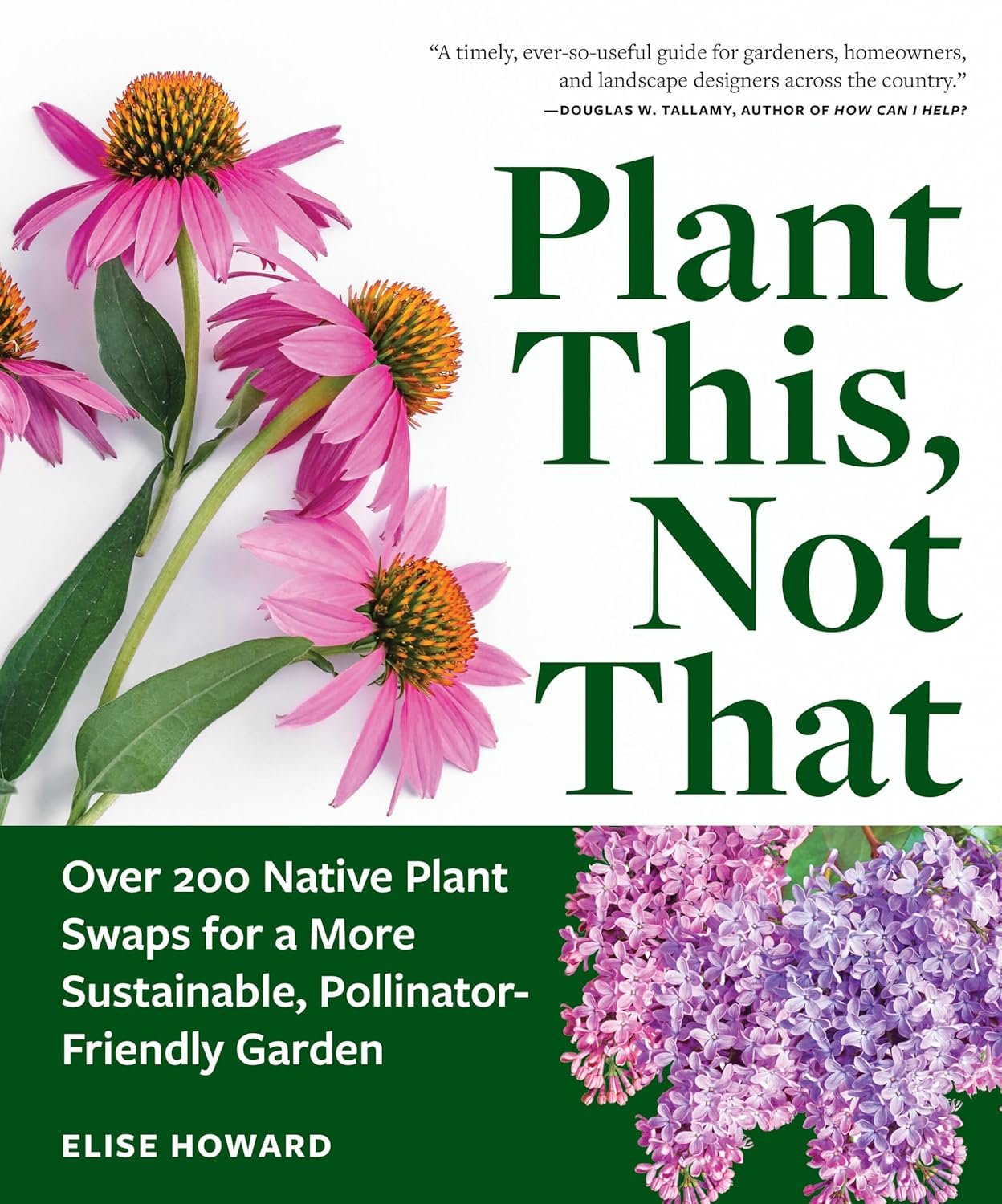
Elise Howard’s book, lavishly illustrated with color photos, offers a treasure-trove of native plants that you can choose instead of the standard garden center offerings. Howard asks gardeners to forgo many staples of American gardens in favor of plants that were present before European migration brought species from around the globe to our shores and before extensive hybridization reduced the number of plants available to pollinators. Why? If a plant isn’t native, it’s not part of the complex web of interdependent species in every local area.
Sometimes the plant substitution that Howard advocates is fairly simple: buy a native hydrangea instead of one that came from Asia, or buy a native rose instead of a highly hybridized rose. But in other cases, you’ll need to choose an entirely different genus in order to go native: instead of a lilac, plant a redbud; instead of a hosta, plant a fern. This guide has a capsule description of each recommended plant, as well as a detailed map that shows where in the United States that plant is native.
The stakes for swapping out are higher when a non-native landscape plant in your yard is also classified as an invasive plant. Invasives include (in at least some part of the United States) privet, barberry, callery pear, Japanese honeysuckle, pachysandra, English ivy, bugleweed, periwinkle, creeping jenny, spotted deadnettle, and many others. These plants can leap boundaries to smother native plants in nearby yards as well as in nearby forests and hedgerows and highway medians. And invasives don’t support local pollinators and other wildlife the way natives do. Plant This, Not That helps gardeners get a handle on what to plant to keep the bees buzzing and the birds singing. For example, instead of privet, plant serviceberry, one of my favorites.
I gleaned many great ideas for my own gardens from this book, and I totally agree with Elise Howard that we should plant more natives, getting rid of lawns and of invasive plants. I write from many decades of experience in incorporating natives into urban gardens, plus twelve years of growing native plants in three large rain gardens. (Rain gardens are slightly sunken areas with native plantings selected for their ability to absorb rainwater directed to them.) From this perspective, I do have a few critiques of Howard’s gardening dicta—dicta that are commonly accepted within the community of native-plant enthusiasts.
Percentages. Along with other prominent native-plant advocates, Howard recommends aiming for 70% native plants on your plot of Earth, including the lawn. This is a high bar, and my gardens don’t achieve it, even though I have no lawn whatever. This is partially because I grow many culinary herbs that are of Mediterranean origin—basil, oregano, parsley, sage, rosemary—as well as non-native tomatoes, peppers, and eggplant. And the huge leaves of my non-native rhubarb plants take up a sunny corner of my yard. My vegetable/herb garden provides my household with an incomparable edible harvest. Even if I did forego a garden that stocks my kitchen, I’d have to buy produce that was raised on someone else’s plot of Earth. (See also my comments on Harmless Non-Natives, below.)
Harmless Non-Natives. What if a plant that you love originated outside of North America but does not spread unduly—no self-seeding, no creeping rhizomes? And what if a noninvasive plant has been hybridized to the point that it has no value to pollinators? Should you keep these plants? These non-natives do take up space that native plants could use, but they’re doing no more harm than would a patio or an Adirondack chair in your yard. For instance, I have many long-lived peony plants, some of which were present when we bought our current property. Peonies originated in Asia, and most of them are of no value to pollinators. But they are not invasive, and they look very nice, both when in glorious bloom and when, after bloom time, they stand as compact green shrubs until a hard frost. I respect the pollinators, but I don’t plan to uproot my peonies.
Hyper-Local Natives. Howard urges that gardeners plant only natives that are very specific to the pollinators in their locale. These days, greenhouses that sell hyper-local plants populate my county in Michigan. But a decade or two ago, I had to search out native plants online or from the few plant nerds who grew them in their back yards. Some of the plants that I bought then are not native to my local bioregion but rather to a couple of states away. Foamflower and Virginia sweetspire are now established and thriving in my gardens, and I don’t plan to replace them with hyper-local natives.
Maintenance. I take exception to Elise Howard’s claim that native gardens are super-easy to maintain. I’ve planted natives that were so highly aggressive that, with much effort, I pulled them all up and banished them from my yard. (Nodding wild onion, I’m talking to you.) I’ve planted natives that were 8 feet tall and kept falling over, looking pitiful in an urban setting. (I gave away the cup plants.) I’ve planted natives that the deer herd in our neighborhood totally devoured. (Farewell, golden Alexanders). I’ve planted natives that were so prone to disease that they were virtually dead every year by midsummer. (Sorry, you poor black-eyed Susans.) Native gardens, like most gardens, have to be edited constantly. The gardener has to add and subtract plants to keep the plot in balance and to provide blooms for pollinators throughout the growing season. For example, I have to dig up some of my blue flag irises every few years, or I’d have nothing else in my rain gardens. Blue flag iris is an attractive plant—with flowers in the spring and neat, upright leaves the rest of the growing season—but I also want room for summer-blooming blazing star and autumn-blooming Joe Pye weed. Further, I spread cedar mulch around the plants in my gardens to reduce weeds. Howard strongly advises against the use of mulch, instead advising that gardeners leave each year’s dead stems and flowers on the soil. But I’ve found that, even in my densely planted native garden areas, weed seeds blow in and weeds must be removed. Since I don’t spray chemical weedkillers in my gardens, mulch is my friend on the weed scene.
Neighborliness. Complaints that I hear about native gardens, even in my highly progressive city, center on tidiness. Native gardens that are not weeded draw criticism for their unruly appearance, and tall native gardens planted on an extension or a street corner can block visibility for pedestrians, bicyclists, and vehicles. If you live in a rural area, you can probably dedicate a section of your property to tall natives like big bluestem, which used to grow in enormous swaths on America’s prairies. In the city or the suburbs, however, such plantings can cause neighborhood friction. My own rain gardens, full of native plants, at first raised the hackles of some neighbors, who thought that I was installing ponds to breed mosquitoes. I now have a descriptive sign in my front yard rain garden and take time to answer the questions of passersby, defusing their concern. Slowly, attitudes may change, but in many areas of the country, city ordinances and HOA rules may still militate against natives. Until native gardens are more generally understood, I’ve compromised with a few “nativars”—plants that have been bred from native stock to bring out certain desirable traits, such as larger flowers or lower height. Pollinators may not always gravitate to my nativar ironweed as much as they would to a hyper-local ironweed, but neighbors can’t object to the appearance of the plant in my front yard.
My recommendations. (1) Dig up plants that are invasive in your region, and send them to a landfill or to a city composting center, not to your backyard compost pile. (2) Remove your lawn—little by little if that works best for you—and plant natives. (3) If you want, keep your vegetable and herb garden, plus some of your beloved non-natives that aren’t invasive. (4) Learn about rain gardens, and create one with native plants. (5) Use Elise Howard’s book as one of your guides, but research carefully before you buy. If you’re going to invest in a native plant, you’ll want to be certain that it will work in your yard—and that it will give you joy.
Addenda:
For plant information, missouribotanicalgarden.org is indispensable (plant finder).
Any book by Douglas Tallamy will give you the ecological arguments for native plants.
Here is my county’s excellent website on rain gardens.
A July 2026 piece by science writer Ferris Jabr in the New York Times (here) is the best I’ve read on a balanced approach to native plants.
Note that I’ve used common names for plants mentioned in this post. A quick online search will give you the scientific names.