

The Forsyte Saga John Galsworthy (1922)
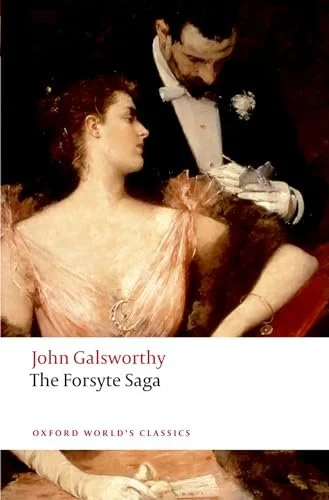
More than a hundred years ago, John Galsworthy gathered three of his novels (The Man of Property, In Chancery, and To Let) plus two short stories into a volume called The Forsyte Saga. The collection was still going strong in the 1960s, when I first read it. Now, coming up in 2026, PBS plans to air the most recent of many screen adaptations of the story. What is the staying power of Galsworthy’s most famous fiction? To answer this question, I recently re-read all 850 pages of The Forsyte Saga, in an Oxford World’s Classics edition from 2008.
First off, in The Man of Property, Galsworthy hammers hard on the destructive aspects of capitalism—specifically the devotion to the accumulation of wealth and to the development of real estate. He frames his economic views in a tragic love story, in which the main protagonist, Soames Forsyte, loses the love of his life, his wife Irene, because he treats her as property. Yup, that was a spoiler, but hold on. I’m not going to encourage you to read this part of the trilogy unless you’d love the anti-capitalism aspects. The Man of Property was written in 1906 and set in the London of the 1880s, so it’s permeated with a kind of nostalgia and spends too many chapters in stuffy Victorian drawing rooms. It also has numerous archaic local references that I can’t imagine I understood when I read it as a high-school student.
In between The Man of Property and the next novel, In Chancery, Galsworthy places a short story called “Indian Summer of a Forsyte.” This is a delightful interlude, in which an aged uncle of Soames, Old Jolyon Forsyte, befriends Irene, now Soames’ estranged wife. Through an odd twist, Old Jolyon is living in the magnificent house that Soames commissioned for Irene but that Soames and Irene never occupied together. The natural setting of this house, outside of London, is entrancing, and Galsworthy’s descriptions recall the best of nineteenth-century nature poetry. Even if you don’t read the rest of the saga, I recommend this short story to you.
The second novel of the saga, In Chancery, is thus named because it deals with two divorces, which in Britain have to be processed by the Court of Chancery. This component of the saga was written in 1920 and set around the turn the twentieth century, as Soames and his sister Winifred both seek to be freed from their spouses. After Soames fails to reconcile with Irene, he becomes obsessed with divorcing her and remarrying so that he can produce an heir to whom he can leave all the money that he’s accumulated. (Winifred’s spouse, meanwhile, is a wastrel and a lout.) Divorce was not an easy legal process in Britain at this time, usually involving proof of adultery, and it carried considerable social stigma. Galsworthy gets into the heads of his characters in a way that’s very modern, and he explores all the complex emotions of marriage, family, and inheritance. Do read this part of the saga.
The third novel, To Let, written in 1921, is set in 1920. Soames’ daughter, Fleur Forsyte, the product of his second marriage, is now in her late teens. She falls in love with her cousin, Jon Forsyte, who is the product of the union of Soames’ ex-wife, Irene, and a cousin of Soames. Got all that? Obviously, the families on both sides are opposed to the match of Fleur and Jon, and the novel goes on at length in an agonizing back-and-forth as the lovers try to navigate extremely difficult feelings. Seriously, skip this one, as well as the short story called “Awakening,” which precedes the third novel.
In summary, the parts of The Forsyte Saga that I advise you to read are the short story “Indian Summer of a Forsyte” and the novel In Chancery. You might consider reading The Man of Property also. Try to get an edition, like the Oxford World’s Classics one, that provides a family tree of all the Forsytes, so that you can keep the characters straight.
Finally, an anecdote. When I was a freshman in college, I had a meeting with my advisor during which he asked what my favorite novels were. I mentioned The Forsyte Saga, and he guffawed, much to my humiliation. He considered Galsworthy hopelessly old fashioned and steered me toward authors such as Joyce and Hemingway. More than a half century later, I feel somewhat justified that PBS is returning to Galsworthy!