Sonata I: The Swiss Character

The Gustav Sonata     Rose Tremain     (2016)

Tremain.jpg

The setting is Switzerland after World War II and, in flashbacks, before World War II. Author Rose Tremain delves into the traditional stereotypes of Swiss character as well as the fraught issue of Swiss neutrality in the face of Nazi aggression.

With exceptionally spare prose, Tremain propels along the story of Gustav Perle; his widowed mother, Emilie; and his best friend, Anton Zweibel. The novel opens in 1947, when Gustav is five years old, and we learn immediately that Emilie is a harsh taskmaster to Gustav: “He never cried. He could often feel a cry trying to come up from his heart, but he always forced it down. Because this was how Emilie had told him to behave in the world. He had to master himself. “ (4)

Gustav’s life changes the day in 1948 when his kindergarten teacher assigns him as mentor to a new student, Anton, a piano prodigy from an exuberant and friendly Jewish family. Emilie is wary of the boys’ budding friendship: “’The Jews are the people your father died trying to save.’” (17) Well, as we’ll learn later in the novel, that isn’t exactly what happened during the war.

The story of the death of Gustav’s father is complicated, but his involvement with Jewish refugees in the early days of the war was perhaps partly inspired by the true story of a Swiss police officer who broke the law by aiding Jews. The closing of the Swiss borders to Jews in 1938 sent many to concentration camps and gas chambers. I don’t think that it’s accidental that The Gustav Sonata has been published when Europe is once again facing a refugee crisis with profound humanitarian and political implications.

Beyond this back story about Gustav’s father, the novel moves forward in time to the 1990s, when Gustav and Anton are both middle-aged. Gustav is the owner of a small hotel in his home town of Matzlingen. Anton, who could not survive the performance pressures of being a concert pianist, is a music teacher in the same place. One final crisis leads to the resolution of the plot, much as a final cadence ends a musical composition.

In my husband’s family there’s a phrase that’s used to describe the mindset of his Swiss ancestors: “Alles ist in bester Ordnung.”  The literal translation is “Everything is in the best order,” but the underlying message is that the Swiss have a passion for orderliness, for precision, for suppressing conflict and emotion, sometimes to the detriment of human kindness. Gustav, in particular, seems to conform to this Swiss stereotype, but Tremain’s novel shows us how he eventually breaks free.

For another novel that has “sonata” in the title, though with a very different tone and setting, check out my review next Friday!

Family Drama in the Florida Heat

Heart of Palm     Laura Lee Smith     (2013)

L Smith.jpg

I wanted to read Laura Lee Smith’s 2017 novel, The Ice House, but my local library hasn’t bought it yet. So I checked out Smith’s 2013 novel, Heart of Palm, to see what her writing is like. I was confused at first by the cover of Heart of Palm, which looks like the front of a cheesy romance novel, but I decided to dip in anyway. Then, right off the bat, I encountered a horrific accident in the Prologue. Regular readers of this blog know that I don’t care for scenes of horror, and the grisliness of this episode almost kept me from continuing. But I’m very glad that I stuck with Heart of Palm.  

This is a novel of the American South, populated with gun-totin’, hard-lovin’, rip-roarin’ Southerners—but stopping short of stereotypes. In 1964, the wealthy and sophisticated Arla Bolton up and marries penniless bad boy Dean Bravo in the fictional Utina, a backwater town near St. Augustine, in northeastern Florida. There’s our set-up for marital difficulties, sibling rivalries, and various brawls. As we move from the 1960s to the present day for the main action, the adult children of Arla and Dean are faced with the extraordinary appreciation of their real estate, which happens to be situated on the Intracoastal Waterway. Being a Midwesterner, I was unfamiliar with this important shipping route along the Atlantic Coast, made up of both natural rivers and artificial canals. The Bravo clan is accustomed to living amidst the swampy tangle of vegetation that lies along the Atlantic and the Intracoastal, and they struggle with whether to sell to the real estate developers who want their parcels of land.

In addition to this main plot about real estate, each of the Bravos has a subplot, and several of the other quirky characters in Utina also get subplots. Novelist Smith develops all the storylines with a deftness that invites immersion in the text. She supports her narrative with descriptions that plop you right under the drooping fronds of palmettos, wiping your brow and sipping a cold brew. With Smith’s pervasive portrayal of the Florida heat, I could feel the suffocating air that makes your clothes stick and your head spin. No wonder the Southerners in Heart of Palm are a bit crazed. They need better air conditioning equipment!

Smith treats her characters—even the scoundrels—with empathy as they make the best of their situations, and she works their tales to a satisfying conclusion. So, will I still be looking to check out Smith’s The Ice House when it arrives at my library? You bet.

An Irish Cozy Mystery

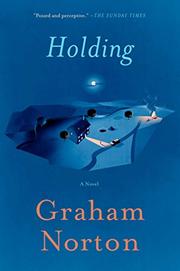
Holding     Graham Norton     (2017)

A village in the west of Ireland, a human skeleton unearthed at a building site, gossip about old love triangles, and a bumbling local police sergeant:  all the ingredients for a classic cozy mystery novel. Holding is indeed that, but it goes beyond the genre.

Norton.jpg

In Holding, Graham Norton has produced some noteworthy character studies of mature people who are at turning points in their lives. He has readers sympathizing with the middle-aged police sergeant, PJ Collins, who is overweight, underutilized, and desperately lonely. Norton also pulls us into the plight of middle-aged Brid Riordan, who loves her kids but often gets drunk to forget how unhappy her marriage is. Another character is Evelyn Ross, who’s stuck in the past, lamenting a failed romance from twenty-odd years ago. There’s also PJ’s elderly housekeeper, Lizzie Meany, whose background is revealed in a heartbreaking and surprisingly violent segment of the novel.

The mystery plot is not that tricky for readers who read a lot of cozies—I guessed the identity of the bones early on and had a good idea who buried them by the midpoint of the book. Still, the climax of the book, with the solution of the mystery, was suitably tense for me. It’s the unraveling of the story, with the appropriate red herrings, that gives the author scope for more interactions of his characters. PJ, for example, compromises his professionalism in his dealings with two of the murder suspects, and Brid makes some major changes in her family situation.

Holding has such a classic-1930s-mystery vibe to it that modern elements like DNA testing and mobile phones seemed slightly odd at first, but Norton skillfully integrates twenty-first-century technology into a rural Ireland that in some ways has not changed for a century—the pubs on the main street, the church fete, the outlying farms and hedgerows. He does allow, of course, for occasional lapses in phone reception that will advance his plot!  

Although I had never heard of him before, Irish-born Graham Norton is a well-known television personality and cultural commentator in Britain. This status might have gained him some book sales in the European market, but it clearly didn’t influence my decision to pick up Holding at my local library and stick with it to the end. (I have a “50-page test.”  I assess each title that I start reading at the 50-page mark to decide if I want to invest more time it in. I abandon many, many books even before page 50. Holding easily passed this test.)

The epilogue of Holding contains suggestions that more adventures of Sergeant PJ Collins may be forthcoming. I hope Norton takes time from his television career to produce another PJ mystery. I’ll be on the lookout!

Favorite Reads of 2017

I’ve reviewed 101 books on the Cedar Park Book Blog in the calendar year 2017, counting reviews of book series as one book. Thirteen individual titles, listed below, stand out as favorites of mine. Not all were published in 2017, but all were reviewed on my blog in 2017.

Cedar branch.jpg

Pre-eliminated from this list are titles from categories that I don’t read—science fiction, fantasy, thriller, and horror. I also abandon fiction that turns out to have what I consider to be too many scenes of extreme violence. So this list of my favorites is heavy on historical fiction, family sagas, and introspective novels. I was surprised that none of the many mystery novels that I reviewed stood out for me as top choices for the year. I think of myself as loving mysteries, especially historical mysteries, but in selecting favorites I gravitated toward non-mysteries that presented ethical challenges and complex family dynamics. I occasionally review biographies and social histories, and one social/economic history, The Rise and Fall of American Growth, made my list of favorites.

The brief blurbs here do not begin to do justice to these books. Click on the title to go to my full review! Here are my favorite reads of 2017, in alphabetical order by title:

  • Anything Is Possible by Elizabeth Strout. Interconnected short stories about families in a rural Illinois town; sort of a sequel to My Name is Lucy Barton.

  • Barkskins by Annie Proulx. A sweeping three-century saga of two French Canadian families and their relationship to the forests of North America.

  • The Dark Flood Rises by Margaret Drabble. Looking at mortality and the environment through the lens of a contemporary British family.

  • Eleanor Oliphant Is Completely Fine by Gail Honeyman. An awkward and abused woman in Glasgow faces her demons and seeks to change her life.

  • The Fortunes by Peter Ho Davies. Interlocking stories about the experiences of Chinese immigrants in America over the past century.

  • A Gentleman in Moscow by Amor Towles. Adventures of a Russian aristocrat under house arrest in a Moscow hotel from 1922 to 1954.

  • The Golden Age by Joan London. Two young polio victims grow up in a convalescent home in Australia in the 1950s.

  • The Last Painting of Sarah de Vos by Dominic Smith. Visiting a painting and its impact on families in the Netherlands (1636-1649), in New York (1957-1958), and in Sydney (2000).

  • Moonglow by Michael Chabon. The fictional biography of a Jewish engineer, recounted by his grandson, touching on key events of the twentieth century.

  • Our Souls at Night by Kent Haruf. Two neighbors in their 70s find companionship and tackle difficulties together.

  • Pachinko by Min Jin Lee. The struggles of Korean immigrant families in Japan during the twentieth century.

  • The Rise and Fall of American Growth: The US Standard of Living Since the Civil War by Robert J. Gordon. A huge and detailed nonfiction book, with emphasis on food, housing, sanitation, and consumer goods that have shaped the economy.

  • The Women in the Castle by Jessica Shattuck. Hardscrabble life in Germany in the aftermath of World War II, with reflections on the rise of Hitler.

Eight of the titles that I reviewed in 2017 appeared in the New York Times list of “100 Notable Books of 2017.” This list has some overlap with the above list of my own favorites:

I’m looking forward to many more great books in 2018!


A Marriage in Nigeria

Stay with Me     Ayobami Adebayo     (2017)

In some traditional cultures, a wife who doesn’t produce male offspring for her husband can be supplanted by an additional wife who might be more fertile. Polygamy and paternalism are accepted.

Adebayo.jpg

In the contemporary Nigerian novel Stay With Me, Akin and Yejide are a modern couple. Theirs is a love match, not an arranged marriage. When they meet at university in the 1980s, they discover their immediate attraction to each other as well as their compatibility—sharing, for example, a keen interest in the Nigerian and international political scene. After several years of marriage, however, they remain childless. Akin is devoted to Yejide and doesn’t want a second wife, but he’s prodded relentlessly by his family until he takes on wife #2, Funmi, and installs her in an apartment separate from the home he shares with Yejide. They can afford this apartment because Akin is a successful accountant, and Yejide is the owner of a thriving hairdressing salon. Funmi is an especially stinging insult to Yejide because her own mother died giving birth to her, leaving her to be brought up by multiple cruel stepmothers. 

That’s the plot setup, which gets complicated by infidelities, deceptions, outright lies, and  sickle cell disease. The narrative alternates between the 1980s and 2008 and between first-person accounts by Yejide and Akin. Another seesawing is between folk practices (some of them downright dangerous) and modern medical procedures (some of them emotionally unsettling). Traditional Nigerian tales exist side-by-side with discussion of recent Nigerian political affairs. The women in Stay with Me assert influence within the family circle, and some women, like Yejide, attend university or own businesses. Yet that pressure on wives to produce male heirs is intense. As Yejide reflects: “The reasons why we do the things we do will not always be the ones that others will remember. Sometimes I think we have children because we want to leave behind someone who can explain who we were to the world when we are gone.” (119)

Through context I navigated the many honorifics that Nigerians employ to express respect for their neighbors, business associates, and relatives, particularly their elders. The dialogue here is resonant and revealing of character. A few of novelist Adebayo’s plot twists are awkward, but she gives us a view into her rich culture, peopled by men and women who strive to make the best of the lot they are dealt.

I leave you with some questions: Is the title STAY with Me or Stay with ME?  Is Akin asking Yejide to stick with him despite all their infertility problems? Or is Yejide asking Akin to be her exclusive marital partner? Or is it both?

Stay with Me was selected by the New York Times as one of the "100 Notable Books of 2017."


Asperger's in Manhattan

Standard Deviation     Katherine Heiny     (2017)

Heiny.jpg

You probably know someone like Standard Deviation’s Audra, a stream-of-consciousness, nonstop chatterer who talks to strangers on the bus and in the elevator, freely associating from one topic to all adjacent topics. You might find her endearing, or you might find her highly irritating and intrusive. Graham, her husband, finds her endearing most of the time, even when she proposes pretty outrageous activities, such as striking up a friendship with Graham’s ex-wife, Elspeth, whom he hasn’t seen in twelve years. In case you’re wondering, yup, Graham left Elspeth for the much younger Audra.

Katherine Heiny’s episodic novel takes us up and down the streets of Manhattan for the adventures of Graham and Audra; their ten-year-old son, Matthew; and Elspeth. Audra leads the way with hilarious monologues. For example, at an origami convention to which Graham and Audra have taken Matthew, Audra exclaims impatiently while waiting in a queue,  “‘What I don’t understand about origami . . . is why can’t anyone like it a little bit? Why aren’t there nice, well-rounded people who enjoy a bit of origami, the way there are nice, well-rounded people who enjoy a bit of bondage?’”(110) Wherever Audra treads, innocent bystanders reel in shock.

But hidden in plain sight in this book is a serious examination of the difficulties of raising a child with autism spectrum disorder. The doctor diagnosing Matthew tells the parents, “’Matthew’s score on the questionnaires for oversensitivity to stimulation ranked more than a full standard deviation above the range for children his age.’” (232) This passage is where we finally find out what the title of the novel means. Heiny presents the case of young Matthew with clear-eyed, unsparing detail, and she presents his parents as devoted unreservedly to helping him become an independent adult. The plot of Standard Deviation trails off in about the final third of the book, but that may be to give the impression of how the lives of Graham and Audra and Matthew will continue in the same vein.

The third-person narrative of the novel is told mainly from Graham’s point of view, and Heiny offers us plenty of Graham’s musings on his family situation:

  • “Who was this doctor to say that because of standard deviation, Matthew stood firmly on the stark cracked-earth desert of Asperger’s, that he would never feel the long cool green shade of normal?” (232)
  • “Graham had been developing a theory lately that the parents of kids with Asperger’s also had Asperger’s only less pronounced. A milder Asperger’s. The seeds of Asperger’s . . . Of all the dozens of special-needs kids’ parents he knew, one parent of every couple always seemed a bit odd, a bit eccentric, a bit Aspergery.” (212)

Indeed, one wonders how Matthew’s mother, Audra, would be diagnosed.

After writing a draft of this review, I read some other major reviews. I was surprised that the reviewers focused on the relationship triangle of Graham, Audra (his current wife), and Elspeth (his ex-wife). That was certainly a sub-plot in the novel, but I found the relationship between Matthew and his parents (Graham and Audra) much more significant. Neither the highly amusing dialogue nor the Manhattan scenery detracts from this book’s thoughtful treatment of the issue of autism.

Fiction with a Christmas Setting

Whether Christmas for you is a religious observance, a civic holiday, or just another day of the week, you can’t avoid the hype in modern American culture. Fiction titles set at Christmastime abound.

Spencer-Fleming.jpg

In the Bleak Midwinter, by Julia Spencer-Fleming, is the 2002 novel that inaugurated an excellent series of contemporary murder mysteries set in upstate New York. Since this book takes place in December, you can get a good dose of drifting snow and icy winds to put you in a wintry mood. Russ Van Alstyne is the police chief in the small town of Miller’s Kill. (A “kill” is a small river in Dutch, but there’s that double meaning.) Clare Fergusson is an Episcopal priest who just started her first job at a local church. On a bitterly cold night, Clare finds an abandoned baby in a box on the church doorstep. She accompanies the baby to the hospital in an ambulance, where she meets Russ, who’s investigating the case. The plot, as twisty as the mountain roads of the Adirondacks, includes multiple murders, red herrings, and scenes of sheer terror. I don’t usually like to read thrillers (because of the sheer terror), but this novel has so much more. Spencer-Fleming makes her characters’ struggles of conscience totally believable and in no way sentimental. Clare has a deep faith that is impressive even to the agnostic Russ. And the sizzling attraction between married Russ and single Clare, evident from chapter 1, grows as the plot develops, pulled along by snappy and intelligent dialogue. Get yourself a copy of In the Bleak Midwinter and plan for some non-stop reading.

Perry--Christmas.jpg

For an easy read by the fireplace after a day of feasting, try one of Anne Perry’s gentle Christmas mysteries. Perry is the bestselling author of full-length historical mysteries set in the Victorian era and in World War I. Every year since 2003, she’s also published a novella-length mystery set during the Christmas season, usually in the nineteenth-century England that she knows so well. These short Christmas mysteries are not complex in their plots like Perry’s full-length novels, but they do display Perry’s signature approach of recording her characters’ brooding introspection. The sleuth of the novella may be a professional or an amateur, but the Christmas festivities are always poignant. A Christmas Garland (2012), set in India during the British colonial rule there, was to me the least successful of these books, but I recommend the series overall. I especially liked A Christmas Secret (2006), about newlyweds moving into a vicarage in rural England and facing a murder. In A New York Christmas (2014) Perry ventures across the Atlantic in 1904. Yes, I do have a weakness for fiction set in New York City!

Sayers--9 Tailors.jpg

For the ultimate in British classic-era Christmas mystery, pick up the 1934 Nine Tailors  by Dorothy L. Sayers. This novel requires that the reader acquire some background knowledge of two subjects: the Fens and the change ringing of church bells. The Fens are low-lying marshy areas in the eastern part of England that were made into arable lands centuries ago by an extensive system of drainage channels. Change ringing is the practice of pulling ropes to sound tuned bells in a tower in a particular and complex order, not for the production of a discernible melody but for the precision of the sequence. Okay, okay, it’s esoteric. But Nine Tailors is worth this price of admission to an adventure of Lord Peter Wimsey that begins on one New Year’s Eve and concludes at Christmastime a year later.  

Hornak.jpg

The twist in Francesca Hornak’s Seven Days of Us (2017) is that a British family is forced to stay quarantined in their rural home for a week at Christmas because one daughter, a physician, has just returned from Africa, where she was treating victims of a deadly virus. Their mandatory togetherness evokes the traditional English-country-house mystery novel, though this is not a mystery. Novelist Hornak brings out some well-worn plot elements, such as the concealment of a medical diagnosis and the arrival of an adult son whose existence was previously unknown. The story is updated to the twenty-first century with emails, text messages, Twitter hashtags, and a bit of gay sex, but the characters are recognizable British types: the grumpy and self-centered paterfamilias, the frivolous young woman, the dense rugby player, the noble doctor. This is pretty good quality chick lit, suitable for light reading over the winter holidays.

Repression in Ireland

The Heart’s Invisible Furies     John Boyne     (2016)

Boyne.jpg

In first-person fictional narrative, Irishman Cyril Avery, adopted son of Charles and Maude Avery, tells us his life story, in bursts every seven years from 1945 to 2015. Cyril starts with a detailed description of his own birth to the unmarried Catherine Goggin, and we know that he must have learned these details from Catherine herself. So we keep waiting for the page on which Cyril finds his birth mother. Be patient, reader, because that page does eventually arrive.

First we get a full account of growing up gay in an Ireland that was dominated by the Catholic Church. The tale is brutal but realistic—novelist John Boyne himself likely suffered some of the violence and indignities described. And Boyne does not confine himself to homophobia in Ireland. His character Cyril lives as an expatriate in Amsterdam and New York for many years. Amsterdam in 1980, though a tolerant city overall, is home to vicious pimps who exploit “rent boys.” New York City in 1987 is the epicenter of the AIDS epidemic, which many Americans saw as a punishment by God for homosexuality.

The cast of The Heart’s Invisible Furies includes straight women who are ostracized by Irish society because of their pregnancies, adoptive parents who are unloving, straight men who assault gays, and gays who strike back. Somehow, Cyril survives, and his tenacity is amazing. He tries hard to comprehend the antagonism toward him:

”’Why do they hate us so much anyway?’ I asked after a lengthy pause. ‘If they’re not queer themselves, then what does it matter to them if someone else is?’

‘I remember a friend of mine telling me that we hate what we fear in ourselves,’ she said with a shrug. ‘Perhaps that has something to do with it.’” (224-225)

I do have some criticisms of The Heart’s Invisible Furies. The text can veer into didacticism as Boyne gives voice to “the heart’s invisible furies,” a line from a WH Auden poem. I found the ending weak in comparison with the rest of the novel—I’m guessing that Boyne used unconventional narrative techniques in order to take his readers right to the very end of Cyril’s life. In addition, I was able to spot a few minor anachronisms because I lived in Dublin myself back in the early 1970s. None of these issues leads me to discourage potential readers.

The status of the Roman Catholic Church in Ireland is today much different than it was in previous centuries. Investigations in recent decades have revealed sexual abuses by priests and severe maltreatment of women and their children in church-run homes for unwed mothers. At least partially because of these scandals, far fewer Irish citizens now attend Mass, and the power of the church over sexuality has lessened. Homosexual activity was decriminalized in Ireland in 1993, and in 2015 same-sex marriage was adopted by popular referendum. In 2017, Leo Varadkar became the first openly gay Irish prime minister.

To get the most from John Boyne's dark and powerful novel, you might want to do a quick review of the history of Ireland and familiarize yourself with Irish terms like "Taoiseach" (prime minister). It’s well worth the effort.

Three Books about the Little House Series

Caroline:  Little House, Revisited     Sarah Miller     (2017)

S. Miller.jpg

Sarah Miller, an established American author of historical fiction and nonfiction, received authorization from the Little House Heritage Trust to produce this novel about the pioneer life of Caroline Quiner Ingalls, the mother of Laura Ingalls Wilder. Laura was the author of the famed series of Little House books, which fictionalized events from her family’s years as pioneers in the Upper Midwest and on the Great Plains in the late nineteenth century.

In this spin-off novel, Caroline, we see most of the same events that Wilder portrayed, but through the eyes of Laura’s mother.

In recounting the early adventures of the Ingalls family, novelist Miller treads a path somewhere between the historical record and the fictionalized version that appeared in the Little House books, specifically the title Little House on the Prairie (published in 1935), which tells of the family’s trip by covered wagon from Wisconsin to Kansas to stake a new land claim in 1869-1870.

I first read Wilder’s Little House series as an adult and was captivated by the details of daily life that she lovingly described. Miller’s novel Caroline paints a less bucolic picture, meticulously chronicling the grueling toil that pioneer families endured. In this version, Caroline Ingalls worked hard, even when she was heavily pregnant, and survived with an irrepressible good humor and positive attitude. Her husband, Charles, was certainly no slacker, either, but his search for the perfect land claim in the expansionist days of the United States must have worn thin on his wife and children.

Fans of Laura Ingalls Wilder’s books will not want to miss Miller’s take on incidents that they know well. (Be sure to read her Author’s Note at the end of Caroline, about the prejudices against Native Americans that contributed to Wilder’s account of the Osage Indians.) Miller writes skillfully and with a clear affection for her topic, presenting the beauty of an unspoiled American landscape but not stinting in her depictions of the diseases and dangers that pioneer women faced.

The World of Laura Ingalls Wilder: The Frontier Landscapes That Inspired the Little House Books    Marta McDowell     (2017)

McDowell 2.jpg

Devoted readers of children’s novelist Laura Ingalls Wilder often seize on any book that provides background about her Little House series. This nonfiction book focuses on the flora and fauna mentioned in Wilder's novels. Marta McDowell structures the text chronologically around what she calls Wilder’s “Life on the Land,” going book-by-book through the sites where Wilder lived, in places that are now in the states of Wisconsin, Kansas, Minnesota, Iowa, South Dakota, and Missouri. (The landscape of upstate New York, where Laura’s husband, Almanzo Wilder, grew up, also gets a chapter.) The style is chatty, with many quotations from the Little House books. The illustrations that McDowell has selected are sometimes excellent complements to the text, especially when they’re maps or period photos. At other times the illustrations are rather pointless; I didn’t need a half-page color photo of wintergreen berries, as just one example.

smith hill 2.jpg

If you’re a diehard Laura Ingalls Wilder buff, you might want to page through McDowell's book, but I can recommend a much better read: editor Pamela Smith Hill’s Pioneer Girl: The Annotated Autobiography (2014), a meticulous and comprehensive analysis of how the Little House books differed from the actual life of the author, as presented in Laura’s previously unpublished memoir and as unearthed by historical research. This is an exceptionally fine book.

Swashbuckling

The Vineyard     María Dueñas     (2017)

Translated from the Spanish by Nick Caistor and Lorenza García

Duenas.jpg

In this sweeping page-turner, María Dueñas recounts a year in the life of Mauro Larrea, as he travels from Mexico City to Havana and on to Jerez de la Frontera in Spain. The year is 1861, and Larrea, a wealthy silver miner, has lost his fortune because his investments became entangled in the American Civil War.

Larrea’s determination to launch another business, with borrowed funds, sends him forth from his home in Mexico City and away from his beloved daughter, Mariana, who is soon to give birth to his first grandchild. Larrea lands first in Cuba, where he faces some culture shock despite the links of language and heritage. He risks everything in a wild gamble, ending up as the owner of an abandoned vineyard in his native Spain. He doesn’t want to run a winery and sails to Jerez intent on selling the vineyard, but he gets entrenched in various sub-plots involving the vineyard’s former owners, including the glamorous and brilliant Soledad Montalvo, now the wife of a London wine merchant. Oh, and he’s worried about his errant son, Nico, who’s living the high life in Paris.

That’s the plot in a nutshell, but this summary doesn’t do justice to the scenes that Dueñas can conjure up, from grimy silver mines to glittering concert halls, from the swirling dust of Mexico to the oppressive humidity of Havana and the wine-infused air of Andalusia. Although the story moves along at a rapid pace, Dueñas is able to help readers visualize each setting with well-chosen descriptors, and she conveys the emotions of Larrea, whose thoughts readers have access to. I became quite fond of the character Larrea, a handsome widower with scars from his years of manual labor, a man who knows how to drive a hard bargain but is soft toward his family and close friends. He’s a man with a conscience, often thinking what his trusted advisors would tell him when he’s in a tough situation. And he certainly does get himself into tough situations as this novel careens along. At times he feels “caught up in this spider’s web that seemed humanly impossible to extricate himself from.” (474)

Yes, The Vineyard is swashbuckling historical romance, but it’s well wrought, in a good translation. And if you like this book, don’t miss the excellent Netflix production of Dueñas’s 2009 novel, The Time in Between, about a seamstress in 1930s Spain who rises in the field of haute couture and then becomes a spy. 

An 18th-Century Romp in NYC

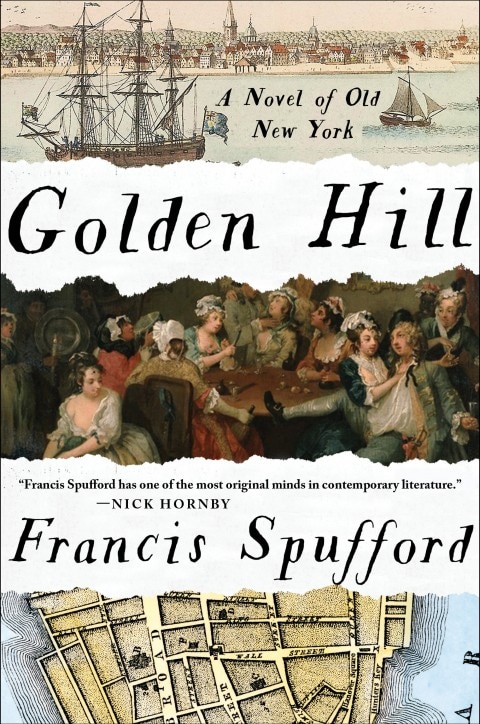
Golden Hill: A Novel of Old New York     Francis Spufford     (2017)

When the English prose novel debuted as a genre in the eighteenth century, it was usually characterized by realism, episodic structure, and the adventures of a hero. With Golden Hill, Francis Spufford replicates many aspects of the early novel while producing more sprightly and less rambling text. Golden Hill is set in 1746 New York City and stars Richard Smith, a Briton on a mysterious mission in the pre-Revolution American colonies.

Smith lands in Manhattan on the rainy evening of November 1, carrying a sort of money order for the enormous sum of a thousand pounds. When he attempts to collect his cash at a firm affiliated with the London firm on which the order is drawn, he understandably comes under suspicion. This may be ancient New York, but it’s still New York, and bankers seek verification. Besides, cash is in short supply in the colonies, where barter and paper money of fluctuating value serve instead.

During a waiting period of sixty days to receive—or not receive—the funds, Smith becomes intimately acquainted with the city of seven thousand souls that already has a “Broad Way” and a “Breuckelen.” He breakfasts at a coffee house and dines with the power brokers of the city. He celebrates “Pope Day” (Guy Fawkes Day, November 5) with the British inhabitants and “Sinterklaasavond” (St. Nicholas’ Eve, December 5) with the Dutch. Novelist Spufford vividly describes the local customs of colonial New York as his character Smith gets into all sorts of scrapes, acts in an amateur theater production, and falls in love with an independent-minded woman.

Sections of Golden Hill do have the ring of eighteenth-century prose, but in other sections Spufford  takes off with paragraphs that sound more contemporary. Here he is describing falling snow:

“. . .the powdery fall was already furring the cobbles with a thin grey nap like velvet, and rimming them white along all the crooked lines between. Everything seemed slowed to the speed of the descending snow. A holy expectation reigned in the thickening air, and passers-by walked as if they did not want to disturb it. Only a small party . . . made any noise. They were singing something, and carrying a small lantern on a pole which lit the flakes to swarming gold in a small globe around itself, and touched the edges of their faces—the line of a hat, the scroll of an ear, the filaments of a beard—with shadowy gilding, like statues in an ancient shrine.” (182)

Spufford’s similes can be striking:

“The awkwardness between them that danger and hilarity had dissolved was drifting back into place, like a sediment in a briskly-shaken bottle that, when shaking ceases, begins to float down again.” (89)

“When a log that has lain half-burned in a winter fire is struck suddenly with the poker, a bright lace of communicative sparks wakes on the instant. The sullen coals shatter into peach and scarlet mosaic, with a thin high tinkling sound, and pulses of the changing shades pass over the surface in all directions with rapidity too great for the eye. So it was when the news of Smith’s disgraceful liaison was suddenly released into the town.” (225)

Spufford conceals the purpose of Smith’s trip to New York until the close of the novel. I usually downrate a mystery if the author does not abide by the fair-play rule, which dictates that facts known to the protagonist cannot be  hidden from the reader. I gave Spufford a pass on this one, however, since Golden Hill is much more than a mystery. It’s an eighteenth-century romp with a serious message about justice at the end—and a coda from that independent-minded woman whom Smith met in New York.

Among My Faves: David Sedaris

Among My Faves:  David Sedaris

Sedaris.jpg

In 2017, David Sedaris published Theft by Finding:  Diaries 1977-2002. This book of excerpts from Sedaris’s extensive diaries is for serious Sedaris buffs, and I count myself as one. If you’ve never read any work by David Sedaris, do *not* start with Theft by Finding, because it will seem rambling and possibly ridiculous. First go read several of Sedaris’s collections of essays or stories. I especially recommend the following:  

  • Me Talk Pretty One Day (2000) has two sections of essays—one about Sedaris’s youth in Raleigh, North Carolina, and one about his move to France as an adult, with his partner, Hugh Hamrick. The essays about Sedaris’s attempts to learn to speak French are so hilarious that I laughed until tears obscured the words on the page.
  • Dress Your Family in Corduroy and Denim (2004) has widely-ranging essays, with a focus on family relationships. Sedaris’s realization that he’s gay is presented frankly and yet with comic self-deprecation.
  • When You Are Engulfed in Flames (2008) includes one of my favorite Sedaris humor pieces: the story of his trip to Japan to try to quit smoking. His idea was to get far away from his usual haunts to break his habit, but he found that smoking is very common in Japan.
  • Squirrel Seeks Chipmunk:  A Modest Bestiary (2010) is a collection of animal fables, a departure from the usual Sedaris essay form.
  • Let’s Explore Diabetes with Owls (2013) continues with Sedaris’s droll observations on humanity. Of particular note is the essay about Europeans’ reaction to the election of President Obama in 2008.

If we have all these other books about David Sedaris’s upbringing and family members and encounters with odd strangers, why do we need to read his diaries? Well, Theft by Finding provides insights into the creative process that produced so many excellently sardonic essays and stories. For example, there are entries that give the background to Sedaris’s most famous piece, “SantaLand Diaries,” about his experiences working as an elf at Macy’s in New York during the Christmas season. “SantaLand Diaries” appears in his 1994 book, Barrel Fever, and also in his 1997 book, Holidays on Ice, but Theft by Finding records the day in December 1992 when Sedaris first read this essay on National Public Radio and caused a sensation among listeners.   

Theft by Finding also includes entries for important events in history, so that you can read Sedaris’s first notice of the AIDS epidemic, as well as his reaction to the attacks on September 11, 2001, while he was living in France. In Theft by Finding you can watch the development of Sedaris’s style, from jotted observations to more expanded commentary on those observations. Sedaris notices absolutely everything and is a master at capturing offbeat, ridiculous, and sometimes illegal activities occurring around him. In his twenties, his existence on the fringes of life, in crime-ridden neighborhoods, put him in the company of panhandlers, drunks, and drug addicts. In mid-life, his expanding celebrity status exposed him to the rich and famous, who can be equally absurd. From reading the diaries, you can see how Sedaris blurs the line between fiction and nonfiction, taking scenes from real life, amplifying them, and surrounding them with extraordinary contextualizations.

For years, David Sedaris scrimped by on odd jobs—refinishing furniture, cleaning apartments. He kicked his meth habit, cut out alcohol and tobacco, and by sheer hard work became one of the most celebrated humor essayists in the English language. He’s among my favorites.

More Medieval Mysteries

In my essay on the twelfth-century Brother Cadfael mysteries and in my subsequent posts (Fifteenth-Century Mysteries, Part 1, and Fifteenth-Century Mysteries, Part 2), I’ve introduced you to my minor obsession with crime novels set in the Middle Ages. Authors who write in this highly specialized sub-genre tend to churn out multiple books for their sleuths. Here are two more series that I liked.

The Domesday Series     Edward Marston (pen name for Keith Miles)     (1993 to 2000)          

Marston.jpg

After the Norman Conquest of England in 1066, William the Conqueror’s Norman barons moved in to subdue the Anglo-Saxon population and redistribute land and assets. In 1086 William ordered the compilation of a massive survey of properties, known as the Domesday Book—in modern English called “Doomsday Book,” perhaps because it sealed the fates of those listed. Conflict is built in to this scenario! Enter Gervase Bret, the brilliant lawyer, and Ralph Delchard, the intrepid soldier, who travel around England investigating disputes related to the Domesday Book and, of course, solving crimes. Descriptive passages in this series are especially fine, and the stories are multifaceted. For example, the plot of The Wolves of Savernake plays well on fear, fantasy, rumor, suspicion, and superstition.

It’s fun to see how Marston works an animal into each title and plot of the eleven volumes:  The Wolves of Savernake (1993), The Ravens of Blackwater (1994), The Dragons of Archenfield (1995), The Lions of the North (1996), The Serpents of Harbledown (1996), The Stallions of Woodstock (1997), The Hawks of Delamere (1998), The Wildcats of Exeter (1998), The Foxes of Warwick (1999), The Owls of Gloucester (2000), and The Elephants of Norwich (2000)

In addition to the Domesday Series, Marston has written a mystery series about a theater troupe in Elizabethan England, featuring the stage manager Nicholas Bracewell. This series has more seaminess and sex. Under his given name (Keith Miles) and the pen names Conrad Allen, Martin Inigo, and Martin Garland, Marston has written dozens of other books set in various historical periods.

The Owen Archer Series     Candace Robb     (1993 to 2008)     

Robb.jpg

In the early 1360s, an archer who has lost an eye in England’s never-ending war in France retires to the city of York, in northern England. Owen Archer apprentices himself to a female apothecary, Lucie Wilton, whom he marries. The mystery part comes in because Owen also works as a spy for John Thoresby, who is the Archbishop of York and the Chancellor of England under King Edward III. As Owen rides away to crack cases, Lucie tends the shop in York and gets involved in sub-plots. Although the dialogue occasionally doesn’t ring true for me, the plots in these books are complex and satisfying. The personalities of Owen, Lucie, and numerous supporting characters are believable and well-rounded.

There are ten Owen Archer mysteries: The Apothecary Rose (1993), The Lady Chapel (1994), The Nun's Tale (1995), The King's Bishop (1996), The Riddle of St. Leonard's (1997), A Gift of Sanctuary (1998), A Spy for the Redeemer (2002), The Cross-Legged Knight (2002), The Guilt of Innocents (2007), and A Vigil of Spies (2008). Two other separate mystery series by Candace Robb feature characters Margaret Kerr and Kate Clifford. Under the pen name Emma Campion, Robb also writes non-mystery historical novels set in the fourteenth century.

Applied Ethics in Scotland

A Distant View of Everything     Alexander McCall Smith     (2017)

The Isabel Dalhousie Series

McCall Smith Distant.jpg

The detective is a fortyish woman in Scotland who edits an academic journal about applied ethics. Seriously? Only Alexander McCall Smith could pull this one off, and he has, for eleven books in this bestselling series of mellow mysteries.

It all started in 2004 with McCall Smith’s The Sunday Philosophy Club, where we meet Isabel Dalhousie. Isabel is an independently wealthy divorcée, so she can afford to pursue her scholarly interest in ethics without pay, and she has the time to investigate activities she comes across that she considers ethically questionable. “There was no reason why she should become involved in the affairs of others, but she seemed to be irresistibly drawn into them. And every time that she did it, it was because she imagined that there was a moral claim on her.” (69)

You might just call Isabel a busybody, but she has many other defining qualities. She speaks Italian, attends classical concerts, collects fine art, and works crossword puzzles. She treasures her city of Edinburgh, though she’s half American: “Her own heritage, she thought, was enviable: Scottish commonsense philosophy on one side and American pragmatism on the other. That was a perfect combination.” (163-4)

Isabel can be stuffy. She muses on sundry subjects randomly, and she can go off into quotes from the poet WH Auden (whom she calls “WHA”) at any moment. She refers casually to the writings of philosophers such as Immanuel Kant. Since I live with a philosopher whose specialty is Kantian ethics, I have assistance with these references, but you can always Google them. The philosophy background adds considerably, I think, to the multifaceted personality that McCall Smith is building for Isabel. (Reader friends of mine either enjoy this approach or despise it.)

Where this series gets spicy is at the third installment, The Right Attitude to Rain (2006), in which Isabel enters into a love affair with Jamie, a handsome, kind bassoonist who’s fourteen years her junior—and also the former lover of Isabel’s niece. As with other aspects of the McCall Smith novels, you’re likely to find the Isabel/Jamie affair either charming or ridiculous. The vagaries of this relationship intertwine with the mystery plots through the rest of the novels.

The mysteries don’t usually involve death. In fact, in A Distant View of Everything, the most recent of the series, Isabel investigates whether a matchmaker’s pairing of a couple is suitable. This plot line is thin, but the ongoing saga of Isabel, Jamie, and their expanding family fills in. Yes, I’ll reveal that the cougar Isabel gets pregnant in her forties, and Jamie is a doting dad.

McCall Smith uses a fair number of Scots words and phrases to add Edinburgh flavor to these novels, but he’s usually careful to provide clues to his dialect choices in the context. In case you’re wondering, though, Scots slang for a toilet is “cludgie,” and in British slang the cheap theater seats, in the highest balcony, are called “the gods.”

And one more thing: the Sunday Philosophy Club doesn’t actually meet. It’s more a pleasant idea. If you want to catch up with the Isabel Dalhousie books, here’s the list to date: The Sunday Philosophy Club (2004), Friends, Lovers, Chocolate (2005), The Right Attitude to Rain (2006), The Careful Use of Compliments (2007), The Comforts of a Muddy Saturday (2008), The Lost Art of Gratitude (2009), The Charming Quirks of Others (2010), The Forgotten Affairs of Youth (2011), The Uncommon Appeal of Clouds (2012), The Novel Habits of Happiness (2015), A Distant View of Everything (2017). In addition, three shorter Isabel Dalhousie stories are available as e-books.

Glaswegian Misery

Eleanor Oliphant Is Completely Fine     Gail Honeyman     (2017)

Honeyman.jpg

Residents of Glasgow, Scotland, often get a bad rap from the rest of Great Britain. Their accents, their cultural scene, and even their weather are disparaged. Along comes Glaswegian Gail Honeyman with this exceptional novel set in Glasgow. Given the title and the cover art, it looks to be chick lit, but (whoa, baby) hang on for a wild ride of seething misery behind that cover.

Eleanor Oliphant is a 30-year-old accounting clerk with a degree in classics and a solitary lifestyle. “Awkward” doesn’t begin to describe her. She’s an outcast among her office mates and spends each weekend downing two bottles of vodka to fog the memories of horrific events in her past. (We don’t get the full circumstances until very late in the novel.) Eleanor speaks in first-person narrative, combining stilted language from her bookish background with comments that demonstrate how isolated she is. She doesn’t understand the basics of social interaction, having been raised by a barbaric “Mummy” and then, from the age of ten, shunted from one foster home to another.

As the action of this novel commences, Eleanor is trying to update herself in order to become appealing to a local pop singer whom she’s developed a crush on from afar. She gets a new hairstyle, a cell phone, and makeup to cover the scars on her face. (Did I mention that there were horrific events in her past?) The scenes in which Eleanor has to interact with salespeople and personal care staff are simultaneously hilarious and cringe-inducing. Here is Eleanor getting a bikini wax: “She painted a stripe of warm wax onto my pubis with a wooden spatula, and pressed a strip of fabric onto it. Taking hold of the end, she ripped it off in one rapid flourish of clean, bright pain. ‘Morituri te salutant,’ I whispered, tears pricking by eyes. This is what I say in such situations, and it always cheers me up to no end. I started to sit up, but she gently pushed me back down. ‘Oh, there’s a good bit more to go, I’m afraid,’ she said, sounding quite cheerful. Pain is easy; pain is something with which I am familiar.” (15)

As her self-improvement kick proceeds, Eleanor is, quite accidentally, drawn into potential friendships with several genuinely kindhearted people who look past her social faux pas and her physical disfigurement. Having friends is something that Eleanor can’t get her head around at first, and she resists. She also, embarrassingly, continues to pursue that worthless pop singer. More about the plot of Eleanor Oliphant Is Completely Fine would introduce too many spoilers. Instead I’ll tell you that I read this book around the clock, unable to put it down. I wanted to know more about poor Eleanor and about how she got to be such an outsider. I wanted to know if her newfound friends could help extricate her from her self-imposed exile in her grim flat.

At the end of the book, one of these friends smiles at Eleanor, and she describes how she feels: “The moment hung in time like a drop of honey from a spoon, heavy, golden.” Hope springs.

A Family in Distress

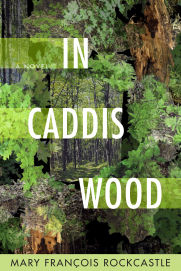
In Caddis Wood     Mary François Rockcastle     (2011)

Rockcastle 2.png

With prose that is reminiscent of the writing of Barbara Kingsolver, Mary Rockcastle takes her readers into the forests and meadows of the upper Midwest for a plaintive story of a long marriage.

Carl Fens is an architect who’s put in long hours away from his family as he’s built a stellar career. Hallie Bok has raised their twin daughters while trying to keep her hand in with writing poetry and teaching. The couple have suffered more than their share of sorrows, the details of which are revealed over the course of the novel:  the early and sudden death of Carl’s father, the departure of Hallie’s mother when Hallie is young, a near-fatal accident involving one of their daughters, the death of a son-in-law. In flashbacks from old diaries, we learn that the previous owners of the family’s bucolic retreat lost a son in the Korean War. Readers need to keep track of all these side issues as the main plot unfolds.

In this main plot, Carl, at age 61, starts exhibiting unusual and troubling neurological symptoms. As part of Hallie’s search for a diagnosis, she inadvertently brings to light a near-affair that she had ten years previously, when she and Carl were briefly estranged. Carl and Hallie have to come to terms with this revelation at the same time that they’re dealing with Carl’s deteriorating health and his major new architectural commission involving redevelopment of a toxic waste site.

The backdrop for most of the novel is the Caddis Wood of the title, a magical place in northern Wisconsin, the site of the family’s second home. Here are just two examples of Rockcastle’s lyrical descriptions:  

“[Hallie] rests her eyes on the late-summer glow of the meadow. The midday grasses are on fire: crimson bluestem, golden switchgrass, straw-colored sideoats grama. Blazing among the bronzed, stiff clusters of goldenrod and yarrow are hearty sunflowers and dogtooth daisies, coneflowers still in color. She sighs happily and drinks from her water bottle, loving the persistence of summer, the way it hangs on in the fading, somnolent heat.” (45)

“At the top of the hill overlooking Echo Pond, she gazes gratefully at the incandescent surface. Another week and the feathery larches will start to yellow, but not yet. Trees cast their shadows on the stippled surface. Water striders and whirligig beetles zigzag merrily.” (214)

A few scenes take place on Captiva Island in Florida, and this oceanside setting is also depicted lovingly: “Dozens of pelicans, more than Hallie has ever seen, are diving headfirst into the sea. When they surface, their beaks shimmer with silver, wiggling meat that is swallowed whole or spilled into the sea. Gluttonous gulls fight over the leftovers. A group of scarlet ibises land next to a crane, red legs aglow in the sunlight, and poke their long saffron beaks doggedly into the sand. The water shivers and pops as if charged with electric current.” (126)

After many heartbreaking life events, the family members in this novel still manage to treasure their time together and pursue their goals. The daughters of Hallie and Carl are named Cordelia (as in Shakespeare’s tragedy King Lear) and Beatrice (Dante’s guide through heaven in his Divine Comedy). Perhaps these names are meant to point out that, despite tragic experiences, we can all find our way to happiness.

An Accidental Thriller

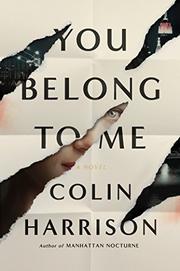
You Belong to Me     Colin Harrison     (2017)

Harrison 2.jpg

Somehow I missed the word “thriller” in the blurbs about this book. Thrillers give me nightmares, so I rarely read them. I thought that You Belong to Me was a literary novel about a map collector. Hah!

Paul Reeves, a 50-year-old collector of old maps of New York City, is indeed a central character, but his quest to acquire rare and pricey specimens is only one of several plot lines that novelist Harrison leads his readers through. Paul’s girlfriend, Rachel, has a little scheme of her own. Then there’s the story of Billy, a tough former Army Ranger from Texas navigating contemporary New York as he tries to win back his gorgeous girlfriend, Jennifer, who’s now married to someone else. That someone else is Ahmed, a prominent Iranian-American financier with relatives who came through the 1979 revolution in Iran with plenty of guerilla survival skills. And guerilla tactics are part of the arsenal of Mexican bodybuilder and hitman Hector, who also gets involved. All of these plots play out on the streets of New York, as we elbow through the lunchtime crowds in Rockefeller Center to reach Christie’s for a map auction, as we creep down a squalid back street behind a grimy weight-lifting gym, as we careen along the Belt Parkway with a murderer in pursuit.

Yes, several gruesome murders take place in the noir New York of You Belong to Me. I tried to zip through those passages quickly, lingering more over paragraphs such as this one, describing a map from 1776: “The large map showed, in stunning detail, the charming young city of New York set amid farm fields, swamps, ponds, streams, and woods, complete with harbor soundings in fathoms. Only months later, in September of that year, much of the southern tip of the city would be consumed in a ghastly fire that broke out in a bordello frequented by British sailors . . . The map also depicted the quaint little village of Brooklyn, spelled ‘Brookland’, and nearby the marshy water of Wallabout Bay . . . The map’s lines were crisp, the detail so magnificent that actual wisps of smoke from individual houses were depicted. Such beauty and precision and provenance made the map fantastically important.” (78)

The title of the novel reveals the theme that unites the narrative: possession. Paul wants to own precious maps of his beloved city. Rachel decides that Paul should belong to her and her alone. Billy and Ahmed both want to possess Jennifer. Hitman Hector wants to acquire the money that is owed to him. Watch out for that greed, New Yorkers! Colin Harrison has your number, and he punches it with impudence and sass. You Belong to Me is the proverbial page-turner, with rapid-fire action and snappy dialogue, but the characters, with all their failings and evil deeds, are strangely endearing. Read this one even if, like me, you don’t usually care for thrillers.

A Confused Hillbilly

Hillbilly Elegy: A Memoir of a Family and Culture in Crisis     JD Vance     (2016)

Vance.jpg

JD Vance’s social analysis of “hillbilly culture,” using the lens of his own life story, has been widely credited with explaining why white working-class Americans voted for Donald Trump in November 2016. Vance’s book also topped several bestseller lists in 2016, and it’s been praised by political commentators on both the right and the left. I wanted to see what all the hype was about, so I checked Hillbilly Elegy out from my local library.

Hillbilly Elegy is meant to be both a memoir and a cultural commentary. The memoir component  is an “up by the bootstraps” tale of a boy overcoming incredible odds to escape from the dying Rust Belt city of Middletown, Ohio, in the early years of the current century. Vance is raised primarily by his maternal grandparents—“Mamaw” and “Papaw” in hillbilly parlance—since his mother is a substance abuser who cycles through five husbands and innumerable short-term boyfriends. The foul-mouthed but loving Mamaw is a strong influence on the young JD; she emphasizes the importance of education and shields him from many of his mother’s violent episodes. Vance graduates from high school, joins the Marines, serves in the Iraq war, gets through college at Ohio State in record time, goes on to Yale Law School, meets a brilliant and kindly woman who becomes his wife, and ends up working for a Silicon Valley investment firm.

Despite the jerky narrative style and the many clichés in the memoir portions of this book, I was drawn to some parts of the story. Vance’s experience in the Marines, for example, is a turning point in his life: “It was in the Marine Corps where I first ordered grown men to do a job and watched them listen; where I learned that leadership depended far more on earning the respect of your subordinates than on bossing them around; where I discovered how to earn that respect; and where I saw that men and women of different social classes and races could work as a team and bond like family.” (175) He cites specific incidents that taught him how to control his temper and interact peaceably with others.

Periodically Vance inserts into his memoir paragraphs of polemic against hillbillies, in the form of disconnected soapbox orations about working-class white people in Appalachia, the South, and the Rust Belt, whose culture “increasingly encourages social decay instead of counteracting it.” (7) Throughout the book, Vance presents the tendency to explosive interpersonal reactions as one reason for the low economic status of people of his background. He asks plaintively, “How much of our lives, good and bad, should we credit to our personal decisions, and how much is just the inheritance of our culture, our families, and our parents who have failed their children? How much is Mom’s life her own fault? Where does blame stop and sympathy begin?” (231)

Vance freely admits that he doesn’t have the answers to these questions, yet he presents contradictory arguments. He rails against lazy hillbillies who are “living off of government largesse” (139), not mentioning the fact that able-bodied adults haven’t been eligible for cash welfare for more than two decades. Vance doesn’t count himself as a recipient of “government largesse” even though he’s benefited from public schools, a public university, the GI Bill, and Pell grants. He assumes that hillbillies are the only people who’ve suffered from the loss of jobs that provide a middle-class lifestyle, when the millennial children of white professionals have endured similar downward mobility.

There is no discussion of the tremendous rise in income inequality in our country, and Vance ignores the plight of non-white working-class Americans. Significantly, he fails to address racism as a factor in the bitterness of the white working-class. (For a first-hand account of this racism, I can refer you to an African American friend of mine who was raised  in the same Middletown, Ohio, as JD Vance.) There’s a constant underlying assumption in Hillbilly Elegy that white working-class hillbillies are the only Americans who grow up in poverty-stricken or violent families. And that these hillbillies are the only ones who might be nonplussed by the elitism of the Ivy League and Wall Street. It ain’t so, JD.

Vance treasures his hillbilly background and yet despises it. He hasn’t quite figured out where he stands, though he aligns himself politically with conservative Republicans. Hillbilly Elegy is an imperfect book, with far too many contradictions and generalizations and cherry-picked citations. But you may want to read it because it’s become a highly influential book in our present-day political climate of angry polarization.

The Immigrant Experience

The Leavers     Lisa Ko     (2017)

Ko.jpg

Adoption has been the subject of several books I’ve reviewed recently, including Don’t Let My Baby Do Rodeo, Celine, Leaving Lucy Pear, and The Tea Girl of Hummingbird Lane. The yearning of some adopted children to find their birth mothers—or of birth mothers to find their biological children—can be a powerful theme for a novel. Lisa Ko takes a slightly different approach to adoption, and in the process she illuminates the lives of undocumented immigrants in the United States. The immigrants in this story work long hours in difficult jobs to provide food and shelter for their loved ones. They have to make heart-rending decisions in their struggle to survive. As the dust jacket tells us, “The Leavers won the 2016 PEN Bellwether Prize for Fiction, awarded by Barbara Kingsolver for a novel that addresses issues of social justice.”

In The Leavers, Deming Guo was born in the United States, but his mother, Polly/Peilan, is an undocumented immigrant from Fujian province in China. She owes large sums to the loan shark who brought her to New York. One day when Deming is in fifth grade in the Bronx, Polly fails to return from her job at a nail salon and disappears from his life. Deming is fostered and then adopted by a well-meaning but misguided white couple in upstate New York and renamed Daniel Wilkinson. Deming/Daniel is the only Asian kid in the quiet community where he spends his teen years, and he constantly longs for his old city neighborhood and for any information about what happened to his birth mother. As novelist Lisa Ko encapsulates the problem, “If he could just talk to his mother in person, maybe he could figure out who he should be.” (270)

As Daniel moves into his twenties, he becomes involved in the music scene in New York City, as a composer and performer.  He routinely experiences synesthesia: “Never had there been a time when sound, color, and feeling hadn’t been intertwined, when a dirty, rolling bass line hadn’t included violets that suffused him with thick contentment, when the shades of certain chords sliding up to one another hadn’t produced dusty pastels that made him feel like he was cupping a tiny, golden bird.” (71) And music keeps him going when he sees no other future for himself:  “A song had a heart of its own, a song could jumpstart or provide solace; only music could numb him more thoroughly than weed or alcohol.” (258)

Polly and Daniel both have their flaws—Polly is often self-centered, Daniel develops a gambling addiction. I think that these characteristics help to keep the novel from falling into clichés. The Leavers alternates between Daniel’s side of the story and Polly’s, between New York and China, gradually revealing what happened on that day when Polly vanished. Did she take the bus to Florida, where she’d talked about relocating? Did the loan shark send her back to China? Did she leave her son (as well as her kindly boyfriend) for a new lover? Did she get hit by a truck? I won’t spoil the ending. I will say that, although the reason for Polly’s disappearance makes sense, the reason for her long-term absence from Daniel’s life doesn’t ring true for me.

However, as usual, I loved the parts of The Leavers that were set in New York City, which is beloved by Daniel:  “Daniel saw the Manhattan skyline, recognized the sketched spire of the Empire State Building, the sparkle of bridges, and from this vantage point the city appeared vulnerable and twinkling, the last strands of sunshine swept across the arches as if lulling them to sleep, painting shadows against the tops of buildings. No matter how many times he saw the city’s outline he pitched inside.” (110)

There are many kinds of “leaving” in this novel. Polly leaves China, and then she leaves her son. Daniel leaves the Bronx, but then he leaves upstate New York to return to the city. In a way, all of us are “leavers,” since we make choices in life that involve leaving other options behind.