PD James & Mysteries

Talking About Detective Fiction     PD James      (2009)

PD James, the esteemed British author of detective fiction, put together this slender nonfiction book in 2009, a few years before her death in 2014.

In it, she sweeps through the history of the genre, going back as far as Wilkie Collins’s The Woman in White (1859); taking her time with Arthur Conan Doyle (1859-1930); explaining the Golden Age of detective fiction in the period between the two world wars; and devoting a long chapter to four women writers of the twentieth century (Agatha Christie, Dorothy L Sayers, Margery Allingham, and Ngaio Marsh). James then dissects the writing process for detective fiction, examining settings, viewpoints, characters, and plots.

At the outset, she spends some time defining her subject:

“The detective story . . . is differentiated both from mainstream fiction and from the generality of crime novels by a highly organized structure and recognized conventions . . . There must be a central mystery, and one that by the end of the book is solved satisfactorily and logically, not by good luck or intuition, but by intelligent deduction from clues honestly if deceptively presented.” (9-10)

James does touch on related fiction, including thrillers, but her emphasis is on the classic works of detective fiction. She knows this subject intimately, having produced fourteen books in the Adam Dalgliesh series, two books in the Cordelia Gray series, and several standalone novels.

How does an author write a detective novel that becomes a classic? James thinks it’s primarily by creating a vivid and distinctive world that the reader can enter. Here she  comments on what are called “cozy” mysteries, set in an English village:

“Detective novelists have always been fond of setting their stories in a closed society, and this has a number of obvious advantages . . . An English village is itself a closed society, and one which, whether we live in a village or not, retains a powerful hold on our imagination, an image compounded of nostalgia for a life once experienced or imagined and a vague unfocused longing to escape the city for a simpler, less frenetic and more peaceful life.” (135-136)

I was pleased that, more than once in this book, James mentions what she calls “the fair-play rule.” This is the convention of detective fiction that the author cannot ever let the detective in the story know more about the mystery than the reader knows. For example, the author cannot have the detective step aside and speak privately with another character in a dialogue that is not revealed to the reader. Authors break the fair-play rule more often than you’d expect, and I growl whenever I see this transgression in a mystery that I’m reading.

Talking About Detective Fiction reads like you’re having a conversation with PD James, but you have the advantage of being able to flip to a discussion of a favorite author—for me, the section on Dorothy L Sayers. James presents the views of Sayers’s admirers and detractors, but she respects Sayers’s Gaudy Night as “one of the most successful marriages of the puzzle with the novel of social realism and serious purpose.” (112)

I was also eager to read James’s analysis of historical detective fiction. She finds this subgenre especially difficult for the writer, since the setting must be so carefully researched. She mentions among the successful authors of historical fiction Anne Perry and Peter Lovesey (Victorian England), Ellis Peters (medieval England), Lindsey Davis (ancient Rome), and CJ Sansom (Tudor England). Although I call the subgenre “historical mysteries,” I agree with her picks.

I wished for an index to Talking About Detective Fiction, but at least it does have descriptive chapter titles. Lovers of mysteries, especially classic British mysteries, will enjoy it.
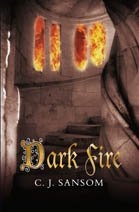
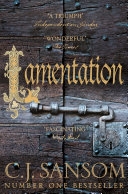
Two Tudor Mysteries

Dark Fire     CJ Sansom     (2004)     PLUS    Lamentation     CJ Sansom     (2014)

Matthew Shardlake is the subject of ridicule on two fronts. He’s a lawyer, so he’s the butt of jokes about acquisitive lawyers. And he has a hunchback, so he gets crude comments about his physical disability. He’s trying to keep up with the everyday demands of his legal practice in London, that great center of political intrigue, when a high-level government official draws him into a time-pressured investigation of a dangerous new military weapon. And it’s also the hottest summer anyone can remember.

In some ways, not a lot has changed since the year 1540.

Dark Fire is the second in the series of historical mysteries by British historian and former lawyer CJ Sansom. We’re  in Tudor England, with Henry VIII on the throne, unhappily married to the fourth of his six wives. Thomas Cromwell is his chief minister, seeking to keep both his job and his head. Our hero, Shardlake, is in Cromwell’s camp, supporting the reformer against those who want to restore Catholicism to England. But Cromwell is about to be executed, and the novelist knows that his readers know this—or if they don’t, they can read his Historical Note at the back of the book.

In first-person narrative, Shardlake takes us along on his frantic mission, twisting through the streets of London and back and forth on the mucky Thames, sweating profusely and reeling from the reek of rubbish and ordure. He’s pretty peeved that Cromwell has coerced him into taking this dangerous assignment, by helping him on an unrelated criminal case. Shardlake is also terrified by the numerous attempts on his life; his many narrow escapes do become implausible, but mysteries are often like that. The book has numerous sub-plots, as Shardlake tries to satisfy Cromwell’s demands, carry on with his own legal cases, maintain his household, and possibly pursue romance.   

The mysterious weapon, Dark Fire or Greek Fire, is a petroleum-based liquid that’s propelled out of a metal device to quickly engulf a target in flames. As an ethical man, Shardlake is conflicted about the moral implications of the use of Dark Fire. His pursuit of the formula and of the flame-throwing equipment sends him into the secretive and fantastical world of Renaissance alchemy—a tough place for a man of logic and reason to find himself.

The cast of characters in Dark Fire is large, including both historical and fictional people, and corruption among the court toadies is rampant. Through the diverse characters he creates, the novelist explores Tudor-era prejudices that still trouble humankind: anti-Semitism, Islamophobia, disability discrimination, and intra-religion persecution. His treatment of these issues blends into his narrative, so it doesn’t come off as heavy-handed.

I was surprised to see Sansom’s fairly positive portrayal of Thomas Cromwell in this novel. Dark Fire was published five years before Hilary Mantel’s award-winning novel Wolf Hall (2009) rescued Cromwell from the opprobrium of history with a detailed portrait of his rise to power. Mantel and Sansom both seem to be saying that history should not be reduced to simplistic good-guys-vs-bad-guys pronouncements. The historical figure Thomas Cromwell and the fictional character Matthew Shardlake are juggling a dozen balls at once, struggling to stay alive, to build their personal careers, and to act for the good of the nation.

Since Dark Fire was such a fine historical mystery, I decided to read the most recent volume in Sansom’s series, Lamentation. This sixth installment of the Shardlake stories is a slower read than Dark Fire, and it wades deeper into religious and political controversies. I relish the dissection of dogmas and doctrines in Tudor England, but if you aren’t interested in the Tudors’ ever-shifting definition of “heresy,” you may find Lamentation somewhat dismal.

The mystery in Lamentation centers on a possibly heretical religious book, handwritten by the queen and stolen from a locked chest in her private chambers. The queen is Catherine Parr, Henry VIII’s sixth and last wife, who must get nervous in the night about the fact that four of her five predecessors were either divorced or beheaded by Henry. Queen Catherine calls upon our hero, Matthew Shardlake, to make discreet inquiries to find the secret book, to keep her from burning at the stake.

The queen’s book did actually exist, but its theft is fictional, as are the ensuing murders and escapades in taverns and dungeons and wherries all over London town. As in Dark Fire, most of the characters in Lamentation have been invented by Sansom. The pleasures of this novel lie in the interaction of the fictional characters with actual figures in Henry VIII’s court during the final year of the king’s life, 1546-1547. Throughout the text, Sansom points gently to the chaos that we know is waiting at the door when Henry dies: the throne passing to his underage son, King Edward VI (Protestant), then to his daughter Queen Mary I (Catholic), then to his daughter Queen Elizabeth I (Protestant). Sansom even gets in a few non-explicit predictions about the execution of King Charles I, which will occur a century later.

Sansom’s historical references are, to my knowledge, accurate, and only a very few anachronisms of speech creep in to his dialogue. The subplots are engaging, and the scenes of sixteenth-century London, in both the palace and the gutters, are constructed well. So if you like wallowing in convoluted royal intrigue, jump right in.

Here are all the books in CJ Sansom’s Matthew Shardlake series so far: Dissolution (2003), Dark Fire (2004), Sovereign (2006), Revelation (2008), Heartstone (2010), Lamentation (2014).

This book review is a bonus Sunday post!

Manhattan 1952/2016

The Dollhouse     Fiona Davis     (2016)

By chance, I’ve been reading and reviewing a number of novels set in New York City lately. If you’re weary of fictional trips to Manhattan, you may want to skip to another blog post. If you’re up for one more saunter down those fabled sidewalks, here we go.

In The Dollhouse, Fiona Davis jumps back and forth between the years 1952 and 2016 to draw fictional portraits of women who live in the same building in New York City, separated by sixty-four years. The building, depicted on the book’s cover, is real. The Barbizon Hotel for Women, built on the Upper East Side in 1927, was home to generations of young females pursuing careers as editors, models, and secretaries. After the hotel was converted to condos in 2005, one floor was set aside as rent-controlled apartments for long-time residents, and this is where 1952 meets 2016.

Darby McLaughlin is the main 1952 character, fresh out of high school and freshly arrived at the Barbizon from Defiance, Ohio, to attend the famed Katherine Gibbs Secretarial School, with tuition paid by her deceased father’s life insurance proceeds. The innocent and awkward Darby gets caught up in a plot of sex, drugs, and bebop, centering around a sleazy jazz club.

Rose Lewin is the main 2016 character, a former local television news star in her mid-thirties, now working for an Internet news startup. At the beginning of the novel, the sophisticated and savvy Rose is living in her boyfriend’s condo in the Barbizon. She’s soon facing both personal and professional crises, as she decides to research and write about the octogenarian women in the Barbizon, who came of age in a distant, almost mythical, era.

The narrative of The Dollhouse is slow to accelerate. I looked forward to the 2016 chapters as I cringed my way through the 1952 chapters, in which Darby is ridiculed and deceived by her hallmates at the Barbizon. The pace picks up when the modern-day Rose becomes obsessed with the events of 1952 and unlayers a key mystery, using reportorial tactics that she knows are unethical.

Darby and Rose are convincing characters, as are several of the supporting cast. The descriptions of Rose’s boorish young boss, Tyler, are trenchant. In one meeting with Rose, “he held a pen under his nose as if it were a mustache, curled up his lip to support it without any hands.” Tyler performs this maneuver while making misogynist comments about Rose’s writing project. Less successful is the depiction of Jason Wolf, a potential love interest for Rose. Jason appears in the story too fortuitously and is too much of a hunk.

Sylvia Plath keeps popping up in The Dollhouse, too. She actually lived at the Barbizon during the summer of 1953 when she was an intern in New York City, and she refers to the hotel in The Bell Jar. This association becomes a running joke in The Dollhouse, as Rose assures one interviewee after another that she is not writing another story about Plath.

The Barbizon itself has a central role in The Dollhouse, titled for the name that young men in New York presumably gave the building back in the day. It’s possible that Fiona Davis chose her title also as an echo of Ibsen’s The Doll’s House, the controversial 1879 drama about the place of women in the home and in society. Davis wades in to the continuing controversy. Is Rose too dependent on the approval of the men in her life? Does Darby make too many sacrifices for the men (and women) in hers? Are teenaged girls always a little crazy? Can their fathers rescue them with (a) kindness or (b) tough love? Are 2016 women different from 1952 women in substance or only in terminology? And is their place in American society really much different?