Old Money, New Money

Sons and Daughters of Ease and Plenty   Ramona Ausubel     (2016)

Ramona Ausubel seems to have several goals for her novel Sons and Daughters of Ease and Plenty. She’s trying to explain what it feels like to be a rich kid who’s not comfortable with riches. She’s narrating a deep love between an Old Money kid and a New Money kid, contextualizing them in their families. She throws in a Great American Road Trip. There are some off the wall sub-plots, like the re-enactments of pre-Columbian Native American life. And there are the quirky elements, like the character who’s a giant, and the fawn that happens to die in a suburban back yard at a critical point in the plot.  
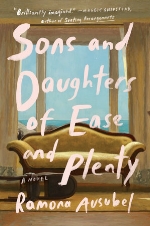
Fern and Edgar Keating and their three children are closing out a wonderful summer at their beach house on Martha’s Vineyard, all shimmering seas and sandy toes and billowing sails. Suddenly, they receive news that Fern’s Old Money, on which they live lavishly, is totally gone. Fern and Edgar have always hated the money; Edgar has even written an anti-capitalist novel. But they know of no other way to survive. Each freaks out in a separate way, but the consequence is that they unintentionally leave their nine-year-old daughter and six-year-old twin sons alone in their huge brick Colonial house in Cambridge, Massachusetts, for several days.

If you think that this sounds like the 1990 Christmas movie Home Alone, you’re right. But it’s a little more believable because the year is 1976, when kids walked to school by themselves and wandered their neighborhood by themselves.

The novel shifts back and forth between the 1976 existential family crisis and the period 1965-1970, when Fern and Edgar met, fell in love, and dealt with the Vietnam War. For Americans who came of age during that war, all aspects of life were shaped by the draft notices, the transport planes to Southeast Asia, the flag-draped coffins on the nightly news, the maneuvering of exemptions for a few, the protests, the beleaguered veterans.

Although Ausubel gets much of the Vietnam-era tone right, she falters on the details. As just one example, in 1966, Fern’s brother, Ben, could have had an exemption from the draft for attending college. Everyone knew this, and any male high-school graduate even marginally qualified for college enrolled. Nervous parents, especially wealthy ones, made sure of this. If an author creates a fictional universe, historical fact doesn’t have to be part of the game. But if an author anchors her story in an actual universe, wrong details are jarring.

I appreciate the magic realism in Ausubel’s tale. After all, the wealthy can seem permanently glittered over with fairy dust. But the mysterious appearances of pie slices at many roadside diners can seem forced in a plot that’s grounded in quotidian family life. And Ausubel doesn’t wrap up a number of sub-plot forays. What really happened with that kiss in the darkened girls’ bathroom? Did Edgar go back to the family business or not? Did anybody call Animal Control about that dead fawn in the back yard? 

Ausubel has some lovely metaphors, tossed off seemingly casually. And her descriptors—of window molding or hair style or suit jacket—are apt but always spare enough to keep the plot bounding along. I turned the 306 pages with enthusiasm, anxious to know what happened to Fern and Edgar and the gang. In the end, though, this good novel lacked the full power that I think Ausubel was capable of.  
Two Tudor Mysteries

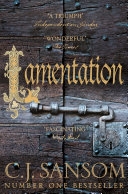
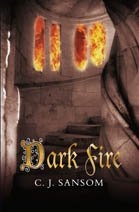
Dark Fire     CJ Sansom     (2004)     PLUS    Lamentation     CJ Sansom     (2014)

Matthew Shardlake is the subject of ridicule on two fronts. He’s a lawyer, so he’s the butt of jokes about acquisitive lawyers. And he has a hunchback, so he gets crude comments about his physical disability. He’s trying to keep up with the everyday demands of his legal practice in London, that great center of political intrigue, when a high-level government official draws him into a time-pressured investigation of a dangerous new military weapon. And it’s also the hottest summer anyone can remember.

In some ways, not a lot has changed since the year 1540.

Dark Fire is the second in the series of historical mysteries by British historian and former lawyer CJ Sansom. We’re  in Tudor England, with Henry VIII on the throne, unhappily married to the fourth of his six wives. Thomas Cromwell is his chief minister, seeking to keep both his job and his head. Our hero, Shardlake, is in Cromwell’s camp, supporting the reformer against those who want to restore Catholicism to England. But Cromwell is about to be executed, and the novelist knows that his readers know this—or if they don’t, they can read his Historical Note at the back of the book.

In first-person narrative, Shardlake takes us along on his frantic mission, twisting through the streets of London and back and forth on the mucky Thames, sweating profusely and reeling from the reek of rubbish and ordure. He’s pretty peeved that Cromwell has coerced him into taking this dangerous assignment, by helping him on an unrelated criminal case. Shardlake is also terrified by the numerous attempts on his life; his many narrow escapes do become implausible, but mysteries are often like that. The book has numerous sub-plots, as Shardlake tries to satisfy Cromwell’s demands, carry on with his own legal cases, maintain his household, and possibly pursue romance.   

The mysterious weapon, Dark Fire or Greek Fire, is a petroleum-based liquid that’s propelled out of a metal device to quickly engulf a target in flames. As an ethical man, Shardlake is conflicted about the moral implications of the use of Dark Fire. His pursuit of the formula and of the flame-throwing equipment sends him into the secretive and fantastical world of Renaissance alchemy—a tough place for a man of logic and reason to find himself.

The cast of characters in Dark Fire is large, including both historical and fictional people, and corruption among the court toadies is rampant. Through the diverse characters he creates, the novelist explores Tudor-era prejudices that still trouble humankind: anti-Semitism, Islamophobia, disability discrimination, and intra-religion persecution. His treatment of these issues blends into his narrative, so it doesn’t come off as heavy-handed.

I was surprised to see Sansom’s fairly positive portrayal of Thomas Cromwell in this novel. Dark Fire was published five years before Hilary Mantel’s award-winning novel Wolf Hall (2009) rescued Cromwell from the opprobrium of history with a detailed portrait of his rise to power. Mantel and Sansom both seem to be saying that history should not be reduced to simplistic good-guys-vs-bad-guys pronouncements. The historical figure Thomas Cromwell and the fictional character Matthew Shardlake are juggling a dozen balls at once, struggling to stay alive, to build their personal careers, and to act for the good of the nation.

Since Dark Fire was such a fine historical mystery, I decided to read the most recent volume in Sansom’s series, Lamentation. This sixth installment of the Shardlake stories is a slower read than Dark Fire, and it wades deeper into religious and political controversies. I relish the dissection of dogmas and doctrines in Tudor England, but if you aren’t interested in the Tudors’ ever-shifting definition of “heresy,” you may find Lamentation somewhat dismal.

The mystery in Lamentation centers on a possibly heretical religious book, handwritten by the queen and stolen from a locked chest in her private chambers. The queen is Catherine Parr, Henry VIII’s sixth and last wife, who must get nervous in the night about the fact that four of her five predecessors were either divorced or beheaded by Henry. Queen Catherine calls upon our hero, Matthew Shardlake, to make discreet inquiries to find the secret book, to keep her from burning at the stake.

The queen’s book did actually exist, but its theft is fictional, as are the ensuing murders and escapades in taverns and dungeons and wherries all over London town. As in Dark Fire, most of the characters in Lamentation have been invented by Sansom. The pleasures of this novel lie in the interaction of the fictional characters with actual figures in Henry VIII’s court during the final year of the king’s life, 1546-1547. Throughout the text, Sansom points gently to the chaos that we know is waiting at the door when Henry dies: the throne passing to his underage son, King Edward VI (Protestant), then to his daughter Queen Mary I (Catholic), then to his daughter Queen Elizabeth I (Protestant). Sansom even gets in a few non-explicit predictions about the execution of King Charles I, which will occur a century later.

Sansom’s historical references are, to my knowledge, accurate, and only a very few anachronisms of speech creep in to his dialogue. The subplots are engaging, and the scenes of sixteenth-century London, in both the palace and the gutters, are constructed well. So if you like wallowing in convoluted royal intrigue, jump right in.

Here are all the books in CJ Sansom’s Matthew Shardlake series so far: Dissolution (2003), Dark Fire (2004), Sovereign (2006), Revelation (2008), Heartstone (2010), Lamentation (2014).

This book review is a bonus Sunday post!

Manhattan 1952/2016

The Dollhouse     Fiona Davis     (2016)

By chance, I’ve been reading and reviewing a number of novels set in New York City lately. If you’re weary of fictional trips to Manhattan, you may want to skip to another blog post. If you’re up for one more saunter down those fabled sidewalks, here we go.

In The Dollhouse, Fiona Davis jumps back and forth between the years 1952 and 2016 to draw fictional portraits of women who live in the same building in New York City, separated by sixty-four years. The building, depicted on the book’s cover, is real. The Barbizon Hotel for Women, built on the Upper East Side in 1927, was home to generations of young females pursuing careers as editors, models, and secretaries. After the hotel was converted to condos in 2005, one floor was set aside as rent-controlled apartments for long-time residents, and this is where 1952 meets 2016.

Darby McLaughlin is the main 1952 character, fresh out of high school and freshly arrived at the Barbizon from Defiance, Ohio, to attend the famed Katherine Gibbs Secretarial School, with tuition paid by her deceased father’s life insurance proceeds. The innocent and awkward Darby gets caught up in a plot of sex, drugs, and bebop, centering around a sleazy jazz club.

Rose Lewin is the main 2016 character, a former local television news star in her mid-thirties, now working for an Internet news startup. At the beginning of the novel, the sophisticated and savvy Rose is living in her boyfriend’s condo in the Barbizon. She’s soon facing both personal and professional crises, as she decides to research and write about the octogenarian women in the Barbizon, who came of age in a distant, almost mythical, era.

The narrative of The Dollhouse is slow to accelerate. I looked forward to the 2016 chapters as I cringed my way through the 1952 chapters, in which Darby is ridiculed and deceived by her hallmates at the Barbizon. The pace picks up when the modern-day Rose becomes obsessed with the events of 1952 and unlayers a key mystery, using reportorial tactics that she knows are unethical.

Darby and Rose are convincing characters, as are several of the supporting cast. The descriptions of Rose’s boorish young boss, Tyler, are trenchant. In one meeting with Rose, “he held a pen under his nose as if it were a mustache, curled up his lip to support it without any hands.” Tyler performs this maneuver while making misogynist comments about Rose’s writing project. Less successful is the depiction of Jason Wolf, a potential love interest for Rose. Jason appears in the story too fortuitously and is too much of a hunk.

Sylvia Plath keeps popping up in The Dollhouse, too. She actually lived at the Barbizon during the summer of 1953 when she was an intern in New York City, and she refers to the hotel in The Bell Jar. This association becomes a running joke in The Dollhouse, as Rose assures one interviewee after another that she is not writing another story about Plath.

The Barbizon itself has a central role in The Dollhouse, titled for the name that young men in New York presumably gave the building back in the day. It’s possible that Fiona Davis chose her title also as an echo of Ibsen’s The Doll’s House, the controversial 1879 drama about the place of women in the home and in society. Davis wades in to the continuing controversy. Is Rose too dependent on the approval of the men in her life? Does Darby make too many sacrifices for the men (and women) in hers? Are teenaged girls always a little crazy? Can their fathers rescue them with (a) kindness or (b) tough love? Are 2016 women different from 1952 women in substance or only in terminology? And is their place in American society really much different?

Tasting the Moon with Chabon

Moonglow     Michael Chabon     (2016)

With a review of a work by Michael Chabon, it’s difficult to avoid gushing out superlatives. Bare superlatives, however, don’t give the readers of the review a taste of the specific delicacies that are on offer in the writing. And Moonglow has many delicious bites.

It’s not a spoiler if you know that the Michael Chabon who is the narrator of Moonglow is fictional and is not the same as the Michael Chabon who is the author of the novel. And Moonglow is truly a novel, though it’s set up as an autobiographical and biographical memoir. Chabon-the-author is expert at inducing you to believe that the fiction he’s creating is really the reconstructed history of his family.

In recent interviews, Chabon-the-author has made it clear that he’s used only brief incidents from his family history as sites from which he has leapt into the fictional worlds of Moonglow. He prefaces the book with a tongue-in-cheek “Author’s Note” in which he disclaims veracity for the “facts” he presents. But as a reader of Moonglow you keep wanting to believe that Chabon-the-narrator is Chabon-the-author, against all this evidence.

The underlying premise of Moonglow is straightforward. In 1989, Chabon-the-narrator sat at the bedside of his dying grandfather as the grandfather spoke about events of his life. He was a daredevil kid in Philadelphia, an engineer with tremendous inventive capacity, an intelligence officer in Europe at the tail end of World War II, an inmate in a minimum security prison in New York State in the 1950s, a snake-hunting retiree in Florida. The grandfather (who never has any other name in the novel) was passionately in love with his wife, a Jewish French refugee ravaged by the Holocaust, whom he met in 1947. The story of this grandmother weaves in and out of the novel about the grandfather.

As with Chabon’s  Pulitzer-winning The Amazing Adventures of Kavalier and Clay (2000), World War II hangs menacingly over the characters. Having wedged his grandfather in to the Allied mop-up operations in Germany in 1945, Chabon-the-author can explore alternate realities that never made it into the history books. What if, for example, a Jewish American officer with extensive knowledge of rocketry were to capture Nazi rocket scientist Wernher von Braun? What if that officer were to uncover the trove of documents revealing the secrets of the V-2 rocket?

Speculative history is a specialty of Chabon-the-author, most notably executed, I think, in The Yiddish Policemen’s Union (2007). In that novel, the alternate history is set up when Jews from around the world establish a homeland in Sitka, Alaska, in the 1940s, and the tale plays out for the next sixty years.

Jewish identity is a key theme for Chabon-the-author, but I see other themes also echoing through his writing: the malleability of fact, the raw beauty of the everyday, the strength of the human spirit in the face of evil (in other people or in the international order). A trademark stylistic device of his that I especially admire is what I call his “extended list,” in which he ranges through all the possibilities of a situation. Here he’s describing sleeping conditions for soldiers in war-torn Europe:

“My grandfather had shared all manner of billets: with dogfaces and officers, in misery and in comfort, in attack and in retreat, and pinned down by snow or German ordnance. He had bedded down under a bearskin in a schloss and in foxholes flecked pink with the tissue of previous occupants. If an hour’s sleep were to be had, he seized it, in the bedrooms or basements of elegant townhouses, in ravaged hotels, on clean straw and straw that crawled with vermin, on featherbeds and canvas webbing slung across the bed of a half-track, on mud, sandbags, and raw pine planks.”

Mimicking the discursive flow of reminiscence, Moonglow see-saws through the life of the grandfather, constantly shifting time and place, occasionally returning to the 1989 scene of the grandson feeding Jello to the dying man. Chabon-the-narrator does not set down his grandfather’s words verbatim but rather casts the episodes he recounts in third person. This technique allows Chabon-the-author to insert astonishing detail. One of my favorite scenes has the grandfather, who does not usually observe religious rites, stopping at a Reform temple on a Friday to pray the kaddish, the prayer of mourning. The congregation is housed in a building that was formerly an International House of Pancakes. As the service goes on, the grandfather feels distant from the other worshipers:

“They might have been strangers in a bus station, solo travelers bound for all points. They might have been separate parties at a pancake house, awash in the syrup emerging from a Wurlitzer organ, played by an old Jew with a Shinola-black pompadour, dressed in a curious tan coverall or jumpsuit and platform saddle shoes.”

Oh, that’s just a taste. You should savor the entire book.

Proulx and the Forest

Barkskins     Annie Proulx     (2016)

In the year 1693, we meet the original “barkskins” of Annie Proulx’s gigantic novel.  René Sel and Charles Duquet are poor young Frenchmen who take their chances in agreeing to cross the Atlantic and serve for three years as loggers in return for a promise of land of their own. Arriving in the maritime regions of New France (now Canada), René and Charles are stunned by the brutal weather, the vicious mosquitoes, and the virgin forests of unimaginable magnitude.

Proulx.jpg

The two axe-wielders take divergent paths in the wilderness. René Sel sticks with his backbreaking job, reluctantly marries a native Mi’kmaq woman, and dooms his descendants to lives of hard labor in the forests to which they are constantly drawn. The Sel family gets stuck in a racial borderland between European and indigenous cultures and never thrives.

Charles Duquet, however, quickly abandons the tree felling and makes his fortune, first in furs and then in lumber, changing his name to Duke along the way. Charles is the consummate shark, founding a dynasty and a business empire.

Over the three hundred years that Proulx follows these two fictional families, both the Dukes and the Sels exploit the forests—the Dukes through land deals and the Sels by actually chopping down tree after tree after tree. The branches of their families occasionally brush against each other. (The characters are so numerous that I needed to flip frequently to the genealogical charts at the back of the book.) Sometimes Proulx pauses and develops a character in depth. At other times she tosses out names and moves on with her plot.

In the end, the main character of Barkskins is the forest—that vast forest that stretches across much of the North American continent at the beginning of the book. Although the species vary as the barkskins and lumber barons move westward, clearing the land, I think Proulx sees all the trees of North America as part of one mystical body. She’s at her most eloquent in describing this character.

When the surveyors in her story get to what will become the state of Michigan, they find sugar maple, beech, yellow birch, oak, hickory, pine, hemlock, spruce, and fir in forests so dense that the paths of the Native Americans are almost impossible to follow. The huge diameters of the trees are a challenge to the technology of the period. I pored over the descriptions of my home state’s trees, in awe of Proulx’s rich language.

She is, in effect, writing a eulogy for the North American forest, which has become a victim of human depredation, part of a global destruction of the environment. As Proulx takes us through the centuries, we see the respect that native hunter-gatherer societies had for the natural world give way to the Europeans’ demands for tillable land and space for cities. Feeding and housing hordes of immigrants increasingly take priority. The forest sighs, weeps, groans, and dies.

The human toll exacted by the felling of those hundreds of millions of trees is not ignored by Proulx. Gruesome deaths, either directly or indirectly related to the timber industry, abound. I found these deaths difficult to stomach; picture the possibilities with axes, lumber mill saws, huge jams of logs rolling through river rapids, and the menacing branches of toppling trees.

This is a glorious but tragic novel, a moral statement about the failure of humans to be stewards of our planet’s abundance. Yes, Proulx’s ending is weak, her narrative seeming to dwindle like the forest itself. In 1693 no one could imagine that the North American forest would ever end. The tragedy that Proulx documents is not one cataclysmic event that's easily recognized. Rather, it’s the loss of one tree after another, until the forest is gone.

Conroy, a Poetic Prince

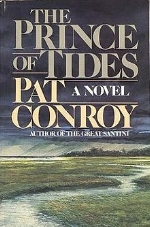
The Prince of Tides      Pat Conroy  (1986)

When Pat Conroy died in March 2016, I ran across many heartfelt tributes to his writing. I felt guilty. How had I missed reading an author so beloved by so many readers?

With a few clicks, I figured it out. Conroy wrote about the American South and about the experience of being a male Southerner who was subjected to brutality in both family and school environments. I find much fiction about the South painfully depressing. In high school, when Carson McCullers was assigned, I ate up The Heart is a Lonely Hunter but then had nightmares for weeks. Heretical as it sounds, I’ve never been enthralled by William Faulkner or Flannery O’Connor.

I decided, however, to give the South another chance by reading Conroy’s The Prince of Tides. It took me several days, since this is a long—and longwinded—novel. I kept thinking how some of the lengthy dialogues could have been edited down considerably without diluting the power of the story. The narrative is complex, certainly, and I was willing to follow it to the end, but I was tempted to skip entire sections just to get on with the plot.

Briefly, that plot follows about forty years in the lives of the three Wingo siblings, who were born in the South Carolina sea islands during World War II. Their father is a successful shrimper who wastes all his earnings on get-rich-quick schemes. He flies into rages and beats his wife and children. That’s the least of the horrors that the Wingo kids endure. Slowly, very slowly, the reader gets the full picture as Tom Wingo, the first-person narrator, explains the family history to a psychiatrist who’s treating his suicidal sister, Savannah, in New York City in the early 1980s.

Despite the hundreds of scenes in this novel that feature Tom Wingo, I didn’t ever grasp his personality in full. Tom is a jokey guy, often spouting self-deprecating retorts and constantly whining about male Southerners with a grim fatalism. He reads widely and finds fulfillment in coaching adolescents in sports. But when he opens his mouth, ridiculous statements spew out.  I never figured out Tom’s mother, either. Is her repeated repression of trauma a form of abuse or of self-preservation or both? Does she exploit or regret her renowned beauty? Isn’t Conroy’s portrait of her as a young mother inconsistent with his portrait of her as an older woman? And Tom describes his brother, Luke, as a hero who’s much larger than life, which is perhaps Conroy’s way of showing how much Tom worshiped Luke.

All that aside, I found much to admire in The Prince of Tides. Conroy’s vocabulary is enormous, and his words are deployed to great effect in evoking the fragile glories of the semitropical saltwater marshes of the South Carolina coast. He tosses off striking metaphors with ease and moves actions forward with powerful verbs. He doesn’t use an ordinary noun when a fanciful one can be found; a song becomes a “canticle,” which will be the exactly right term for that sentence. The smells of the Low Country fishing industry often have metallic descriptors that succeed in recreating the place. The flora and fauna thriving in the thick, humid atmosphere are portrayed with particularity and reverence.

Conroy gives his character Savannah Wingo the vocation of poet, and he seems to envy the way Savannah can transform the stories of her troubled youth into paeans for a disappearing way of life. You can read The Prince of Tides if you want a sprawling Southern melodrama. I read The Prince of Tides for the poetry of the language.