Millennials vs Boomers

Boomer1     Daniel Torday     (2018)

Torday.jpg

The hard-driving music, the hand-rolled joints, the idiosyncratic clothing, the privileged youth in prosperous times, the disillusionment with war that their elders got them into: it’s the Baby Boomers, right? Well, those descriptors could also be applied to the Millennial generation, except that Millennials might call those smokes “spliffs.”  

Daniel Torday’s deeply satirical novel pits the Boomers against the Millennials in the aftermath of the Great Recession of 2008. It’s not clear whether the Boomers or the Millennials come out worse in his view, which is a very dark view.  

Millennial Mark Brumfeld has an editorial job in New York City and a PhD in English under his belt. He and  his girlfriend, Cassie Black, both play in bluegrass bands, groovin’ to retro tunes by the Louvin Brothers, Bill Monroe, and Ralph Stanley. When Mark’s career and relationship both fall apart, he has to move to his parents’ basement in Baltimore. He vents his rage against the economic machine in videos that he posts on the Dark Web, ranting about how the Baby Boomers have had all the luck and now refuse to retire to allow Millennials to secure jobs. Mark styles himself as “Boomer1,” even though he was born in 1980 (go figure). His ominous online mantras include “Retire or we’ll retire you” and “boom boom.”  

Some sections of this novel are presented from Mark’s viewpoint and other sections follow Cassie as she figures out her sexual orientation and her career trajectory. The main Boomer character is Julia, Mark’s mother, who was a musician on the fringes of stardom back in the late 1960s. She gets her chapters, too, sometimes flashing back forty years, but these chapters do not pack the power of the rest of the novel. The plot gets hot when Mark’s anti-Boomer videos spark a nationwide revolution among Millennials, leading to vandalism and violence against prominent Boomers and against the institutions that support them. 

I think that many of the Boomers do deserve blame for abandoning the causes of civil rights and pacifism that characterized their heyday in the 1960s. After the protest marches, the Boomers graduated, put on the suits, joined the establishment, and inherited money from the Greatest Generation. The Boomers could afford to buy houses because they had little or no student loan debt. And they spoiled their kids, the Millennials, nodding in agreement as those kids followed their dreams, however impractical. I understand the Millennial anger, expressed here by Boomer1 in portraying his parents’ generation: “They were not the purveyors nor the architects nor the executors of the noble task nor the players in the great game. They were the recipients of the spoils, and they basked in it. They received the signifier but not the sign, they were the first generation to have fall in their lap all the lucre without exerting one iota of the toil.” (112)  

However, novelist Torday liberally inserts indicators of ambivalence and incongruity into his characterizations and into his narrative. Both Mark and Cassie, for example, have alternate names. Cassie was born Claire Stankowitcz. Mark, in addition to his Boomer1 handle, calls himself “Isaac Abramson,” the biblical figure led to ritual sacrifice by his father. For all his education, Mark makes foolish financial choices that exacerbate his situation. (He thought he could get a tenure-track academic job in English? Really? That’s been a long shot since the 1970s.) Meanwhile, Cassie exploits the burgeoning world of banal digital news while she reveals Mark’s naiveté and the oversimplification of his anti-Boomer crusade. Symbols are also tossed around. Mark’s Boomer mother, Julia, had her hearing damaged in those amped-up rock concerts of yore and refuses to wear a hearing aid for her increasing deafness, so she truly can’t hear what Mark is saying about the Boomers.  

Boomer1 is an enigmatic novel, with no clear heroes or villains. Torday will challenge your assumptions and stereotypes with his well-paced and thoughtful novel.

Quiet Conflict

Upstate     James Wood     (2018)

Wood J.jpg

The British-born writer James Wood, transplanted to the United States, has produced a novel about a British businessman visiting his adult daughter in upstate New York. Commentary on the differences between the two countries is inevitable. Here are a couple of the observations of the character Alan Querry:  

  • “He did sincerely love—and rate as one of the great American contributions—the phrase ‘Take it easy.’ . . .That benign blessing wouldn’t catch on in Britain, where the pavements were sopped with cold rainwater and everyone seemed to have attended queuing school, to learn how to do it with the requisite degree of resigned submission.” (27)

  • “America was peculiar, more foreign than he had expected, it sharpened his senses. What a contradictory place: for every limitation, there was an expansion, for every frustration, an easement. The train was absurd, trundling along at barely sixty miles an hour. And Penn Station was a bloody embarrassment to a great capital city. To a great city, rather.” (51)

These are the contexts of the novel, which revolves quietly around family conflict. Alan’s 2007 trip to Saratoga Springs, New York, arises from his concern over the mental health of his daughter Vanessa, who teaches philosophy at Skidmore College. Traveling with Alan is his other daughter, Helen, a harried and hurried music executive with Sony in London. The fourth main character is Josh, Vanessa’s boyfriend, who has alerted Vanessa’s father and sister to a potentially serious bout of depression that Vanessa seems to be suffering. Although the stated issue is Vanessa’s health, Helen isn’t in great shape either, with a rocky marriage, twin sons whom she has little time for, and an urge to leave Sony and start her own company.

This is a novel to be savored for its simplicity and its glimpses into the minds of people sincerely endeavoring to help each other, though with approaches determined by the personality of each. Alan, for example, is a real estate developer who is “not in the top tier, probably not even in the second or third tier” (119) of developers in his region because he’s not cutthroat enough. Vanessa views her father and sister as “proud, impulsive people who considered themselves largely modest and rational.  . . .Vanessa hated confrontation—partly because she couldn’t believe that anyone who had strongly argued with her could ever like her again.” (153) The underlying motives of the boyfriend Josh are elusive until the very end of the novel.

The landscapes of upstate New York are richly portrayed in this work that sometimes verges into prose poetry. But don’t expect bedazzlement or sensationalism when you’re going to be served thoughtfulness.


Reckoning with the Past

My Ex-Life     Stephen McCauley     (2018)

This novel is hilarious. One-liners, often capping a narrative paragraph or a conversation, pop up on nearly every page: “Julie knew only one man who’d betrayed his marriage for a woman older than his wife, and it was overstating it to say she knew Prince Charles.” (3)

Short descriptors of characters pack a punch with clever comparisons:

  • “She had the melancholy, elongated beauty of a Modigliani, while he had the compact boyishness of a high school wrestler.” (49)

  • “She had the hard face of someone who could stand to eat a cupcake once or twice a year.” (266)

  • “He had a dark suntan, an attractive affectation, but one that these days looked somehow vintage, like a dial telephone or an electric carving knife.” (266)

Beyond the hilarity, Stephen McCauley spins a touching story of missed opportunity, unfair betrayal, loss of dignity, and cynical exploitation—all with hopes for second chances, or maybe even third chances.

Fifty-something David Hedges is a freelance college admissions consultant for sulky rich kids in San Francisco. As the book opens, his lover has deserted him, and in his distress he’s been putting on weight. The charming carriage house that he’s rented for years at a low rate is being sold out from under him. As if all this isn’t enough, he gets a call from his ex-wife, Julie Fiske, who lives in a seaside tourist town north of Boston. David hasn’t been in touch with Julie for decades, and he figured that she was doing well with her second husband and teenage daughter. Not so much. Julie’s husband has left her for a younger woman and is demanding that she buy him out of their house. Julie’s income as a teacher won’t stretch to this purchase, but she’s desperate to stay in the house where her daughter has grown up. Oh, and the daughter, Mandy, is struggling with body image issues and with loneliness that is leading to highly questionable friendships.

David takes a trip east, ostensibly to help Mandy with her college applications but actually to get away from San Francisco and to get some perspective on his own path forward. The resolution of this plot setup has a number of twists and revelations of secrets, as does real life. Novelist McCauley keeps churning out the funny lines, but he ends My Ex-Life on a nostalgic note that gave me a good sense of resolution. 

Evangelical Secrets

The Book of Essie     Meghan MacLean Weir     (2018)

Weir.jpg

Given the prevalence of news stories about sexual abuse of children, women, and young men by priests in the Catholic Church, we may fall into the assumption that such abuse does not occur very much in Protestant evangelical religious groups. This novel is here to remind us that, wherever there is a great imbalance of power in a relationship, the potential for abuse of all kinds exists, and cover-ups that prolong the agony of the victims are certainly not limited to church hierarchies operating behind the closed doors of Catholic bishops’ offices.

The story of Esther (“Essie”) Hicks seems transparent. She’s one of the stars of the long-running fictional reality TV show Six for Hicks, which has chronicled the career of a preacher father (Jethro), a scheming mother (Celia), and their six children since before Essie’s birth. Essie is the youngest member of the family, and now, at age 17, she finds herself pregnant. Since it’s clear that her daily activities are tightly circumscribed and often filmed, readers suspect early on that the pregnancy is unlikely to have been the result of a consensual relationship.

 We hear from three characters in turn, in first-person narrative:

  • Essie Hicks;

  • Roarke Richards, a male student at Essie’s high school who is not really part of the Hicks religious group; and

  • Liberty (“Libby”) Bell, who herself grew up in a different ultra-conservative millennarian cult and is now a journalist reporting on Essie.

Essie seems to have an elaborate plan to escape her family and provide financial security for herself and her unborn child, drawing on the significant resources generated for her parents by the TV show and by her father’s ministry. “Don’t get mad, get even,” she says at one point (131), as she remains improbably calm. However, the specifics of Essie’s plan are not revealed, even though readers hear directly from her throughout the novel. A lot is left to guesswork, and that keeps those pages turning. I was especially fascinated by the background details offered by the novelist, such as the phrasing used by the evangelicals in their conversations. Perhaps this was because I was brought up in a similar fundamentalist environment—though minus the reality TV show. I know the territory. Roarke sums up Essie’s family and her entire religious community in one explosive sentence: “You are, all of you, manipulative, self-centered, egomaniacal phonies. You use people up and you toss them aside.” (140)

The Book of Essie certainly has its flaws. I wanted much more character development of Essie’s father, Rev Jethro Hicks, the preacher who has kept evangelicals spellbound both in his mega-church and on television for decades. I wanted more explanation of the personality of the inscrutable Celia Hicks, Essie’s mother and the true force behind the media throne that Jethro occupies. I wanted more background on Essie’s five older siblings. I wanted less unrealistic analysis of difficult life situations by teenagers (Essie, Roarke), however precocious they may be. I wanted less of the distracting subplot about the tragic life story of Libby Bell.

Still, the narrative momentum of The Book of Essie is strong, with the author withholding the revelation of the paternity of Essie’s baby until late in the novel. The exploitation of Essie, not just by the man who impregnated her but by the many people who conspired to hide this crime, is painful to read about. Sadly, Essie’s story plays out in real life all too often. 


A Novel with Heart

The Ice House     Laura Lee Smith     (2017)

LL SMith.jpg

When I reviewed Laura Lee Smith’s previous novel, Heart of Palm, I resolved to read The Ice House as soon as my local library ordered it. Here is a novelist who can weave a complex plot and manage to tuck in all the seemingly loose threads by the end. She can conjure up characters who are like people you know, maybe because their conversations are so convincing. She can take you inside a manufacturing plant (in The Ice House, it's a company that produces those bags of crystal clear ice) and make you feel as if you’re getting a personal tour, from the production floor to the administrative offices to the parking lot. Best of all, her novels have heart. Her characters wrestle with tough decisions in their lives, and they do the very best that they can. They’re imperfect but basically likeable.

The Ice House is set mainly in Jacksonville, in the same sector of Florida as Heart of Palm, and once again, the oppressive heat of the region is highlighted. In The Ice House, the outdoor weather contrasts with the mandatory frigidness of the ice-making plant, where workers wear heavy parkas year round. One of the owners of the plant, Johnny MacKinnon, bears the nickname “Ice,” and a chunk of the novel’s action takes place in the chilly northern reaches of Scotland, where Johnny grew up and where his ex-wife, son, and granddaughter live.

“Johnny’s father used to have a saying: And as soon as you’re oot one load o’ shite, there’s another.” (30)  This is how the arc of the narrative works, with one catastrophe after another occurring for the main characters. Johnny is facing surgery for what may be brain cancer. He’s estranged from his adult son, who’s a heroin addict. And his ice company is being charged with negligence for a leak of ammonia gas; the potential fines would wipe out the business. Minor characters also encounter serious problems. My favorite struggler is Chemal, the Puerto Rican teenager who lives next door to Johnny. Chemal becomes a Sancho Panza of sorts to Johnny’s Don Quixote as they take off on a hasty, ill-advised trip to Scotland.

The Ice House is about trying to reconcile the issues in life when death comes stalking. It’s about showing compassion and accepting the differences in the people around you. And I found the ending highly satisfying. 

Adventures in 1956 Italy

The Italian Party     Christina Lynch     (2018)

Lynch C.jpg

Welcome to Siena, Italy, in the year 1956, when the Italians have regrouped after the destruction and privations of World War II. Rolling into this magnificent Tuscan city are the newlywed Americans Michael and Scottie Messina, in a brand new Ford Fairlane. (Good Lord, how much it must have cost to ship that behemoth for them!) Michael has a job selling Ford tractors to Italian farmers, whom he must convert from their traditional agrarian practices. Scottie will be the model housewife, supporting him.

Italy is a major character here, as Scottie meets the locals and comes to adore the small shops, the camaraderie, and even the gossip. “Everything about it fascinated her—the way food was revered, treasured rather than seen as an inconvenience to be packaged in a way that made it as easy as possible to prepare and consume. Nothing in Italy was ‘instant’ or ‘new and improved.’” (86) An excellent aural learner, Scottie quickly learns to speak Italian. “Here in Italy she felt like a different person altogether—more expressive, more curious, more open.” (58)

Michael, on the other hand, sees Italy as backward, greatly in need of an infusion of American-style mechanization and democracy. And he has a view of his new wife that was common in the 1950s: "She had no mission other than to keep house for him. He envied her naïveté, her unsullied innocence, her lack of secrets. She was the American ideal he was sent there to promote. She was like Dale Evans, he thought: a beautiful, pure, faithful, true cowgirl. She was the only one not there with an ulterior motive.” (55)

Well, not so much. Little by little, the sunny picture darkens as we learn that many secrets lie beneath the surface of this marriage and of this sojourn in Italy. I won’t spoil the revelations for you, but you can know that treacherous international espionage is involved. Still, the sun shines a lot in Siena, and novelist Christina Lynch keeps us bubbling along with glorious meals of pasta and prosciutto and panini and Prosecco. As one character tells Michael, “‘The world is your oyster, my boy. You should suck it down in one gulp and be happy. A beautiful wife, a good job, and an Italian assignment . . . Life here is a party. Join the fun.’” (265)

Yes, this is an Italian party. The title of the novel is certainly referring to the glamorous lifestyle that Scottie and Michael can afford to live in Italy. But it also refers to the political parties that the plot revolves around, and even to the representation of Italy globally. Lynch sets up the view of American exceptionalism that dominated the Cold War era, and then she pokes at its underpinnings, especially through Scottie’s love of Italy. Yet even Scottie relies on a multitude of American beauty products to put together her stunning appearance. In a scene describing Scottie’s daily beauty routine, Lynch itemizes Helene Curtis Spray Net, Lady Gillette razors, Peggy Sage Spice Pink nail polish, Revlon Creamy Ivory liquid foundation, Michel flesh-colored powder, Max Factor eye shadow, Maybelline mascara, Coty Dahlia Pink creamy lipstick, Joy by Jean Patou eau de toilette, Taylor-Woods fifty-four-gauge stockings, and Warner’s garters. (182-3)

The Italian Party is as effervescent and rosy as the Campari-and-soda drinks that the characters order constantly in streetside cafés. The tone is similar to that of A Gentleman in Moscow, by Amor Towles, another frothy confection with seriousness underlying its brisk plot. I highly recommend both novels.

Two Novels by Quindlen

Anna Quindlen is a bestselling American writer who moved into fiction in the mid-1990s after winning a 1992 Pulitzer for her essays in the New York Times. I recently read two of her novels, Alternate Side (2018) and Miller’s Valley (2016) and found them so dissimilar that I wouldn’t have guessed that they were written by the same person. Here’s a look at each.

 Alternate Side     Anna Quindlen     (2018)

Quindlen Alternate.jpg

The surface story in Alternate Side centers on a family living in present-day Manhattan: Nora and Charlie Nolan plus their twin children who are off at college. Nora and Charlie have a reasonably satisfactory marriage, but as they progress through middle age, their attention is increasingly focused on externals in their affluent lives: Charlie’s disappointments at work, the offer of a new job for Nora, Charlie’s obsession with parking spots near their townhouse, Nora’s unremitting revulsion at the neighborhood rats. (By “rats” I do mean the small rodents, not human criminals.) The parking issue comes to the fore with a violent incident on the Nolans’ block, which powers the narrative for most of the novel and draws in the neighbors and the local handyman and his family. Family history is filled in along the way as Nora remembers incidents from the past: “Certain small moments were like billboards forever alongside the highway of your memory.” (184)

The underlying story in Alternate Side is the class divide in New York City. Nora truly enjoys living there, but . . . “even loving New York as she did, Nora sometimes felt it was like loving an old friend, someone who had over the years become different from her former self. Of course, Nora and Charlie had become different, too. It was a though, as the city had prospered and become less dirty, less funky, less hard and harsh, the Nolans and their friends had followed suit, all their rough edges and quirks sanded down into some New York standard of accomplishment. The price they had paid for prosperity was amnesia. They’d forgotten who they once had been.” (79-80)

Though some of Quindlen’s characters are faded stereotypes, others come to life, and the plot carried me along to the end. The title of the book, on first take a reference to parking regulations, actually points up both the family issues and the sociological issues. Quindlen seems to be writing both a paean to a glorious New York and a satire of its more prosperous denizens. “The dirty little secret of the city was that while it was being constantly created, glittering glass and steel towers rising everywhere where once there had been parking lots, gas stations, and four-story tenements, it was simultaneously falling apart.” (55-56)

For more novels set in, and dominated by, New York, click on the “New York Novels” line in my Archive in the right-hand column. Or, for something totally different, read the following review of another Quindlen novel.

Miller’s Valley     Anna Quindlen     (2016)

Quindlen Miller's.jpg

In rural Pennsylvania, Mimi Miller gives a first-person narration of her life, from her childhood in the 1960s through her early adulthood and, in an Epilogue, into her seventh decade. The story is set against the backdrop of a federal program to buy up all the property in Miller’s Valley so that the area can be flooded and turned into a reservoir for a nearby dam. Mimi, herself a well-drawn character, is surrounded by other characters whom Quindlen develops beyond the level of the standard type. Mimi’s mother is a no-nonsense nurse at the local hospital. Her father is a farmer and general repairman for the entire valley. A wacko aunt lives in an adjacent house and refuses ever to leave it. Mimi’s two older brothers are polar opposites of each other, much like the Prodigal Son and his hardworking brother. Her two successive boyfriends are also a study in contrasts. Quindlen excels here in showing the complicated family dynamics at play in even the most mundane of interactions.

I especially liked the Epilogue, in which readers get to see how the whole crew ends up in the present day. But then, I’m a sucker for such Epilogues when I get attached to the fictional folks in the main body of a novel.


Newport, RI, through the Centuries

The Maze at Windermere     Gregory Blake Smith     (2018)

Blake Smith.jpg

Get ready for a historical fiction jamboree in this century-hopping novel set in Newport, Rhode Island, with five different sets of characters playing out their scenes in alternation.

Year 2011:  Sandy Alison is a tennis pro, once ranked #47 in the world but now nursing a weak knee and giving lessons to the Newport summer elite. He’s a good-looking guy who does his share of bed hopping as he tries to figure out his next career moves. He circulates on the edges of the wealthy Newport crowd, with Alice du Pont, the owner of the Windermere estate; with her sister-in-law; and with her best friend, an African American jewelry maker.

Year 1896: Franklin Drexel hangs on at this same Windermere estate in the Gilded Age. An urbane closeted gay man of modest means, Franklin plans to marry a wealthy woman as a cover and then escape periodically to the demi-monde in New York to satisfy his sexual needs. With the help of a couple of Newport matrons, Franklin fixes his sights on widow Ellen Newcombe, and the chase begins.

Year 1863:  In the depths of the Civil War, a 20-year–old Henry James (yup, that one) has managed to avoid military service and is practicing his writing craft.  Although Henry’s family resides year-round in Newport, he haunts the hotels where the summer people gather, people-watching and jotting notes constantly. He strikes up a friendship with Alice Taylor, thinking he may base a character in a novel on her. She gets a different impression.

Year 1778:  Stepping back farther in American history, we land in the Revolutionary War, with a British officer, Major Ballard, stationed in Newport. He’s obsessed with Judith Da Silva, the 16-year-old daughter of a Jewish merchant, and determined to seduce and then discard her. Subplots ensue.

Year 1692:  Prudence Selwyn is a Quaker teenager who loses her mother and father in quick succession and is left, with no ongoing income, to manage a household, a toddler sister, and a resident house slave. She ponders what her path should be as she treads through prickly situations.

The novelist weaves in a great many small links between these stories, especially with respect to landmarks in Newport. For example, the name of one of the characters in the 1692 story resurfaces as a place name in a later century, and Newport’s Quaker Meeting House and Jewish cemetery are significant in several of the stories. These links are clever and entertaining, but I was more taken with the thematic unity of Smith’s depiction of gender roles. Two of the five stories are told by men in first-person narration, and two others are in close third person narration focused on a male character. (Only the 1692 story is told by a female, in diary format.) In all five stories males target females with selfish objectives, whether sexual or literary or financial. Yet the females are feisty, sometimes protected by family members, sometimes making independent decisions about their reactions to male wishes.

Smith casts each component of his novel in the language of its era, and I think he captures the period idioms, especially the voice of Henry James, pretty well, even though he gets “who” and “whom” mixed up sometimes. Give this novel a few chapters and you may be hooked for the duration.

The Meaningful Life

The Italian Teacher   Tom Rachman     (2018)

You may have run into someone like the fictional painter Bear Bavinksy: talented, brash, egotistical, smart, selfish, mercurial, ribald, cruel, a bear of a man. Unless you’re prepared to spar on his level, it’s best to steer clear of characters like Bear. But if he’s your father, you have to deal.

In this thoughtful novel, Charles “Pinch” Bavinsky is the son who lives in Bear Bavinsky’s shadow. Pinch is one of the many children whom Bear fathers by numerous wives and mistresses over a long career in the twentieth century. (The total—and startling—number of children is not revealed until Bear’s funeral.) In Pinch’s childhood, Bear abandons the boy and his mother, a ceramicist named Natalie, in Italy. Pinch puts together a life for himself, going to college in Canada with the financial assistance of his maternal grandmother. He suspects that he may have artistic talent, like both his parents, but Bear quashes his hopes. Pinch ends up teaching Italian in London, always seeing his life as much lesser than that of his father, whom he worships. I don’t think that “worship” is too strong a verb here.

Within the narrative of The Italian Teacher, centered on this fraught father-son relationship, Rachman is pursuing the theme of how to have a meaningful life. For decades, Pinch views his life and his work as insignificant because he’s not an internationally renowned artist. “To succeed as an artist demands such a rare confluence of personality, of talent, of luck—all bundled into a single life span. What a person Dad was! Pinch decided that perhaps he himself had ability too, but this was insufficient. He lacked the personality. The art world was always beyond him.” (273-4)

Pinch mourns his mother’s lack of fame also: “She was disregarded, and will remain forever so, among the billions whose inner lives clamor, then expire, never to earn the slightest notice.” (151) Can persons with great talent, in any field of endeavor, be fulfilled even if they don’t receive the acclaim of the establishment in that field? What if they don’t have the stomach for the political machinations necessary for career building? Can they construct rewarding lives solely through quiet, solitary pursuit of their artistic or intellectual goals, with internal gratification? Rachman considers these questions from many angles, and he allows his character Pinch to struggle to find answers, as Pinch also struggles to free himself from the domination of his father’s personality and reputation.

Toward the end of the book, Pinch takes up painting after years of artistic inactivity. "Pinch raises  his brush, leans forward on the balls of his feet, floorboards creaking. From the corner of his eye: all these painterly tools, a kaleidoscope of colors, his companions. Is that tragedy? That the peaks of my life are entirely inside? Other people—those I so craved—mattered far less than it seemed. Or is this what I pretend?" (309-310)

Read this novel with care, savoring the development of Rachman’s characters and his attention to identifying those “peaks” in life.

The Upper-Middle-Class Façade

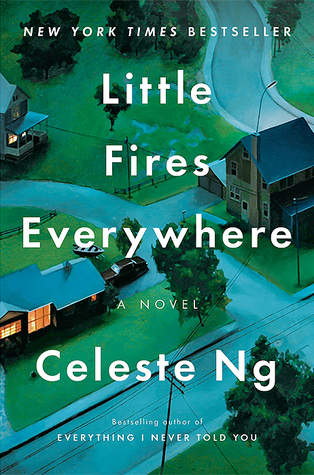
Little Fires Everywhere     Celeste Ng     (2017)

Ah, adolescents in late-1990s Shaker Heights, Ohio.

The first chapter of Little Fires Everywhere lures the reader in with a blazing house, then backtracks about a year to paint portraits of the four teenaged Richardson children who resided in that house (Lexie, Trip, Moody, and Izzy)--plus the new 15-year-old in town, Pearl Warren. The Richardson family lives the American Dream, with trendy clothes and cars, luxurious vacations, and bright career prospects for the kids. Most of the Richardsons are also selfish and self-centered. Pearl, in contrast, is a smart but naïve vagabond who roams the country in an old VW Rabbit with her single mother, Mia, who’s an accomplished photographic artist. Pearl and Mia rent an apartment in a Shaker Heights duplex owned by Mrs Richardson and furnish it sparsely with castoffs, in distinct contrast to the elegant six-bedroom Richardson mansion. Tellingly, Ng refers to most adults as “Mrs” and “Mr,” but Mia Warren is always “Mia.”

The social commentary on economic inequality and lifestyle choices inherent in this setup would be enough to fuel a novel—and a spectacular house fire. But novelist Celeste Ng plunges far, far deeper into the problems in Shaker Heights, where she herself has lived. This suburb of Cleveland was established early in the 20th century as a planned community, with rigid rules about all aspects of outward appearance and organization. Near the end of the book, Izzy Richardson thinks about “life in their beautiful, perfectly ordered, abundantly furnished house, where the grass was always cut and the leaves were always raked and there was never, ever any garbage in sight; in their beautiful, perfectly ordered neighborhood where every lawn had a tree and the streets curved so that no one went too fast and every house harmonized with the next; in their perfectly ordered city, where everyone got along and everyone followed the rules and everything had to be beautiful and perfect on the outside, no matter what a mess lay within.” (323)

The “mess” behind the gorgeous façade of Shaker Heights includes unplanned pregnancy, controversial interracial adoption, prejudice against immigrants, unethical journalism, and parents who pay little attention to their wayward kids. Ng’s narrative is complex, with multiple strands tightly interwoven, and all her characters, no matter how peripheral, are drawn with exquisite care. The reading becomes unstoppable as the novel barrels along toward the fire that will inevitably consume the Richardson home.

The “little fires” of the title are the blazes on the gasoline-soaked beds that the arsonist lights. But these fires are also the incendiary issues shoved under the beds of upper-middle-class Americans: bigotry, greed, and a general disdain for those who diverge in any way from the norms set by their communities. Ng doesn’t preach; she shows.

Being Catholic in Brooklyn

The Ninth Hour     Alice McDermott     (2017)

McDermott.jpg

Being Catholic in early-20th-century Brooklyn wasn’t easy. If your loved one committed suicide because of untreated depression, he or she could not have a funeral or be buried in consecrated ground. If your spouse became severely incapacitated, mentally or physically, you could not get a divorce and remarry, even if you were committed to caring for that first spouse. If you were involved in a sexual relationship outside of marriage, your eternal soul was in extreme peril.

Alice McDermott doesn’t dance around these situations in The Ninth Hour. She presents them forthrightly, and she also presents some of the potential advantages of being Catholic in early-20th-century Brooklyn. If you were widowed by the suicide of your husband, the local nuns might take you in, give you a job in their laundry room, and help you raise your daughter. If you were trying to care for a disabled spouse, the “nursing sisters” might come to your tenement every day to perform the most menial and repulsive of tasks. If you were committing mortal sin in a consensual adult relationship, the nuns might look the other way and just suggest that you do penance.

The Ninth Hour looks frankly at all these cases, balancing the pros and cons. Many modern novels stereotype nuns as either cruel harridans or genial saints. The nuns in The Ninth Hour instead come to life beautifully and individually, as women who have entered religious life for widely differing reasons, as pragmatists who approach their vocations with varying levels of compliance. And the parish priest, who makes a brief appearance, is indeed proud and officious, but when one of the nuns calls on him, he agrees to intercede in a case of sexual abuse. The lay people that McDermott portrays also avoid easy categorization. The young widow, Annie, does not wallow in her grief. The neighborhood milkman is attentive to his disabled wife but does not sacrifice all to her care.

Alice McDermott, who won the National Book Award for Charming Billy in 1998, is a major American writer. I find McDermott’s language wonderfully resonant—her descriptions of weather are particularly fine—and her evocations of historical period are offered with a delicate touch. I never felt that the historicity of The Ninth Hour was being shoved at me. For example, the title of the book refers to the nuns’ afternoon prayers, but actual scenes involving liturgical observances are minimal.

McDermott is especially revered by many progressive Catholics for her clear-sighted depictions of people of faith in all their varieties. Her approach to religion is very different from, and superior to, that of other contemporary writers. By chance, I read The Ninth Hour in the same week that I read Fire Sermon by Jamie Quatro, which is another book about moral decisions by people of faith. In Quatro’s novel, a married woman spends endless hours in guilt-ridden examination of conscience about a brief affair. I do not recommend Quatro’s self indulgent and occasionally sickening book.

If you are interested in the intersections of morality, religion, and culture, read McDermott’s The Ninth Hour instead. And if you like novels about New York, click on that category in the Archive of Book Reviews, in the right-hand column.

Meet an Iranian Poet

Song of a Captive Bird     Jazmin Darznik     (2018)

Darznik.jpg

If you’ve never heard of the Iranian poet Forugh Farrokhzad (1935-1967), get ready to be introduced to the startling voice of a woman who writes viscerally about the emotions of repression, alienation, and love. In Song of a Captive Bird, Iranian-American writer Jazmin Darznik has fictionalized the life of Forugh Farrokhzad, who is known primarily as “Forugh.” Inserted throughout Darznik’s prose text are excerpts from English translations of Forugh’s poetry, which provide a taste of her style and illuminate the events of the novel.

Song of a Captive Bird gave me insights into a culture that I knew very little about. The Persian literature of Iran goes back at least two and a half millennia, with a strong tradition of love poetry, and Forugh steeped herself in this literature as she wrote her own poems. Here, in first-person narrative, novelist Darznik imagines Forugh’s struggles with writing candidly, as a woman, about sexuality in mid-twentieth-century Iran:

“Mine was a country where they said a woman’s nature is riddled with sin, where they claimed that women’s voices had the power to drive men to lust and distract them from matters of both heaven and earth. Yet, when I leafed through magazines and opened volumes of poetry, I found that men has always described their love and their lovers with utter frankness and freedom. For thousands of years men had compared their beloveds to whatever they pleased, voiced all manner of amorous petitions and pleas, and described all the states to which love delivered them. And people read this poetry with complete equanimity. No one screamed out in protest. No one cried, ‘Oh God, the foundations of morality have been shaken!’" (170)

Reviewers of Forugh’s poetry sometimes compare her to Sylvia Plath (1932-1963), who was her contemporary, though there is no evidence that the two knew of each other’s work. I see similarities, in that both expressed women’s emotions in a raw style that was often criticized during their lives as unwomanly or otherwise inappropriate.

Readers should be cautious not to accept as fact all the incidents in this novelized version of Forugh’s life. As Darznik explains in her “Author’s Note” at the end of the book, she extrapolated, because biographical information about Forugh is sparse. In the novel, Forugh characterizes herself as a difficult girl-child in a highly patriarchal society: “My willfulness was my mother’s torment. An Iranian daughter is taught to be quiet and meek, but from earliest childhood I was stubborn, noisy, and brash. A good Iranian daughter should be pious, modest, and tidy; I was impulsive, argumentative, and messy. I thought of myself as no less than my brothers, with wit and daring to match theirs.” (367) Darznik’s portrayal of Forugh continues her brashness and daring into adulthood, as she publishes what is viewed as scandalously explicit verse under her own name and as she takes on lovers. Forugh specifically defies and undermines the strong cultural emphasis on female virginity.

Darznik’s casting of the novel in first-person narrative lends an immediacy and also creates tension for the reader: Does the story extend through Forugh’s entire life? If so, how will Forugh explain her own death?  I found the last 75 pages (out of 401 pages) of Song of a Captive Bird to be weaker than the rest of the book, with many years of Forugh’s life skipped over and with the cause of Forugh’s death left ambiguous. But these critiques do not significantly diminish the power of the story.

From a twenty-first-century standpoint, we know what was going to happen in Iran after Forugh’s death. In the Iranian Revolution of 1979, the Pahlavi dynasty of monarchs was overthrown, and an Islamic regime under Ayatollah Khomeini came to power. Many Iranians who could afford to leave the country emigrated, including Jazmin Darznik’s own family. In the two suitcases that her family was able to take with them when they fled, Darznik’s mother brought a slim volume of Forugh’s poetry. This act speaks to the influence of Forugh.

Near the end of Song of a Captive Bird, Darznik puts into Forugh’s mouth a prophetic statement, lamenting Iran’s adherence to patriarchal traditions and its reliance on its vast oil reserves:  “I feared an age that had lost its heart, and I was terrified at the thought of so many crippled hands. Our traditions were our pacifiers, and we sang ourselves to sleep with the lullaby of a once-great civilization and culture. Ours was the land of poetry, flowers, and nightingales—and poets searching for rhymes in history’s junkyards. The lottery was our faith and greed our fortune.” (373-4)

After the Civil War

Varina     Charles Frazier     (2018)

Frazier.jpg

By page 3 of Varina, you know that you are in very competent hands. You can trust that Charles Frazier will imprint the landscape of the Civil War era on your brain for a long time. You will see into the souls of the characters and perhaps learn some truths about the issue of race in the United States. And his telling of the tale may break your heart.

Backing up a bit, let me explain that Frazier’s novel is a fictionalized version of the life of the second wife of Jefferson Davis, the president of the Confederate States of America during the American Civil War. The teenaged Varina (“V”) Howell marries the widower Jefferson Davis, who is the age of her parents, and goes on to social prominence in Washington, DC, in the 1840s and 1850s as the spouse of Congressman and then Senator and then Secretary of War Davis. The secession of the southern states in 1861 upends her life.

The bulk of the novel is the story of Varina’s incredibly difficult trek from Richmond, Virginia, the capital of the Confederacy, toward Florida in the spring of 1865, as the Confederates surrender to the Union to end the war. Varina, her children, and a small entourage (not including her husband), hope to reach Florida and then cross over to Cuba to escape retribution from Union soldiers or prosecution by the federal government. Varina’s trip is recounted in flashbacks from the standpoint of 1906, when a middle-aged man of mixed race, James Blake, tracks down the elderly Varina, living in upstate New York, and asks her how he happened to be part of her household for a few years during his early childhood.

Is this plot vaguely reminiscent of the plot of Cold Mountain, Frazier’s 1997 international bestseller and winner of the National Book Award? Oh, sure. Both books present in grisly detail the wasteful destruction of life and land during the Civil War; both involve treacherous journeys against the backdrop of the ravaged American South; and both feature strong, educated female characters. The story is one that encompasses multitudes and can be told from countless points of view. Although many events in the novel Varina hew closely to the biographical facts of the actual life of Varina Davis, Frazier has invented the character of James Blake and has speculated about Varina’s analyses of master-slave relationships and about her intellectual struggles with the institution of slavery. Here are a couple of samples of Varina’s (fictional) thoughts:

“Even very young she saw slavery as an ancient practice arising because rich people would rather not do hard work, and also from the tendency of people to clench hard to advantageous passages in the Bible and dismiss the rest.” (102)

“. . . they—she and Jeff and the culture at large—had made bad choices one by one, spaced out over time so that they felt individual. But actually they accumulated. Choices of convenience and conviction, choices coincident with the people they lived among, following the general culture and the overriding matter of economics, money and its distribution, fair or not. Never acknowledging that the general culture is often stupid or evil and would vote out God in favor of the devil if he fed them back their hate and fear in a way that made them feel righteous.” (328)

Although I learned a great deal about Varina Davis and her family in this novel, I see the heart of the book as the American South.

“V thought about how the landscape would never be the same after this war even if the blasted battleground healed with new green growth and burned farms were either rebuilt or allowed to rot into the dirt. The old troop movements, battles and skirmishes, places of victory and defeat and loss and despair. Slave quarters, whipping posts, and slave market platforms. Routes of attack and retreat. Monumental cemeteries of white crosses stretching in rows to the horizon, and also lonesome mountain burials . . .” (212)

I agree with Varina, and presumably with Charles Frazier, that the wounds of the Civil War are still festering in the United States today.

For another novel about the aftermath of war, this time World War II, see my review of The Women in the Castle by Jessica Shattuck (2017).

Vermont Secession?

Radio Free Vermont: A Fable of Resistance     Bill McKibben     (2017)

McKibben.jpg

This novel . . . wait! Bill McKibben doesn’t write novels, does he? Isn’t he the one who produced that groundbreaking book about climate change, The End of Nature, way back in 1989? Isn’t this the guy who founded the climate activism group 350.org? Yup, same guy! And now he’s broadening his scope to generalized civic resistance and expanding his genres to include prose fiction. And can Bill McKibben write a respectable novel? Absolutely.

The story:  Vern Barclay is a 72-year-old Vermonter who for decades has hosted a radio show on which he interviews local folks, plays a few tracks of music, and covers events like store openings. He stumbles into becoming the leader of a movement for Vermont to secede from the United States, as the US is currently being led by President Trump, the Congress, and the Supreme Court. To Vern’s surprise, the secession movement snowballs, and he goes into hiding on an isolated farm, since he’s being hunted by both state and federal law enforcement officers for his involvement in an act of civic resistance that got him into a pile of shit.

Vern’s sidekicks in his adventure are a teenaged computer geek, a survival camp instructor, and an Olympic athlete. Vern records podcasts for Radio Free Vermont—“underground, underpowered, and underfoot”—as his team plots comical, nonviolent subversive capers. By including in the novel some of Vern’s ad-libbed broadcasts, McKibben can expound for a couple of pages on topics such as the corporatization of America, the value of Vermont’s town-hall decision-making process, and the problems with agricultural subsidies. McKibben does get in a few environmental points, as Vern laments the warming of Vermont’s winters and rejoices over the return of moose to the wild. But this is not primarily a book about the environment. Instead, the time-honored phrase “All politics is local” is extended to its logical conclusion as Vern rehearses the long history of community activism in Vermont, which was originally established in 1777 as an independent republic and only joined the United States in 1791. Throughout the book, the many small, owner-operated breweries in Vermont are promoted by name, as are other products for which the state is famous (hello, Ben and Jerry’s).

I read this book in one sitting, and I laughed out loud at several points. McKibben’s sarcasm ranges from gentle mockery of uptalk (speech that ends every sentence with an interrogative tone) to outright scorn for the private military companies that are employed by the feds—the bumbling operations of “Whitestream” in Radio Free Vermont evoke the infamous Blackwater activities in Iraq. The narrative spirals into incredible territory toward the end, but that’s part of the appeal of this novel. It’s a fable. In an “Author’s Note” at the back of the book, McKibben acknowledges that secession is not really a viable option. That isn’t what Radio Free Vermont is about. Instead, I think McKibben wants to show us how an appeal to reasonableness, combined with deft use of the internet and the media, can encourage the American populace to rise up against policies that undermine ethics, morality, and the rule of law. He may be speaking only to the converted, but his voice is loud.

Moral Quandaries in Berlin, Part 2

Here in Berlin     Cristina García     (2017)

Garcia.jpg

The cover of Here in Berlin tells us that this is “a novel,” but upon opening it you’ll be excused if you mistake it for a collection of short stories. Either way, Cristina García has produced a striking picture of contemporary Berlin by presenting pieces of historical Berlin.

The construct is this:  a Visitor, never named, interviews Berliners, many of them aged residents of a nursing home, and records their stories in their own words. The Visitor also sets down a few third-person accounts of Berliners. In addition, the Visitor records some interviews with Cubans, both in Berlin and in Cuba, as she explores the connections between East Germany and Fidel Castro’s Cuba as those connections existed from the end of World War II until 1989, when the Berlin Wall came down. It had never occurred to me before, but now it’s obvious that there would have been movement of people between these two centers of Communist power in the twentieth century. Students would have traveled from Cuba to study in Berlin, for instance, and transatlantic business would have been conducted.

How did the (fictional) Visitor secure her (fictional) interviews? “The Visitor struggled with balancing what she found with what eluded her. On fortuitous days, stories dropped like gifts out of the windless skies, typically prompted by loneliness, or happenstance. Other stories—the forgotten, interstitial ones she’d come to Berlin to collect—she coaxed from the grist of history. Why was apocalypse so compelling? What did war keep offering that ensured its survival?” (109)

Oh, the stories that emerge! The primary revelations concern the Nazi era and the period of the late 1940s, when Berlin was an apocalyptic landscape of destruction and starvation. Nonagenarians reveal to the Visitor long-hidden secrets of their precarious survival, and slightly younger Berliners recount grim childhoods, when World War II was grinding to a horrific conclusion, with Hitler’s troops fighting to the bitter end and the Russians storming Berlin. The voices are so authentic that you may start to think of the book as documentary rather than fictional.

War crimes are prominent in the stories, as ordinary Germans explain how they were sucked into the Nazi machine. Toward the middle of the book, a former Luftwaffe pilot laments, “We grew old, very old, before our time. Sometimes I think it’s better to remember nothing at all. Memories are selective. We pick and choose what we need to believe, what we require to survive.” (122) The specter of collusion in war atrocities hangs over almost all the speakers. An amnesiac photojournalist explains: “Dear Visitor, the ghosts in Berlin aren’t confined to cemeteries. Listen. Don’t you hear their whisperings? Feel their tugs on your sleeves? Their stories lie beneath the stories that nobody want to talk about. They haunt the present like palimpsests, shaping it with their hungers.” (96)

Over it all, the Visitor tries to pinpoint her reasons for conducting the interviews in the first place. She finds linkages between some of the characters, making Berlin sometimes seem like a small town where everyone knows everyone else. For instance, an ophthalmologist whom the Visitor interviews has a couple of the other story tellers as patients. A Cuban who moved to Berlin and became a geology professor reports his long-ago affair with a crippled German ballerina whom the Visitor also interviews. To fully appreciate Here in Berlin, it helps if you can read German, or at least are willing to Google the meanings that you can’t get from context. Sure, most readers will know that “danke” is “thanks,” but I’m guessing that fewer will recognize “Ku’damm” as the shorthand for “Kurfürstendamm,” the broad avenue of shops in Berlin. A few misspellings in the German are unfortunate editing errors. The bits of Spanish that dot the text are less problematic.

The memories of war cannot be erased by time, it seems, or even by the deaths of the participants. In the gleaming new Berlin, a city of lovely lakes and rivers, heinous acts linger: “Most of the city’s new architecture—dazzling, sleek—has sprung up along these riverbanks. Berlin longs to define itself by the future, yet it remains a hostage to its past.” (88)

For a different take on Germany in the years right after World War II, see my review of The Women in the Castle, a novel by Jessica Shattuck. And for another collection of linked short stories, try Anything is Possible by Elizabeth Strout.

Bonus Post: A Woman in the Chem Lab

Chemistry     Weike Wang     (2017)

Wang.jpg

Don’t let this book fool you. The simple declarative sentences and frequent thematic tangents might lead you to believe that it’s the work of an unsophisticated novelist. Not so. Weike Wang makes her readers think hard about the role of immigrants in American society, about the difficulties that women (of any race) face in choosing careers in the sciences, and about the tensions between the personal and the professional in the lives of talented people.

No one in Chemistry except the narrator’s boyfriend, Eric, is given a name, which emphasizes the universality of this tale. The first-person narrator is a young woman who should be heading into her final year of a doctoral program in chemistry at a prestigious university—never named but presumably Harvard. She’s Chinese American, brought to the United States as a young child and raised by parents who would make Amy Chua of Tiger Mother fame seem tame. Boyfriend Eric is a paragon, a white guy who has had spectacular success in pursuing science degrees and who is just embarking on what will undoubtedly be a rewarding academic career. He wants to marry the narrator, but she demurs, worried about forfeiting her intellectual capacity. Added to this tension is a side plot about the narrator’s best friend, a physician in New York, who talks to the narrator frequently on the phone. On the edges of the novel are also students whom the narrator tutors in math and science topics.

Readers glimpse about two years of the narrator’s life, as she gets counseling to help with her decisions, eats a great deal of carryout pizza, drinks too much wine, and muses about scientific topics ranging from the details of electrical circuitry to the discovery of radium. Should she plow on with the doctorate even though the highly competitive lab work no longer gives her any joy? Should she marry Eric, a man very well suited to her personality and intelligence, even though he can never fully understand her family’s culture and language? If she doesn’t pursue chemistry, what should she do with her life? And if she moves to the Midwest to follow Eric, should she take her comical, untrainable dog with her?

The narrator touches on these questions, wanders off, and then circles back to them. Chemistry doesn’t give readers all the answers, but that’s it’s charm. And Weike Wang is an author to watch.

Lonely French Siblings

How to Behave in a Crowd     Camille Bordas     (2017)

Bordas.jpg

Isidore Mazal starts narrating this novel as a beleaguered eleven year old, and he tells us about the next couple of years of his life. He lives in France with five siblings; four of the siblings are in their twenties, working on advanced degrees, and they never come into sharp character focus. We do get a good picture of his sister Simone, who is only eighteen months older than Isidore but far ahead of him in school. Simone, like the rest of the family, calls her brother “Dory” despite his requests to be called “Izzy.”  She insists that he take notes for the biography of her that she assumes he will write once she’s famous. She comes right out and tells him, “I take it for granted that you’re gonna love me no matter what. I don’t do anything for it.” (101)

The five older children in the unusual Mazal family are academic prodigies, while Isidore is merely smart. He does fine in his grade level at school, but he’s also smart in ways that his family members don’t appreciate. He’s very observant of the situations around him. This is especially apparent during his many unsuccessful attempts to run away from home; his family scarcely notices that he’s left the house. When, early in the book, his father dies suddenly of a heart attack while on a business trip, Isidore catalogs the grief patterns of his mother and siblings. He tells us, “Because we never talked about the father—the fact that he was dead, the fact that he’d once been alive—saying the word dad itself felt out of place, or like I might’ve used it wrong.” (120) That’s a lot of alienation for a kid in adolescence.

You may notice in this quote about his parent that Isidore shies away from the term “dad,” using instead “the father.” This Francophone locution, found throughout the book, points up not just the estrangement that Isidore feels from his distant—and then deceased—father but also the mix of French and American language and cultural references  in the novel. I wasn’t bothered by it, but some other reviewers found it jarring. It may help to know that Bordas was born in France and has written two previous novels in French, but now lives in Chicago. She creates a generic France, perhaps from her memories.

Isidore’s observations, and his repeated attempts to offer his family an emotional compass for life, are poignant. Someone needs to help those friendless siblings, those pitiful sloggers in academia. In addition, Isidore does his best to cheer up Denise, a girl at his school who suffers from severe depression. His compassion is remarkable, given the cheerless atmosphere of his home. Simone explains to Isidore: “There’s a big drawback to being smarter than the rest, and I’ll tell you what it is, because I assume it will be in part responsible for the kind of person I’ll become: loneliness.” (50) Truly, most of the Mazal family does not know how to behave in a crowd.

I have a few reservations about this novel. Some of the witty repartee goes on too long, as do didactic components that don’t fit the flow of the narrative. For example, Isidore’s middle-school German class carries on a long discussion of Bertolt Brecht’s concept of the Verfremdungseffekt. (Don’t ask! Yawn, skip a page or two!) But novelist Bordas sparks up the story with side plots such as Simone’s unwanted pen pal and the town’s celebration of the oldest woman in the world. Overall, How to Behave in a Crowd is a pleasant little novel with an appealing hero.

A Connecticut Family

The Children     Ann Leary     (2017)

Oh, no, I thought—another fluffy tale of wacky, self-absorbed New England trust-fund kiddies seeking personal gratification at the expense of those around them. I almost sent The Children back to the library. But I kept reading and watched the plot twisting, folding back on itself, and finally turning dark, very dark. The fluff definitely receded.

Leary 2.jpeg

You have to pay close attention up front to sort out all the family connections in this novel. Charlotte Maynard, a 29-year-old single, agoraphobic woman, is one of the kiddies and is the narrator of The Children. She lives in a huge Connecticut house named Lakeside with her zany mother, Joan, who exercises excessively and pinches pennies ludicrously. Charlotte is involved intermittently with Everett, the groundskeeper at Lakeside. Charlotte’s sister is Sally, a gifted musician with mental health problems. Stepbrothers Spin and Perry Whitman are offspring from Charlotte’s stepfather’s first marriage, which ended acrimoniously when the stepfather, Whit Whitman, fell for Joan. As the novel opens, Whit has recently died, and the family dynamics are reshuffling. Got all that?

Spin, who teaches and lives at a nearby private school, arrives at Lakeside with a girlfriend, Laurel Atwood, who is preternaturally accomplished in skiing, fiction writing, and life hacks. Laurel’s life hacks veer daringly into illegal territory. Charlotte doesn’t see this as a problem, because she herself runs a profitable internet scam, a fake “mommy blog” with corporate sponsorship. But Sally, who is back at Lakeside from New York after losing her orchestra job, has serious reservations about Laurel.

This is the setup, but I won’t spoil the plot development for you. Author Ann Leary takes the basic framework  in directions you’d never expect, with characters who are believable despite—or maybe because of—their oddities. We see people and events through the eyes of Charlotte, which creates a layer of reportorial unreliability, since Charlotte is an admitted scammer. Through Charlotte, Leary pokes fun at several aspects of contemporary culture, especially internet culture. For example, Charlotte’s wildly successful blog revolves around children whom she’s invented (another reference to the novel’s title), and Leary revels in skewering the blog’s fervent mommy-followers. The technological references, which are up-to-the-minute as of 2017, may soon date this novel, but for now it’s trendy in a good way.

The pace of The Children is fast, the dialogue is clever and authentic, and the storyline is well executed. I see the novel as a work of warning about the consequences of seemingly innocuous lies and the seeming innocuousness of consequential lies. The human heart can have unexpectedly sinister depths. That’s the dark part. Yet Charlotte reminds us that we can always count on the stars, which are as stable as it gets in our universe. “Once you find Polaris, you’ve found true north. You can navigate anywhere from there.  Find a landmark . . . You have to find a hill or a house or a tree while it’s still dark; that way you’ll be oriented the next day, when the stars are gone.” (245)

Two from the Bascombe Tetralogy

The Lay of the Land     Richard Ford     (2006)

Let Me Be Frank With You     Richard Ford     (2014)

These books are the third and fourth in Richard Ford’s tetralogy that follows the adult life of the character Frank Bascombe. Some background:

  • In the first novel of the series, The Sportswriter (1986), Frank is deep in grief over the death of his young son and his subsequent divorce from his wife. Although he had wanted to write fiction, he’s turned to writing about sports to support himself.
  • In Ford’s second offering, Independence Day (1995), Frank has changed careers and is selling real estate in New Jersey. This novel, which won both the Pulitzer Prize and the PEN/Faulkner Award for Fiction, is set at the titular American holiday.
  • Holiday celebrations, which often cause simmering family tensions to boil over, figure prominently in all four books about Frank. An Easter dinner is a key scene in The Sportswriter, and the two books that I’m reviewing here are set at Thanksgiving (The Lay of the Land) and during the Christmas season (Let Me Be Frank With You).
Ford Lay of Land.jpg

In The Lay of the Land, the political backdrop is the contested presidential election of 2000, which was still not decided by Thanksgiving of that year, so tension and accusation and fear are in the air. As always, Ford’s focus is on Frank Bascombe’s inner life, narrated in first person. Speaking to his adult daughter, Clarissa, Frank says, “I’ll commit suicide before I keep a fucking diary. Diaries are for weaklings and old queer professors. Which I’m not.” (240) And yet this entire novel is like a very detailed, highly reflective diary. Frank is now fifty-five and married to his second wife, Sally Caldwell. He’s recently been treated for prostate cancer at the Mayo Clinic. You might find Frank’s trips to the toilet tiresome, but his need to empty his bladder frequently is a constant reminder of the threat of death that hangs over him.

He calls this phase of his life “the Permanent Period—no fear of future, life not ruinable, the past generalized to a pleasant pinkish blur.” (249) There’s a fatalism to Frank’s categorization of late middle age in this way. He’s still selling real estate, though he does have occasional regrets about giving up his dream of writing fiction. He rationalizes: “Realtors share a basic industry with novelists, who make up importance from life-run-rampant just by choosing, changing and telling. Realtors make importance by selling, which is better-paying than the novelist’s deal and probably not as hard to do well.” (84)

The Lay of the Land is expansive, exhilarating, and sometimes exhausting. It’s the work of an accomplished prose stylist who gives us a view into an ordinary life on ordinary and non-so-ordinary days. The exquisite specificity with which Frank describes his surroundings contrasts with his inability to connect with some people. These people are sometimes fairly conventional—like Sally—and sometimes quite unusual—like the Tibetan Buddhist with the Americanized name, Mike Mahoney, “a five-foot-three-inch, forty-three-year-old realty dynamo” (14) who works for Frank’s real estate office on the Jersey Shore.                                 

Ford Frank with You.jpg

The theme of Frank’s relationships is developed further in the most recent volume of the tetralogy, Let Me Be Frank With You, four linked short stories in which Frank Bascombe meets with four different people from his past. The year 2012 is coming to an end, and New Jersey is reeling from the October onslaught of Hurricane Sandy. All around him is destruction, but Frank has survived that cancer diagnosis so far, and in retirement he’s withdrawn more into himself. “For months now—and this may seem strange at my late moment of life (sixty-eight)—I’ve been trying to jettison as many friends as I can, and am frankly surprised more people don’t do it as a simple and practical means of achieving well-earned, late-in-the-game clarity. Lived life, especially once you hit adulthood, is always a matter of superfluity leading on to less-ness.” (187) He provides a summation of how he sees his own character: “. . . a man who doesn’t lie (or rarely), who presumes nothing from the past, who takes the high, optimistic road (when available), who doesn’t envision the future, who streamlines his utterances (no embellishments), and in all instances acts nice.” (140-41) Well, Frank may think he’s always “nice,” but readers can catch him in some unkind deeds.

I found Let Me Be Frank With You less masterful than The Lay of the Land, and I noted a few discontinuities, such as Sally’s birthday moving from summer to near Christmas. Still, Ford’s trademark particularization pulls you in, letting you gape at the damage wrought by the hurricane (and by the previous collapse of the real estate market in 2008), letting you linger on the inevitable wrinkles in the aging faces of the characters.

The Frank Bascombe tetralogy is by turns hilarious and devastatingly serious, honest and deceptive, reflecting the life of one American man—and a slice of American history.