New York Noir, Plus

Manhattan Beach     Jennifer Egan     (2017)

Egan.jpg

Jennifer Egan won the Pulitzer Prize for her 2010 collection of linked short stories, A Visit from the Goon Squad. The form of her fiction before 2017 was unconventional, so critics seem shocked that Egan was capable of producing, with the publication of Manhattan Beach, a traditional historical novel, especially since such novels are not fashionable at the moment. I had never read anything else by Egan, so I approached Manhattan Beach as a seasoned reviewer of multitudes of historical novels, and it’s a good one.

The setting is New York City, first in the depths of the Great Depression and then in the midst of World War II. Keep your finger on the front or back endpapers of Manhattan Beach so that you can refer to the map of the Brooklyn Naval Yard as it existed during World War II. This may help you locate and picture the scenes of the novel that take place there.

The plot? I hesitate to reveal much, since one of the pleasures of this novel is the intricacy of the entangled story lines, which the reader unravels with every turn of the page. The central character is Anna Kerrigan, whom we first meet as a child in 1934, when she accompanies her down-at-the-heels father, Eddie, on a visit to a mobster’s home, which overlooks Manhattan Beach. Both this locale and the title of the book point to the prominence of bodies of water as recurrent images in Egan’s writing. The mobster is Dexter Styles, whose back story we’ll learn. We’ll follow Eddie, too, as well as Anna’s severely disabled younger sister, Lydia. The characters in Manhattan Beach have to confront organized crime, Wall Street bankers, Park Avenue doctors, and Nazi submarines. It ain’t dull!

The main line of interest, however, is Anna, who reaches the age of 19 during World War II and is able, like many women of the period, to secure war-related employment at the Brooklyn Naval Yard. She hates the tedium of taking quality control measurements of small parts and escapes on her lunchtimes to the piers that jut out into the East River. Gazing at the water, she sees a diver in a bulky canvas suit slipping below the surface, and she has an epiphany. “Jealousy and longing spasmed through her. . . she felt a seismic rearrangement within herself. It was clear to her now she had always wanted to be a diver, to walk along the bottom of the sea. But this certainty was fraught with worry that she would be denied.” (62-3) Anna single-mindedly and aggressively pursues her quest to become a diver, repairing the underwater portions of vessels heading out to war. Although Rosie-the-Riveter was welcomed in factories that turned out bombers, Anna-the-Diver has a tougher time convincing the male authorities at the ship yard to connect her to an air hose and let her clamber down the ladder into the depths.  

As Egan has explained in several author profiles (and as her acknowledgements at the end of the novel reveal), she exhaustively researched all the arcane detail in Manhattan Beach, learning not only about diving but also about the New York waterfront,  nightclubs, Irish Americans, gangsters, and merchant marine ships. At times, Egan seems so anxious to assure her readers of the historical authenticity of her novel that she piles on the data, listing, for instance, too many product brand names or too many seafaring terms. This is a small complaint, as is my sense that some turns of plot are clichéd and that the denouement of Manhattan Beach is somewhat abrupt. Still, I was left with the feeling that I’d like to know more about the later lives of the characters, and that’s always a sign that the novelist has done a very good job of constructing those characters.

Manhattan Beach has been touted as one of the great novels of the decade. I wouldn’t go that far in my praise, but I did find it very well-crafted and solidly entertaining. Check it out! And for more New York mystery/adventure, read my reviews of Brendan Mathews's The World of Tomorrow and of Colin Harrison's You Belong to Me.

Irishmen at the 1939 World's Fair

The World of Tomorrow     Brendan Mathews     (2017)

Mathews.jpg

The cover of this novel depicts the key setting: New York in 1939, site of the World’s Fair, with its theme and slogan “The World of Tomorrow.” When you open the book, the endpapers offer a map of the fairgrounds, with the iconic trylon and perisphere structures, which are also on the back cover.

Brendan Mathews compresses almost all the action of his novel into one week in New York City in early June of 1939, a time when the Great Depression had eased, when the future in America seemed bright, when World War II was still unimaginable to most Americans, despite the actions of Hitler in Europe. Three Irish brothers are at the center of a large cast of characters. Francis Dempsey has fled Ireland after a prison break and a run-in with the Irish Republican Army that left him, unexpectedly, with a bundle of cash. With Francis is his brother Michael, a disenchanted seminarian who has been severely injured by an IRA bomb. Francis and Michael assume fake identities when they arrive in New York, but they do seek out the third brother, Martin, who is married to Rosemary and has two daughters. We learn about Rosemary’s complicated family history in New York, and we also pick up the stories of other characters who will cross paths with the Dempseys. Irish expatriate Tom Cronin is a retired hit man who is called back to the city to retrieve the cash that Francis lifted from the IRA. Lilly Bloch is a Jewish street photographer from Czechoslovakia who’s on a limited visa in New York but is hesitant to return to her home and her fiancé given the Nazi presence in Prague.

The plot can be as rollicking as a slapstick Laurel and Hardy movie of the period, and when Mathews is in this mode, the pages turn themselves, especially in the climatic final scenes at the World’s Fair. However, I did find Mathews’s supernatural elements sometimes hard to swallow. The shell-shocked Michael has long conversations with the ghost of the poet William Butler Yeats. This is a way for readers to know what Michael, who cannot speak, is thinking, but it can get tedious.

Quibbling aside, The World of Tomorrow is serious and well written historical fiction, weaving in the funding of IRA terrorism by Irish Americans, the role of women in the mid-twentieth century, the political corruption of New York, and the competitive jazz scene of the city. Here is Martin, dragging home at dawn from a jazz gig: “. . . the early-morning hours were his favorite. Walking a nearly vacant street, with only a couple slouched against each other in the distance, steam drifting lazily from a manhole, a splash of neon thrown into a puddle, an after-hours bar whose last diligent drinkers hunched over their highball glasses—this was the New York he had come seeking.” (45-46)

Hanging over all the narrative is the reader’s knowledge of what is to come:  “The World of Tomorrow” will be postponed until after a long, devastating war that stretched around the globe. In the closing pages of the novel, Mathews spells this out: “. . . the story of the months and years ahead would be broadcast in boldface headlines and urgent radio bulletins. It would be told in V-Mail and telegrams from the War Department and in prayers offered in church. More than they could know, it would be written in silences, absences, and empty spaces. But the story of those years would also be told in love letters saved and bundled in ribbon, and in songs dreamed up during nights in the barracks, and in the warmth of the spotlight before the first note was sung, and in sunlit hours when it was possible to believe that everyone you had lost was only late, and would be home soon enough.” (546)

An Embezzler in Brooklyn

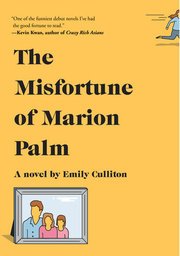
The Misfortune of Marion Palm     Emily Culliton     (2017)

When I tell you that this novel is set in contemporary New York, you may be thinking, “Not another story about bored rich people and their sad affairs!” Well, this one is different.

Culliton.jpg

Marion Palm, the central character in Emily Culliton’s The Misfortune of Marion Palm, is not a New Yorker you’d find in a Jay McInerney novel. She’s a college dropout who’s overweight, not very attractive, and keen on embezzlement. Yes, she lives in a pricey Brooklyn brownstone, but that’s only because she married Nathan, a clueless poet. His trust fund turns out to be smaller than Marion assumed, so Marion embezzles to bring the place up to standard and maintain their lifestyle. She has access to money because she’s a development officer, raising funds at the private school that her two daughters attend. Marion is very good at embezzling, but this school is run so haphazardly that stealing from the till is a piece of cake.

As the book opens, however, an IRS audit of the school is looming. So Marion takes off with a backpack full of cash, leaving Nathan and the young daughters. Marion is not as adept at running away as she is at embezzling, which leads to her involvement with Russian gangsters. Nathan, meanwhile, can barely order pizza delivery and get the girls out the door to the school bus.

Marion’s motivation for fleeing is not only the audit. She has a useless husband and no friends. As we learn in flashbacks, she’s had some raw deals in life. She’s disenchanted with her fake upper-middle-class life and the disdain with which she’s treated by the other parents at the school. She can see how wealthy New Yorkers squander their superfluous dollars, and she views her thefts as helping to correct financial inequality, Robin-Hood style. These issues outweigh Marion’s devotion to her children.  

Novelist Culliton’s prose is economical, her dialogue is rapid-fire, and her chapters are brief. Don’t assume that this means that her underlying themes aren’t serious. The plot moves along so speedily that I recommend reading The Misfortune of Marion Palm in one sitting, to get the full effect.

If you like The Misfortune of Marion Palm, you might want to pick up another mold-breaking Brooklyn novel, Lucinda Rosenfeld’s satiric Class, reviewed here. Novelist Maria Semple’s offerings also have a similar feel. Check out my review of Semple’s Today Will Be Different, set in Seattle, here. Like Culliton’s novel, these two also puncture the pretentiousness of the monied set. 

Sonata II: A Czech Musical Quest

 The Prague Sonata     Bradford Morrow     (2017)

Morrow.jpg

“Sonata” is the theme for this Bradford Morrow novel as well as for the novel I reviewed in a recent post, Rose Tremain’s The Gustav Sonata. Yet these two books are totally different in style and plot. 

The Prague Sonata centers on a fictional manuscript of a musical work from the late eighteenth century. Meta Taverner, a musicologist in New York City in the year 2000, is given one of the three movements of this unknown piano sonata by an elderly Czech woman who then promptly dies. Meta sets out on a mission, starting in the Czech Republic, to locate the remaining two movements of the sonata and to determine its composer.

The Prague Sonata is an amalgam of quest and mystery novel. There’s also a good chunk of historical fiction, as we travel back to Prague in the days before and during World War II to meet the woman who separated the three movements of the sonata in the face of the arrival of Nazi troops. Morrow explores the connections between the twentieth-century Czech owner of the manuscript and the twenty-first-century sonata seeker: “Had Meta herself been bequeathed a handwritten sonata from a fond, eccentric father, would she have had the guts and the wisdom to split it into three orphaned movements in hopes of protecting it from the enemy?” (70)

Classical musicians and lovers of classical music (among whom I count myself) will find much to enjoy in The Prague Sonata, which includes details of musical notation and rhapsodic descriptions of performances of the mysterious sonata. Trooping through the streets of Prague with Meta, I became genuinely interested in how the movements of the sonata might be reunited and how the composer might be ascertained. Occasionally, however, Morrow’s musical metaphors become strained:  “Despite her doubts about love at first sight . . . they’d been improvising a duet on either side of the river. A duet that wanted to evolve into a fugue. One whose harmonic and rhythmic structures moved toward the same resolution.” (231)

Morrow also wants to tell us a lot about Czech history, not only from the World War II era but also from the time of the Velvet Revolution against the Soviets in 1989. If these and other background paragraphs had been edited down, the pace of the novel would have picked up. A romance component does add spark to the narrative. Meta’s lawyer boyfriend, who remains behind in New York, is unsympathetic to her quest in the Czech Republic, leaving her open to forming a new relationship. I won’t reveal spoilers!

Late in The Prague Sonata a character brings up Willa Cather’s 1918 novel My Ántonia, arguably the best fictional depiction of Czech immigrants (called “Bohemians”) in the United States: “’This was written years ago, but the heartland of Nebraska and the Bohemians who settled there haven’t changed all that much. Time kind of stands still on the prairie.’” (385-6) I read My Ántonia recently and found this American classic to be surprisingly nuanced. Between My Ántonia and The Prague Sonata you can get a sense of the richness of Czech culture.

Family Drama in the Florida Heat

Heart of Palm     Laura Lee Smith     (2013)

L Smith.jpg

I wanted to read Laura Lee Smith’s 2017 novel, The Ice House, but my local library hasn’t bought it yet. So I checked out Smith’s 2013 novel, Heart of Palm, to see what her writing is like. I was confused at first by the cover of Heart of Palm, which looks like the front of a cheesy romance novel, but I decided to dip in anyway. Then, right off the bat, I encountered a horrific accident in the Prologue. Regular readers of this blog know that I don’t care for scenes of horror, and the grisliness of this episode almost kept me from continuing. But I’m very glad that I stuck with Heart of Palm.  

This is a novel of the American South, populated with gun-totin’, hard-lovin’, rip-roarin’ Southerners—but stopping short of stereotypes. In 1964, the wealthy and sophisticated Arla Bolton up and marries penniless bad boy Dean Bravo in the fictional Utina, a backwater town near St. Augustine, in northeastern Florida. There’s our set-up for marital difficulties, sibling rivalries, and various brawls. As we move from the 1960s to the present day for the main action, the adult children of Arla and Dean are faced with the extraordinary appreciation of their real estate, which happens to be situated on the Intracoastal Waterway. Being a Midwesterner, I was unfamiliar with this important shipping route along the Atlantic Coast, made up of both natural rivers and artificial canals. The Bravo clan is accustomed to living amidst the swampy tangle of vegetation that lies along the Atlantic and the Intracoastal, and they struggle with whether to sell to the real estate developers who want their parcels of land.

In addition to this main plot about real estate, each of the Bravos has a subplot, and several of the other quirky characters in Utina also get subplots. Novelist Smith develops all the storylines with a deftness that invites immersion in the text. She supports her narrative with descriptions that plop you right under the drooping fronds of palmettos, wiping your brow and sipping a cold brew. With Smith’s pervasive portrayal of the Florida heat, I could feel the suffocating air that makes your clothes stick and your head spin. No wonder the Southerners in Heart of Palm are a bit crazed. They need better air conditioning equipment!

Smith treats her characters—even the scoundrels—with empathy as they make the best of their situations, and she works their tales to a satisfying conclusion. So, will I still be looking to check out Smith’s The Ice House when it arrives at my library? You bet.

Asperger's in Manhattan

Standard Deviation     Katherine Heiny     (2017)

Heiny.jpg

You probably know someone like Standard Deviation’s Audra, a stream-of-consciousness, nonstop chatterer who talks to strangers on the bus and in the elevator, freely associating from one topic to all adjacent topics. You might find her endearing, or you might find her highly irritating and intrusive. Graham, her husband, finds her endearing most of the time, even when she proposes pretty outrageous activities, such as striking up a friendship with Graham’s ex-wife, Elspeth, whom he hasn’t seen in twelve years. In case you’re wondering, yup, Graham left Elspeth for the much younger Audra.

Katherine Heiny’s episodic novel takes us up and down the streets of Manhattan for the adventures of Graham and Audra; their ten-year-old son, Matthew; and Elspeth. Audra leads the way with hilarious monologues. For example, at an origami convention to which Graham and Audra have taken Matthew, Audra exclaims impatiently while waiting in a queue,  “‘What I don’t understand about origami . . . is why can’t anyone like it a little bit? Why aren’t there nice, well-rounded people who enjoy a bit of origami, the way there are nice, well-rounded people who enjoy a bit of bondage?’”(110) Wherever Audra treads, innocent bystanders reel in shock.

But hidden in plain sight in this book is a serious examination of the difficulties of raising a child with autism spectrum disorder. The doctor diagnosing Matthew tells the parents, “’Matthew’s score on the questionnaires for oversensitivity to stimulation ranked more than a full standard deviation above the range for children his age.’” (232) This passage is where we finally find out what the title of the novel means. Heiny presents the case of young Matthew with clear-eyed, unsparing detail, and she presents his parents as devoted unreservedly to helping him become an independent adult. The plot of Standard Deviation trails off in about the final third of the book, but that may be to give the impression of how the lives of Graham and Audra and Matthew will continue in the same vein.

The third-person narrative of the novel is told mainly from Graham’s point of view, and Heiny offers us plenty of Graham’s musings on his family situation:

  • “Who was this doctor to say that because of standard deviation, Matthew stood firmly on the stark cracked-earth desert of Asperger’s, that he would never feel the long cool green shade of normal?” (232)
  • “Graham had been developing a theory lately that the parents of kids with Asperger’s also had Asperger’s only less pronounced. A milder Asperger’s. The seeds of Asperger’s . . . Of all the dozens of special-needs kids’ parents he knew, one parent of every couple always seemed a bit odd, a bit eccentric, a bit Aspergery.” (212)

Indeed, one wonders how Matthew’s mother, Audra, would be diagnosed.

After writing a draft of this review, I read some other major reviews. I was surprised that the reviewers focused on the relationship triangle of Graham, Audra (his current wife), and Elspeth (his ex-wife). That was certainly a sub-plot in the novel, but I found the relationship between Matthew and his parents (Graham and Audra) much more significant. Neither the highly amusing dialogue nor the Manhattan scenery detracts from this book’s thoughtful treatment of the issue of autism.

Three Books about the Little House Series

Caroline:  Little House, Revisited     Sarah Miller     (2017)

S. Miller.jpg

Sarah Miller, an established American author of historical fiction and nonfiction, received authorization from the Little House Heritage Trust to produce this novel about the pioneer life of Caroline Quiner Ingalls, the mother of Laura Ingalls Wilder. Laura was the author of the famed series of Little House books, which fictionalized events from her family’s years as pioneers in the Upper Midwest and on the Great Plains in the late nineteenth century.

In this spin-off novel, Caroline, we see most of the same events that Wilder portrayed, but through the eyes of Laura’s mother.

In recounting the early adventures of the Ingalls family, novelist Miller treads a path somewhere between the historical record and the fictionalized version that appeared in the Little House books, specifically the title Little House on the Prairie (published in 1935), which tells of the family’s trip by covered wagon from Wisconsin to Kansas to stake a new land claim in 1869-1870.

I first read Wilder’s Little House series as an adult and was captivated by the details of daily life that she lovingly described. Miller’s novel Caroline paints a less bucolic picture, meticulously chronicling the grueling toil that pioneer families endured. In this version, Caroline Ingalls worked hard, even when she was heavily pregnant, and survived with an irrepressible good humor and positive attitude. Her husband, Charles, was certainly no slacker, either, but his search for the perfect land claim in the expansionist days of the United States must have worn thin on his wife and children.

Fans of Laura Ingalls Wilder’s books will not want to miss Miller’s take on incidents that they know well. (Be sure to read her Author’s Note at the end of Caroline, about the prejudices against Native Americans that contributed to Wilder’s account of the Osage Indians.) Miller writes skillfully and with a clear affection for her topic, presenting the beauty of an unspoiled American landscape but not stinting in her depictions of the diseases and dangers that pioneer women faced.

The World of Laura Ingalls Wilder: The Frontier Landscapes That Inspired the Little House Books    Marta McDowell     (2017)

McDowell 2.jpg

Devoted readers of children’s novelist Laura Ingalls Wilder often seize on any book that provides background about her Little House series. This nonfiction book focuses on the flora and fauna mentioned in Wilder's novels. Marta McDowell structures the text chronologically around what she calls Wilder’s “Life on the Land,” going book-by-book through the sites where Wilder lived, in places that are now in the states of Wisconsin, Kansas, Minnesota, Iowa, South Dakota, and Missouri. (The landscape of upstate New York, where Laura’s husband, Almanzo Wilder, grew up, also gets a chapter.) The style is chatty, with many quotations from the Little House books. The illustrations that McDowell has selected are sometimes excellent complements to the text, especially when they’re maps or period photos. At other times the illustrations are rather pointless; I didn’t need a half-page color photo of wintergreen berries, as just one example.

smith hill 2.jpg

If you’re a diehard Laura Ingalls Wilder buff, you might want to page through McDowell's book, but I can recommend a much better read: editor Pamela Smith Hill’s Pioneer Girl: The Annotated Autobiography (2014), a meticulous and comprehensive analysis of how the Little House books differed from the actual life of the author, as presented in Laura’s previously unpublished memoir and as unearthed by historical research. This is an exceptionally fine book.

A Family in Distress

In Caddis Wood     Mary François Rockcastle     (2011)

Rockcastle 2.png

With prose that is reminiscent of the writing of Barbara Kingsolver, Mary Rockcastle takes her readers into the forests and meadows of the upper Midwest for a plaintive story of a long marriage.

Carl Fens is an architect who’s put in long hours away from his family as he’s built a stellar career. Hallie Bok has raised their twin daughters while trying to keep her hand in with writing poetry and teaching. The couple have suffered more than their share of sorrows, the details of which are revealed over the course of the novel:  the early and sudden death of Carl’s father, the departure of Hallie’s mother when Hallie is young, a near-fatal accident involving one of their daughters, the death of a son-in-law. In flashbacks from old diaries, we learn that the previous owners of the family’s bucolic retreat lost a son in the Korean War. Readers need to keep track of all these side issues as the main plot unfolds.

In this main plot, Carl, at age 61, starts exhibiting unusual and troubling neurological symptoms. As part of Hallie’s search for a diagnosis, she inadvertently brings to light a near-affair that she had ten years previously, when she and Carl were briefly estranged. Carl and Hallie have to come to terms with this revelation at the same time that they’re dealing with Carl’s deteriorating health and his major new architectural commission involving redevelopment of a toxic waste site.

The backdrop for most of the novel is the Caddis Wood of the title, a magical place in northern Wisconsin, the site of the family’s second home. Here are just two examples of Rockcastle’s lyrical descriptions:  

“[Hallie] rests her eyes on the late-summer glow of the meadow. The midday grasses are on fire: crimson bluestem, golden switchgrass, straw-colored sideoats grama. Blazing among the bronzed, stiff clusters of goldenrod and yarrow are hearty sunflowers and dogtooth daisies, coneflowers still in color. She sighs happily and drinks from her water bottle, loving the persistence of summer, the way it hangs on in the fading, somnolent heat.” (45)

“At the top of the hill overlooking Echo Pond, she gazes gratefully at the incandescent surface. Another week and the feathery larches will start to yellow, but not yet. Trees cast their shadows on the stippled surface. Water striders and whirligig beetles zigzag merrily.” (214)

A few scenes take place on Captiva Island in Florida, and this oceanside setting is also depicted lovingly: “Dozens of pelicans, more than Hallie has ever seen, are diving headfirst into the sea. When they surface, their beaks shimmer with silver, wiggling meat that is swallowed whole or spilled into the sea. Gluttonous gulls fight over the leftovers. A group of scarlet ibises land next to a crane, red legs aglow in the sunlight, and poke their long saffron beaks doggedly into the sand. The water shivers and pops as if charged with electric current.” (126)

After many heartbreaking life events, the family members in this novel still manage to treasure their time together and pursue their goals. The daughters of Hallie and Carl are named Cordelia (as in Shakespeare’s tragedy King Lear) and Beatrice (Dante’s guide through heaven in his Divine Comedy). Perhaps these names are meant to point out that, despite tragic experiences, we can all find our way to happiness.

An Accidental Thriller

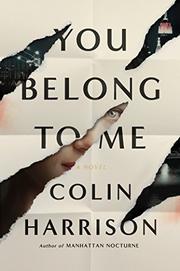
You Belong to Me     Colin Harrison     (2017)

Harrison 2.jpg

Somehow I missed the word “thriller” in the blurbs about this book. Thrillers give me nightmares, so I rarely read them. I thought that You Belong to Me was a literary novel about a map collector. Hah!

Paul Reeves, a 50-year-old collector of old maps of New York City, is indeed a central character, but his quest to acquire rare and pricey specimens is only one of several plot lines that novelist Harrison leads his readers through. Paul’s girlfriend, Rachel, has a little scheme of her own. Then there’s the story of Billy, a tough former Army Ranger from Texas navigating contemporary New York as he tries to win back his gorgeous girlfriend, Jennifer, who’s now married to someone else. That someone else is Ahmed, a prominent Iranian-American financier with relatives who came through the 1979 revolution in Iran with plenty of guerilla survival skills. And guerilla tactics are part of the arsenal of Mexican bodybuilder and hitman Hector, who also gets involved. All of these plots play out on the streets of New York, as we elbow through the lunchtime crowds in Rockefeller Center to reach Christie’s for a map auction, as we creep down a squalid back street behind a grimy weight-lifting gym, as we careen along the Belt Parkway with a murderer in pursuit.

Yes, several gruesome murders take place in the noir New York of You Belong to Me. I tried to zip through those passages quickly, lingering more over paragraphs such as this one, describing a map from 1776: “The large map showed, in stunning detail, the charming young city of New York set amid farm fields, swamps, ponds, streams, and woods, complete with harbor soundings in fathoms. Only months later, in September of that year, much of the southern tip of the city would be consumed in a ghastly fire that broke out in a bordello frequented by British sailors . . . The map also depicted the quaint little village of Brooklyn, spelled ‘Brookland’, and nearby the marshy water of Wallabout Bay . . . The map’s lines were crisp, the detail so magnificent that actual wisps of smoke from individual houses were depicted. Such beauty and precision and provenance made the map fantastically important.” (78)

The title of the novel reveals the theme that unites the narrative: possession. Paul wants to own precious maps of his beloved city. Rachel decides that Paul should belong to her and her alone. Billy and Ahmed both want to possess Jennifer. Hitman Hector wants to acquire the money that is owed to him. Watch out for that greed, New Yorkers! Colin Harrison has your number, and he punches it with impudence and sass. You Belong to Me is the proverbial page-turner, with rapid-fire action and snappy dialogue, but the characters, with all their failings and evil deeds, are strangely endearing. Read this one even if, like me, you don’t usually care for thrillers.

The Immigrant Experience

The Leavers     Lisa Ko     (2017)

Ko.jpg

Adoption has been the subject of several books I’ve reviewed recently, including Don’t Let My Baby Do Rodeo, Celine, Leaving Lucy Pear, and The Tea Girl of Hummingbird Lane. The yearning of some adopted children to find their birth mothers—or of birth mothers to find their biological children—can be a powerful theme for a novel. Lisa Ko takes a slightly different approach to adoption, and in the process she illuminates the lives of undocumented immigrants in the United States. The immigrants in this story work long hours in difficult jobs to provide food and shelter for their loved ones. They have to make heart-rending decisions in their struggle to survive. As the dust jacket tells us, “The Leavers won the 2016 PEN Bellwether Prize for Fiction, awarded by Barbara Kingsolver for a novel that addresses issues of social justice.”

In The Leavers, Deming Guo was born in the United States, but his mother, Polly/Peilan, is an undocumented immigrant from Fujian province in China. She owes large sums to the loan shark who brought her to New York. One day when Deming is in fifth grade in the Bronx, Polly fails to return from her job at a nail salon and disappears from his life. Deming is fostered and then adopted by a well-meaning but misguided white couple in upstate New York and renamed Daniel Wilkinson. Deming/Daniel is the only Asian kid in the quiet community where he spends his teen years, and he constantly longs for his old city neighborhood and for any information about what happened to his birth mother. As novelist Lisa Ko encapsulates the problem, “If he could just talk to his mother in person, maybe he could figure out who he should be.” (270)

As Daniel moves into his twenties, he becomes involved in the music scene in New York City, as a composer and performer.  He routinely experiences synesthesia: “Never had there been a time when sound, color, and feeling hadn’t been intertwined, when a dirty, rolling bass line hadn’t included violets that suffused him with thick contentment, when the shades of certain chords sliding up to one another hadn’t produced dusty pastels that made him feel like he was cupping a tiny, golden bird.” (71) And music keeps him going when he sees no other future for himself:  “A song had a heart of its own, a song could jumpstart or provide solace; only music could numb him more thoroughly than weed or alcohol.” (258)

Polly and Daniel both have their flaws—Polly is often self-centered, Daniel develops a gambling addiction. I think that these characteristics help to keep the novel from falling into clichés. The Leavers alternates between Daniel’s side of the story and Polly’s, between New York and China, gradually revealing what happened on that day when Polly vanished. Did she take the bus to Florida, where she’d talked about relocating? Did the loan shark send her back to China? Did she leave her son (as well as her kindly boyfriend) for a new lover? Did she get hit by a truck? I won’t spoil the ending. I will say that, although the reason for Polly’s disappearance makes sense, the reason for her long-term absence from Daniel’s life doesn’t ring true for me.

However, as usual, I loved the parts of The Leavers that were set in New York City, which is beloved by Daniel:  “Daniel saw the Manhattan skyline, recognized the sketched spire of the Empire State Building, the sparkle of bridges, and from this vantage point the city appeared vulnerable and twinkling, the last strands of sunshine swept across the arches as if lulling them to sleep, painting shadows against the tops of buildings. No matter how many times he saw the city’s outline he pitched inside.” (110)

There are many kinds of “leaving” in this novel. Polly leaves China, and then she leaves her son. Daniel leaves the Bronx, but then he leaves upstate New York to return to the city. In a way, all of us are “leavers,” since we make choices in life that involve leaving other options behind.

Prolix But Successful

The Nix     Nathan Hill     (2016)

Nathan Hill has written an excellent book. Remember this as you read my petty complaints, which I’m going to get out of the way first:

Hill.jpg

1—There are at least four separate novels crammed into The Nix, centered on (a) Samuel Andresen-Anderson, a college professor and failed writer who was abandoned by his mother, Faye, in 1988; (b) Faye Andresen-Anderson, a sweet Iowa girl who got involved with anti-war activists in 1968 Chicago; (c) Pwnage, a video-game addict who plays online with Samuel in 2011; and (d) Laura Pottsdam, a “college sophomore and habitual, perpetual cheater” in 2011. Plus there are several sub-plots. All that said, Hill pulls these disparate pieces together well.

2—About 100 pages could have been cut out of the 620 pages of The Nix. For example, in sections about video games, Hill goes out too far on the verbosity limb. The wordiness does tend to amplify Pwnage’s obsessions, but my head was swimming for many pages.

3—The Nix fudges the dates of the 1968 Democratic National Convention. Yes, yes, I know about authorial privilege in creating a fictional universe, but it really messes up readers’ engagement with the story when the novelist plays loose with significant historic events in a novel that’s firmly entrenched in a particular period. (I’m fine with fudging obscure events.)

4—The title of The Nix refers to a Norwegian house spirit that appears at pivotal points in life. I like this conceit a lot, but I found Hill’s invocation of the nix sometimes strained.

So why do I still think that The Nix is an excellent novel? Hill’s vocabulary range is astounding, and his sentence structure is mesmerizing, recalling for me the work of much more seasoned writers, such as Michael Chabon. Hill can make the most mundane description remarkable, as in this riff on traffic in Chicago: “The closer he gets to the city, the more the highway feels malicious and warlike—wild zigzagging drivers cutting people off, tailgating, honking horns, flashing their lights, all their private traumas now publicly enlarged. Samuel travels with the crush of traffic in a slow sluggish mass of hate. He feels that low-level constant anxiety about not being able to get over into the turn lane when his exit is near. There’s that thing where drivers next to him speed up when they see his turn signal, to eliminate the space he intended to occupy. There is no place less communal in America—no place less cooperative and brotherly, no place with fewer feelings of shared sacrifice—than a rush-hour freeway in Chicago.”

Hill can even pontificate in a way that isn’t offensive. He examines the motivations of his character Faye at length. Here is a brief excerpt: “She knew that way down deep she was a phony, just your average normal girl. If it seemed like she had abilities that no one else did, it was only because she worked harder, she thought, and all it would take for the rest of the world to see the real Faye, the true Faye, was one failure. So she never failed. And the distance between the real Faye and the fake Faye, in her mind, kept widening, like a ship leaving the dock and slowly losing sight of home. This was not without cost. The flip side of being a person who never fails at anything is that you never do anything you could fail at. You never do anything risky. There’s a certain essential lack of courage among people who seem to be good at everything.”

Hill captures the mood and texture of historical periods exceptionally well, even though he’s too young to have had direct experience of those periods. His home economics classroom in 1968 Iowa, for instance, is priceless and spot-on. Even minor characters in The Nix come alive. Readers can, for example, deduce quite a bit about Faye’s college friend Alice from this description of Alice as an older woman: “She’d decided that about eighty percent of what you believe about yourself when you’re twenty turns out to be wrong. The problem is you don’t know what your small true part is until much later. . . She grew up and bought a house and found a lover and got some dogs and stewarded her land and tried to fill her home with love and life and she realized her earlier error: That these things did not make you small. In fact, these things seemed to enlarge her. That by choosing a few very private concerns and pouring herself into them, she had never felt so expanded. That, paradoxically, narrowing her concerns had made her more capable of love and generosity and empathy and, yes, even peace and justice.”

This sprawling, ambitious novel about small choices that have enormous consequences is definitely worth your time, and Nathan Hill is a novelist to watch.

Procreational Shenanigans

The Heirs     Susan Rieger     (2017)

Five sons are the beneficiaries of the estate of Rupert Falkes, who dies in the first chapter of The Heirs. Or maybe there are seven sons, since it comes to light after Rupert’s death that he may have had a mistress and family on the side. But then again, maybe he didn’t.

This witty novel has a large cast of characters who populate its complex plot, which lurches back and forth in time. Novelist Susan Rieger fleshes out the personalities of the five sons quite well, but it’s the mother, Eleanor, widow of Rupert Falkes, whom readers come to know best.  “Rupert married Eleanor because she was the girl of the year in 1960, because all the other men he knew wanted her, because she knew the difference between sarcasm and irony, because she was a knockout, because she’d read George Orwell, because she was sexually electrifying, because he could talk to her.” (13) Later in the novel we learn that “she was a MILF before there was a word for it.” (205) Okay, then, you should get the drift: sexual adventuring is a theme in The Heirs.

The family doesn’t need the money that Rupert leaves. They’re all filthy rich in their own right. It’s the inheritance of uncertainty about Rupert’s past that dominates their discussions and Rieger’s analyses of their discussions. Rupert was a self-made man, an orphan who was left as an infant on a church doorstep in England in 1934 and rose to be a prominent New York lawyer. His family thought they knew him. Eleanor was from well-established American bloodlines and brought wealth to the marriage. She’s more inscrutable, but she’s fully adept at social graces, like knowing not to wear white shoes after Labor Day.

Rupert’s sideline in sons isn’t the only procreational plot in The Heirs. For instance, Rupert’s gay son, Sam, longs desperately for a child of his own. And the wife of an early boyfriend of Eleanor’s wonders if her husband might be the father of at least some of Eleanor’s kids. The liaisons get mighty tangled.

Like her characters, Rieger is acerbic and sophisticated, willing to insert barbs no matter how sharp and providing a glimpse into the lives of the elitist ultra-wealthy. Despite, or perhaps because of, the furious pace and the elements of retroactive continuity, The Heirs is deliciously entertaining. And if you’ve been reading this blog for a while, you know that I’m a sucker for novels set in New York. Check out other reviews in the New York Novels category from the Archive of Book Reviews in the right column.

A Dystopian America

The Mandibles:  A Family, 2029-2047     Lionel Shriver     (2016)

Hang onto your hat. The year is 2029, and Russia and China now rule the world. The economy of the United States has crashed spectacularly, because of the national debt run up by the Latinos who control the federal government. All savings and investments are worthless, inflation is uncontrolled, jobs have disappeared, and ordinary citizens have become scavengers and thieves to stay alive. Guns, though forbidden, are essential. Despite the dire situation, elderly Americans continue to be cosseted, through programs such as Social Security and Medicare, because they are reliable voters. (Somehow, voting isn’t disrupted.)

Caught in this maelstrom are four generations of the Mandible family, New Yorkers who used to be upper middle class. Over the course of the eighteen years that this novel covers, most members of the Mandible clan survive and eventually escape to a locale (I won’t reveal where) that has created an isolationist libertarian paradise, basing its economy on the gold standard, with a flat tax and no social services. In other words, Lionel Shriver’s book is not just an echo of Ayn Rand but a loud, clanging reverberation.

A “mandible” is a jawbone, and in this novel the Mandibles exercise their jawbones frequently to expound on political and financial issues. I grew weary of the ultra-right-wing screeds against the Federal Reserve and against non-white people. There were even snide references to Chelsea Clinton and someone named (ha-ha-ha) Krugman. Almost all the characters whom Shriver presents as reasonable and civilized humans espouse views that are economically untenable and, to me, morally reprehensible.

Yet I kept reading through to page 402 in order to follow the threads of daily life in Shriver’s dystopian scenario. As housing becomes scarce in the years after 2029, more and more of the Mandibles crowd into one home, inevitably creating scenes of interpersonal conflict. What do you do when there is no more toilet paper and very limited water supply? How do you stretch a cup of rice to feed a crowd? These conundrums of human existence in a sadly debased America are sometimes solved in clever ways. And some of the future language that Shriver injects into the dialogue is amusing, if flippant. For example, since the very aged Baby Boomers are pariahs, the word that replaces “crap” is “boomerpoop.”

A couple of the characters in The Mandibles are intrepid in the face of disaster. The hero of the Mandible family turns out to be Willing, who is thirteen years old in 2029 and comes of age as he teaches himself advanced survival skills. He’s the one who leads the way to the promised land of libertarianism. Another Mandible, Avery, who is middle-aged at the start of the novel, blossoms: “Things seemed to matter again. It seemed to matter how she spent her time and what she told her children. Why, it was tempting to wonder whether, while the likes of the Stackhouses were musing idly over whether to cover the footstool in taupe or mauve, folks on the margins were living real lives, and making real decisions, and conducting real relationships, full of friction and shouting and moment—whether all this time the poor people had been having all the fun.” (188)

But mostly The Mandibles is a book about ugliness. Kindly people die. Hard-nosed scammers prosper. The only African American character has advanced dementia and is kept tied up.  As Carter Mandible, an unemployed economist, pronounces, “It’s the decent people who always get fucked.” (125)

The Mandibles did prod me to consider the place of the Unites States in history. Shriver puts these same considerations into the mind of my favorite character, Florence, early in the book: “She didn’t think about being American often, though that may have been typically American in itself. She didn’t regard being American as especially formative of her character, and that may have been typically American, too. . .  For years now it had ceased to be controversial to suppose that the era of the ‘American Empire’ was fading, and the notion that her country may already have had its day in the sun she didn’t find upsetting. Plenty of other countries had flourished and subsided, and were reputed to be pleasant places to live. She didn’t see why being a citizen of a nation in decline should diminish her own life or make her feel personally discouraged.” (74)

A Southeast Asian Story

Miss Burma     Charmaine Craig     (2017)

Craig.jpg

The dust jacket for Miss Burma tells us that novelist Charmaine Craig is a “descendant of significant figures in Burma’s modern history.” And Craig’s dedication for the book is to the memory of her mother, Louisa, and of her grandparents Ben and Khin. These three are major characters in Miss Burma, so right from the start, I was wondering how much of the story is factual—how much Louisa, as a participant in historic events, told Charmaine directly. Obviously, the novelist had to invent many lines of dialogue in order to create 355 pages.

Charmaine Craig’s grandmother Khin was from the minority ethnic group in Burma called the Karen (kah-REN). Her grandfather Ben (or Benny) was born into a Jewish family in Burma but raised partly in India when he was orphaned. When Benny marries Khin, he decides to identify with the Karen people. The novel follows Khin and Benny’s family through a tumultuous period in Burma’s history, as the country becomes a battleground between the British and the Japanese in World War II and then as civil war among ethnic factions causes further devastation in the following decades. Benny becomes a leading member of the Karen resistance to the majority Burmese. A key event in the narrative is the beauty contest in 1956 in which Khin and Benny’s mixed-race daughter Louisa is crowned Miss Burma. We get Benny’s thoughts at this event: “From the looks of it, these people were prepared to adore whichever girl, of whichever origins, became their queen. Perhaps beauty alone had the power to transfigure people so. And yet, Benny reminded himself with a shudder, there was something insidious about beautifying the country’s image by means of a girl, whatever her background, for somewhere in the darkness beyond the delta, innocent people continued to be shot and killed.” (226)

Louisa herself is sometimes ambivalent about the struggle of the Karen people. We learn that she had “this feeling that it was wrong for anyone to claim exclusive rights to a corner of the earth—wrong for no other reason than that everyone was passing. . . . She was suddenly sure that Burma’s most beautiful feature was its multiplicity of peoples.” (318)

A little Burmese history is helpful if you decide to read this novel. Burma won its independence from Great Britain in 1948. After years of civil war, the current military regime took power and changed the name of the country to Myanmar, though it’s still known as Burma in some political circles. Probably the best known figure in Myanmar is Aung San Suu Kyi, who is now State Counsellor. Her father, Aung San, is portrayed as a character in Miss Burma. Like many other nations, Burma has long been struggling with how to bring diverse ethnic and tribal peoples together. How do you decide on proper representation? Do you set up a separate territory for every minority group? What if territory is disputed? How do you address differences of language and religion? How do you end state-sanctioned genocide and community-based thuggery?

As Charmaine Craig lays out the case for better treatment of the minority groups in Burma, she can get somewhat preachy, and the segments in which she graphically describes brutal guerilla warfare are grim. I preferred the chapters in which she explores the personal relationships of the characters and their ethnic identities, against a backdrop of national chaos, in the lush landscape of Burma. Miss Burma is for readers who like delving into history that’s less well known in the US, especially those who are intrigued by southeast Asia.

Pregnancy & Pear Trees

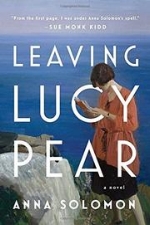
Leaving Lucy Pear     Anna Solomon     (2016)

It seems to me that about half the novels that I read have at the heart of the plot a single woman with an unintended pregnancy. Granted, I read a lot of historical novels, and historically the pregnancy of an unwed woman was a cause of anxiety, grief, distress, secrecy, scheming, and crime.

In the novel Leaving Lucy Pear, Beatrice Haven is the young single woman with an unintended pregnancy. She leaves her newborn daughter in a pear orchard in Cape Ann, Massachusetts, on a night when she expects that pear thieves will be present to find the bundle. All this is revealed in the prologue, set in 1917. The main action of the story occurs a decade later. Unbeknownst to Beatrice, the baby has been named Lucy Pear and has been raised by Emma Murphy, the mother of a large, impoverished Irish American family. Beatrice, who is from a wealthy Jewish family in Boston, continues to be tormented by her act of abandoning her child and spends much of her time at the home of the uncle who owns the pear orchard. The lives of Beatrice and Emma intertwine in complex ways as the plot works toward resolution of some, but not all, of the issues raised about motherhood, womanhood, sexuality, and family ties. 

The setting of the North Shore in Massachusetts is significant. This rocky peninsula between Boston and New Hampshire is rich with literary associations, from Nathaniel Hawthorne to TS Eliot. The time period is also significant, with the political backdrop of the Prohibition era and the controversial 1927 executions of Sacco and Vanzetti, professed anarchists who were accused of robbery and murder. Weaving in and out of the narrative of Leaving Lucy Pear are threads about the temperance movement, liquor smuggling, anarchism, communism, industrialization, labor unions, and social class. 

Anna Solomon’s writing is delicate and introspective. There are many sentences like this: “When she looked at him, her cheeks wrinkled and red from where her sleeves had pressed into them, her eyes pinned him to his chair.” (235) As a reader, I wanted to find out the next component of the plot, but I also wanted to linger on scenes in which character traits are revealed by family members discussing domestic matters. 

Beatrice abandons her baby so that she can move on with her life, go to Radcliffe, and perhaps become a concert pianist. But her plan falters, and that may have been the best outcome for her. Late in the novel, a minor character pronounces, “’Most people want to be extraordinary. Make a mark in the world. But for what? In my experience it’s the extraordinary people what aren’t happy, always expecting something better than they get. Whenever anything at all happens to me, I tell myself it’s happened to everyone else, too. It’s actually very comforting.’” (313-314)


Novels about Paintings, Part 2

The Last Painting of Sara de Vos     Dominic Smith     (2016)

As I read this novel, I assumed that the title painting, the last painting of Sara de Vos, was At the Edge of a Wood. The creation of this fictional work of art is placed in 1636, as de Vos is grieving the death of her only child, a daughter, from the plague. The painting shows a dark-haired girl in the foreground, barefoot in the snow, watching a group of skaters on the frozen river beyond. It’s dusk in winter in the Netherlands, so the quality of light is otherworldly.

According to novelist Dominic Smith’s complex story, At the Edge of a Wood has been owned by the de Groot family for more than three hundred years, and it’s considered by some to have caused bad luck for the owners. Marty de Groot, the owner we meet in Manhattan in 1957, certainly hasn’t suffered financially, but Marty’s law career is stalled, and he and his wife are unable to have children.

Also in 1957 but in Brooklyn, the novelist introduces us to Ellie Shipley, an Australian graduate student in art history at Columbia University. She’s trying to finish her PhD dissertation about female painters of the Dutch Golden Age, and she does art restoration work to support herself. Along comes a commission, not to restore but to copy a painting by (wait for it) a female painter of the Dutch Golden Age: At the Edge of a Wood. Ellie wades in, not so much for the money as for the technical and artistic challenge of reproducing a stunning painting. This is, of course, forgery.

Forty-odd years later, in 2000, Ellie is an esteemed art historian and curator in Sydney, Australia. As she’s gathering paintings on loan from around the world for an exhibit, it becomes apparent that both the original At the Edge of a Wood and the copy she painted will be arriving in Sydney. The forgery will be revealed, and since Ellie is the only person who could have painted the copy, she sees her comfortable life crumbling before her.  

The book moves back and forth effortlessly among three settings:  The Netherlands 1636-1649 (dark, burgher-ruled); New York, 1957-1958 (shiny, jazz-filled); and Sydney, 2000 (sunny, cosmopolitan). The characters of Sara de Vos, Marty de Groot, and Ellie Shipley—all drawn convincingly—move through these settings and through their interconnected lives.  

Novelist Smith does an excellent job of rendering visual art in words, and not only in the passages where he describes paintings. References to the light in a scene come in frequently. For example, here is Ellie on the subway in New York City: “She always has the sensation of being swallowed by the roaring dark of the first tunnel, her ears popping and the sudden appearance of her reflection on the blackened windowpane like some hangdog daguerreotype from another century.“ (208) And here is Marty, in his office at night after committing a terrible deed: “He’s never been up here at night and there’s a sensation of being fortified behind glass, of something solid between him and the mercantile canyons of the city. The office buildings are phosphorescent through the darkness, effulgent with a smoky light that reminds him of dry ice.” (249).

By the end of the novel, you’ll know what the last painting of Sara de Vos actually was. I’ll leave you with this summation of the plot: “You carry grudges and regrets for decades, tend them like graveside vigils, then even after you lay them down they linger on the periphery, waiting to ambush you all over again.” (262)

A Young Adult Romance

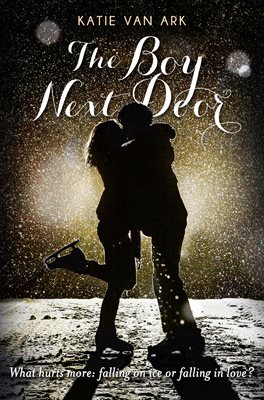
The Boy Next Door     Katie Van Ark     (2016)

Swoon Reads is an online community for readers and writers of Young Adult fiction (swoonreads.com). Writers submit manuscripts for rating and commentary by readers and writers; the very best submissions are published as paperback books by a division of Macmillan. Katie Van Ark’s novel was one of the winners in the romance category, and since she’s a distant relative of mine, I’m stepping out of my usual review zone to tell you about The Boy Next Door.

Lead characters Maddy and Gabe are high school students who’ve known each other since childhood. They’re also competitive figure skating partners, and they’re at the top of the sport, heading toward international events. Maddy has always been in love with Gabe. Gabe, however, has decided to keep things platonic with Maddy, and he dates other young women. When their skating coach picks the theme music from Zeffirelli's Romeo and Juliet for their new routine, Maddy and Gabe have to display attraction toward each other on the ice, and the main plot takes off. As in real life, the path of romance in The Boy Next Door is not straightforward but winding. The chapters alternate first-person narratives from Maddy and Gabe, and several subplots are woven in neatly.

What’s most striking about The Boy Next Door is the figure skating, which unifies the narrative without overpowering the romance theme, even though Maddy and Gabe put in a staggering number of hours at the ice arena. Van Ark knows the sport as an insider, and she describes elaborate skating routines in elegant prose. I know nothing about figure skating, but I was flying along as Maddy executed those triple Axels, cheering for Maddy and Gabe both as skaters and as romantic partners.

Even if you don't usually read romances, pick this one up. As a bonus for Midwesterners, it’s set in Kansas and written by a Michigander!

A Hoot of a Mystery

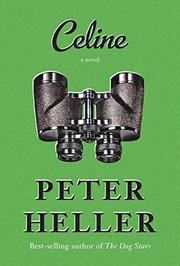
Celine     Peter Heller     (2017)

Peter Heller’s latest is both a mystery novel and a study of his title character. Celine Watkins is still working as a private investigator at age 68, in spite of her emphysema. She specializes in finding missing persons, especially in reuniting adoptees with their birth families. Celine is feisty, mouthy, clever, brave, discerning, blue-blooded, compassionate, stylish. She’s a hoot.

The story line involves a client, Gabriela, who wants to know what happened to her father, a renowned photographer, some twenty years past. He disappeared near Yellowstone National Park, either killed and consumed by a grizzly—or not. Celine and her longsuffering husband and sidekick, Pete, head west from their home base in Brooklyn, stopping in Denver to borrow Celine’s son’s camper and some firearms. And then we’re into the wilderness. Celine and Pete uncover more and more chilling secrets of the case, on their laptop, through phone calls, and in quirky small-town diners along the way. Celine relishes the danger. She seems to have overcome any fear of death, since she can see her health slipping away, and what the hell, she would have died long ago if she hadn’t sworn off the booze. It helps that she’s a crack shot.

The nature writing in Celine is top-notch, which makes sense, since Heller has published four major nonfiction books on adventure travel at the ends of the earth. A sample: “The sun sets behind mountains but the cloudless sky that is more than cloudless, it is lens clear—clear as the clearest water—holds the light entirely, holds it in a bowl of pale blue as if reluctant to let it go. The light refines the edges of the ridges to something honed, and the muted colors of the pines on the slopes, the sage-roughened fields, the houses in the valley—the colors pulse with the pleasure of release, as it they know that within the house they too will rest.” (94) Yup, that’s the golden hour in the American West.

Celine offers up a zany detective, zippy if farfetched dialogue, a serviceable mystery plot, eccentric supporting characters, and gorgeous descriptive passages. Add some flashbacks that fill in Celine’s earlier life, and those pages flip by quickly.

Novels about Paintings, Part 1

A Piece of the World     Christina Baker Kline     (2017)

Baker Kline.jpg

Novels that prominently feature a painting (fictional or real) are not a new idea. In 1891, Oscar Wilde published The Picture of Dorian Gray, a horror story about a portrait that ages while the subject of the portrait remains youthful—but gets nastier. More recently, Tracy Chevalier’s Girl with a Pearl Earring takes a different tack. In her 1999 novel, Chevalier imagines a life story from the actual portrait of an anonymous young woman. In this case, the art work, by the seventeenth-century Dutch artist Johannes Vermeer, is real, hanging in the Mauritshuis in The Hague. The fictional story by Chevalier evokes the period of the painting’s creation beautifully. (See the Vermeer portrait here.)

Christina Baker Kline’s A Piece of the World has an approach similar to that of Chevalier. Baker Kline conjures up a fictional memoir by the subject of Christina’s World, a 1948 painting by the American artist Andrew Wyeth that hangs in the Museum of Modern Art in New York City. In this case, some facts about the actual subject, Christina Olson, are known. Olson really was descended from one of the judges at the Salem Witch Trials of the late seventeenth century. She was born in 1893 and lived on a farm near Cushing, Maine, suffering all her life from a disability that affected her ability to move her limbs. In 1939, she became friends with Andrew Wyeth, who summered in Maine and frequently painted her, her brother, and scenes from their farm. As Olson grew older, she became more disabled and moved from place to place by crawling. In his painting Christina’s World, Wyeth places Olson on the ground, with her back to the viewer, clawing the soil as she twists to look at her farmhouse, which is up a hill from her. (See the Wyeth painting here.)

Beyond the historical facts, Baker Kline weaves a fictional life, narrated by a fictional Christina Olson but quite believable. (The only parts of the narrative that I found somewhat strained were the dialogues between Wyeth and Olson.) Baker Kline invents a full life for Olson, from her birth until the unveiling of Wyeth’s expressive painting of her. The onus of disability for those in rural areas and without access to current medical treatments is clear. (For another novel about disability, see my review here.)

Christina Olson and her family live a life of austerity, particularly during the Great Depression, without electricity or running water in their house. Their daily existence is like that of a pioneer family in the nineteenth century. Baker Kline describes their chores in detail:  the stoking of the wood burning stove, the lighting of the kerosene lamps, the hand harvesting of the blueberries. These activities, and the grim farmhouse, attracted the eye of Wyeth, who painted a vanishing way of life with its surrounding stark landscapes. It strikes me that A Piece of the World has many characteristics of a Laura Ingalls Wilder novel, albeit set in Maine and written for adults.

As I was reading A Piece of the World, I turned frequently to the reproduction of the painting Christina’s World bound into the back of the book. This tender novel about a woman’s simple life complements Wyeth’s haunting work of art.