Four Novels in One

4 3 2 1      Paul Auster     (2017)

Do not read other reviews of this novel before you read the novel itself! All the reviews--except for mine!--give away too much of the plot and spoil the revelations, good and bad.
Paul Auster has created a mesmerizing series of narratives by mixing up four novels in one book. The protagonist in all four, Archie Ferguson, bears the Scottish surname that his grandfather received at Ellis Island, but he’s Jewish American, born in Newark in 1947. His life story through early adulthood plays out in four distinctly different ways, depending on choices made by Archie himself and by his family members and friends. The author doles out these four stories in segments, taking us through the phases of Archie’s young life, and he helpfully labels each segment. (There are four versions of chapter 1, four versions of chapter 2, and so forth.)

Some elements of Archie’s personality and tastes carry into multiple stories. Archie is always a good athlete, either in baseball or basketball. He’s sexually active at an early age. One of his bed partners is Amy Schneiderman, who in different versions of the story is his stepsister, cousin, or family friend. Sometimes the Archies have the same experience, as when a professor at Columbia gives two different Archies a copy of the university’s literary magazine. In all four of the narratives, Archie seems to have a preponderance of tragic, early deaths surrounding him, including death by car accident, lightning strike, brain aneurysm, and fire.

As you read 4 3 2 1, you could make a spreadsheet to keep track of all the plot elements, but I recommend that instead you let the stories flow over you. Auster’s extremely long compound complex sentences encourage this latter approach, since the words stream seamlessly down the pages, pulling you along.

4 3 2 1 is about how everyday decisions of everyday people can have long-term ramifications, both for themselves and for those surrounding them. Within the novel, Auster has the characters themselves analyze the phenomenon of choices that change lives:

“ . . . from the beginning of his conscious life, [Archie had] the persistent feeling that the forks and parallels of the roads taken and not taken were all being traveled by the same people at the same time, the visible people and the shadow people, and that the world as it was could never be more than a fraction of the world, for the real also consisted of what could have happened but didn’t, that one road was no better or worse than any other road, but the torment of being alive in a single body was that at any given moment you had to be on one road only, even though you could have been on another, traveling toward an altogether different place.”

Reading all 866 pages of 4 3 2 1 takes serious commitment. You are more likely to keep turning those pages if you enjoy novels about the 1960s in America. When I saw that Archie Ferguson was born in 1947, I immediately calculated that he would come of age in the 1960s, during the Vietnam War, when young American males were subject to the draft, and those drafted males were almost always sent to the jungles of Southeast Asia. Novelist Auster confronts this cruel fact in four different ways, and watching him do it is intriguing. Paul Auster was himself born in 1947, so he knows whereof he writes, though I would caution against reading 4 3 2 1 as a memoir or autobiography, despite the metafictional echoes of the novel’s closing pages.

One of the four Archie Fergusons, studying at Columbia University on a draft deferment, muses: "The postwar children born in 1947 had little in common with the wartime children born just two and three years earlier, a generational rift had opened up in that short span of time, and whereas most of the upperclassmen still bought into the lessons they had learned in the 1950s, Ferguson and his friends understood that they were living in an irrational world, a country that murdered its presidents and legislated against its citizens and sent its young men off to die in senseless wars, which meant that they were more fully attuned to the realities of the present than their elders were.”

Another theme that I pick up from 4 3 2 1 is the way wealth—or the lack of it—affects life choices dramatically. Here is one example, right after one of the Archies has come into some cash:

“Thousands of dollars were sitting in his account at the First National City Bank on the corner of West 110th Street and Broadway, and just knowing they were there, even if he had no particular desire to spend them, relieved him of the obligation to think about money seven hundred and forty-six times a day, which in the end was just as bad if not worse than not having enough money, for these thoughts could be excruciating and even murderous, and not having to think them anymore was a blessing. That was the one true advantage of having money over not having money, he decided—not that you could buy more things with it but that you no longer had to walk around with the infernal thought bubble hanging over your head.”

And then there’s New York City of the 1960s, conjured up by Auster with all its grit and glamor, and I can seldom resist New York novels. As one character comments, “New York is it.”
Koreans in Japan

Pachinko     Min Jin Lee     (2017)

“Pachinko” is a popular Japanese slot-machine game. You may wonder, until well past the halfway point of this novel’s 485 pages, what pachinko has to do with a saga about four generations of a Korean family in the twentieth century. Have patience.

First you have to be well steeped in the story of Sunja, a poor teenager who is seduced by Hansu, an older Korean gangster, in her village in what is now South Korea. By chance, Isak, a Korean Christian minister, passes through the village. He rescues Sunja from the ignominy of an unwed pregnancy by marrying her and taking her to Japan, where he will work as a missionary. The year is 1933.

Historical events of the turbulent twentieth century constantly buffet Sunja, Isak, and their extended family and friends in Japan, where the bulk of the story plays out. Japan’s expansionist wars of the 1930s and 1940s fuel nativist sentiments in the Japanese  populace. Korean immigrants, who are “zainichi” (foreign residents), are relegated to the most menial jobs and are paid less than Japanese for the same work. Korean children born in Japan do not become citizens—they’re essentially countryless. As one character pronounces: “’This country [Japan] isn’t going to change. Koreans like me can’t leave. Where we gonna go? But the Koreans back home aren’t changing, either. In Seoul, people like me get called Japanese bastards, and in Japan, I’m just another dirty Korean no matter how much money I make or how nice I am.’“ (383)

Once Korea is partitioned into North and South in 1948, the situation gets even murkier: “After the [Korean] peninsula was divided, the Koreans in Japan ended up choosing sides, often more than once, affecting their residency status. It was still hard for a Korean to become a Japanese citizen, and there were many who considered such a thing shameful—for a Korean to try to become a citizen of its former oppressor.” (441)

A few ethnic Koreans living in Japan figure out that they can become entrepreneurs in the pachinko business, and a well-run pachinko parlor can turn a nice profit. Proceeds from pachinko parlors, plus help from that gangster Hansu, pave the bumpy road out of poverty for some characters in the novel. Other characters hide their Korean ethnicity, dressing like the Japanese, learning to speak Japanese without an accent, taking a Japanese spouse. This subterfuge is possible because the physical characteristics of Japanese people and Korean people are often very similar.

The straightforward, direct sentence style in Pachinko suits the themes of the novel, and the Korean and Japanese words in the text give the flavor of the setting without weighing down the narrative. I caught the simple ones, like “kimchi” (the Korean dish of fermented cabbage and radish) and “hanko” (a hand stamp of one’s name, used throughout East Asia). The meanings of other words were obvious from their context, but I had to look up a few as I read.

It would have been easy for novelist Lee to paint the Japanese as always the bad guys and the Koreans as always the good guys, but she does not adopt this dichotomy. Although she lays out the Japanese discrimination against Koreans clearly, her long list of characters includes both Koreans and Japanese who are deceitful and honest, talented and mediocre, wise and foolish, lazy and hardworking, compassionate and heartless, selfish and generous, prejudiced and open-minded. She pulls into her story subplots that touch on issues such as the status of minority Christians in Japan and the evolving attitude toward the place of women in the family and in the workplace over the course of the twentieth century. 

Above all, though, this is a universal story about the immigrant experience—about taking a job that’s far beneath your skill level because you don’t know the language, about being segregated into a slum area, about being subject to complicated rules that you don’t understand, about living constantly with fear. Immigrants enter a game of chance, stacked against them, much like pachinko players.

In her Acknowledgements, Lee tells us that it took her nearly thirty years to write this impressive novel. It was well worth the time.

North Woods Morality

The Hearts of Men     Nickolas Butler     (2017)

“Who knows what evil lurks in the hearts of men?”  This line from the 1930s pulp fiction radio drama The Shadow captures the theme of Nickolas Butler’s probing new novel.

The hero of The Hearts of Men is Nelson Doughty, his surname perhaps chosen by the author because it’s an archaic English word meaning “fearless” or “persistent.” We first meet Nelson in 1962 at a fictional Boy Scout campground, Camp Chippewa, in northern Wisconsin, where he is a nerdy, bespectacled thirteen year old who is constantly bullied by the other campers. He does, however, find a savior—the elderly scoutmaster who runs the camp—and also strikes up a somewhat tentative friendship with a popular, athletic older boy named Jonathan.

I cringed in horror at the cruelties Nelson endured as a teenager, but his adult life holds even further unhappinesses, in Vietnam as well as back at Camp Chippewa. I won’t spoil the plot, which unfolds over the ensuing 57 years, until the year 2019. By that year, the evil lurking in the hearts of men has intensified: “There seems an atmosphere everywhere these days in America, a malevolent vibration in the air, every citizen so quick to righteous rage, some tribal defensiveness, seeing the fault in each other's arguments, rather than some larger common field of compromise, if not agreement.” (278)

Novelist Butler unfurls the secrets of both men and women as Nelson, Jonathan, and their families seek the standards by which they’ll live out their lives. “A scout is trustworthy, loyal, helpful, friendly, courteous, kind, obedient, cheerful, thrifty, brave, clean, and reverent.” Will this Boy Scout Law serve the purpose? Or is there an Army code that one can follow? Organized religion doesn’t seem to have the answer, at least in Butler’s Wisconsin. Some of his characters have an innate sense of fairness and generosity, but many of them are seriously flawed. The men, in particular, struggle with how to define themselves as males in American society. Are you a real man if you hold your liquor, beat your kids, frequent strip clubs, and cheat on your wife?

Throughout the book, Butler tosses off similes that stop you in your tracks: “The beer is ever so cold and bright, like swallowing winter sunlight carrying a memory of summer wildflowers, resting hay.” (149) His descriptions of summer in northern Wisconsin, viewed from a car window, are perfect: “Fields and fields of waist-high Cargill corn and knee-high Pioneer soybeans, muddy barnyards of shit-splattered Guernseys and Holsteins, sun-bleached and woebegone trailer parks, falling-down barns begging for a splash of gasoline and a match, cemeteries ringed in browning arborvitae and chain-link fences, derelict stone silos, small to middling northern rivers, forests of maple and oak and red pine sliding by at fifty-five miles per hour.” (154) Similarly, I know exactly the kind of place that Butler’s characters are in when he places a scene in a supper club, a dining establishment peculiar to rural areas of the upper Midwest.

The choice of Camp Chippewa, mosquitoes and all, as a primary setting for this epic is inspired. When you’re camping in northern Wisconsin, you’re far away from the cares and distractions of city life, forced to confront elemental truths. At one point, the young Nelson comes out of the woods into a clearing, and this is what he sees:  “A star sliced loose from its berth and went scuttling out into the void, turning and turning without ever a hope of gaining traction again. I am cut loose, he thinks. And, To hell with them all.” (95)

Soviet House Arrest

A Gentleman in Moscow     Amor Towles     (2016)

For Americans who grew up during the Cold War of the 1950s and 1960s, the Soviet Union was a scary place. Only a little information leaked out about everyday life there: long lines to purchase basic necessities, people crammed ten to a room in tiny apartments, the KGB ready to pounce on any political or social dissent. So Amor Towles’s fictional foray into Moscow’s elegant Metropol Hotel in the years from 1922 to 1954 is captivating on many levels. Towles posits that high-level Communist Party officials still wined and dined themselves and foreign dignitaries, right through the Depression of the 1930s, and that ordinary Soviet citizens found small bits of happiness despite privations and surveillance. Some displayed great courage in adversity. Towles’s portrait of the fictional Count Alexander Rostov gives us a glimpse into what might have happened to one of the ousted aristocrats in the aftermath of the Russian Revolution of 1917.

In 1922, the erudite and cultured young Count Rostov is sentenced to permanent house arrest in the Metropol Hotel, just off Red Square in Moscow. This is not exile to Siberia, but if Rostov walks out the door of the hotel, he will be shot. The Count, relegated to a tiny attic room, approaches his predicament with the utmost composure. Since his own family members are all dead, he gradually fashions himself a family from the employees and guests of the Metropol. While chaos and war unfold outside the Metropol, all is grace and style inside. Count Rostov is, to me, a Russian version of Lord Peter Wimsey, from the 1930s British mystery novels of Dorothy L. Sayers. Yes, he can be snobbish at times, but he’s generous, principled, and unwaveringly loyal to his friends.

As the years of Rostov’s life tick by, Towles tosses off details about the Metropol in one witty scene after another. Pay close attention to the most minuscule of these details, which Towles is constructing carefully as he builds toward the denouement of his novel. You can easily get pulled into enjoyment of individual episodes, as friends arrive to visit Rostov, a famous actress becomes his lover, and a young girl takes him behind the scenes to secret places in the enormous hotel. Rostov comes to know every cranny of the hotel intimately, and this knowledge will serve him well as the plot whirls to a conclusion in the final hundred pages of this 462-page book.

“Sophisticated” does not begin to do justice to Towles’s writing style. Here he is describing a clock: “Suddenly, that long-strided watchman of the minutes caught up with his bowlegged brother at the top of the dial. As the two embraced, the spring’s within the clock’s casing loosened, the wheels spun, and the miniature hammer fell, setting off the first of those dulcet tones that signaled the arrival of noon.” (32)

Here he is in the hotel kitchen, describing a bouillabaisse, the ingredients assembled with tremendous difficulty in a Soviet Union with closed borders: “One first tastes the broth—that simmered distillation of fish bones, fennel, and tomatoes, with their hearty suggestions of Provence. One then savors the tender flakes of haddock and the briny resilience of the mussels, which have been purchased on the docks from the fisherman. One marvels at the boldness of the oranges arriving from Spain and the absinthe poured in the taverns. And all of these various impressions are somehow, collected, composed, and brightened by the saffron—that essence of summer sun which, having been harvested in the hills of Greece and packed by mule to Athens, has been sailed across the Mediterranean in a felucca. In other words, with the very first spoonful, one finds oneself transported to the port of Marseille—where the streets teem with sailors, thieves, and madonnas, with sunlight and summer, with languages and life.” (221-222)

I guessed some but not all of the elements of caper that caps the plot of A Gentleman in Moscow. The surprises were highly enjoyable.

A Chinese Tea Tale

The Tea Girl of Hummingbird Lane     Lisa See     (2017)

“’No coincidence, no story.’” With this quote from her mother, the first-person narrator of The Tea Girl of Hummingbird Lane, Li-Yan, begins. Remember that line as you read Lisa See’s moving tale of the collision of a traditional culture with the modern world.

In the mountainous Yunnan province in the far southwest of China live the Akha people, one of China’s tiny ethnic minorities. The Akha speak a distinctive language and practice a kind of animistic religion, involving many taboos and ritual sacrifices, guided by patriarchal village shamans. When this novel opens, in 1988, the province was even more isolated than it is today, and because of its inaccessibility the Akha people were not touched very much by such Chinese political movements as the Great Leap Forward and the Cultural Revolution. They were also exempt from China’s One Child policy because of their minority status.

Li-Yan is the daughter of a tea-growing Akha family, but she yearns for an education and an escape from her isolated village. When she has a baby out of wedlock, she refuses to allow the baby to be killed, as is the Akha tradition. Instead she makes a grueling journey on foot to an orphanage in the closest town to relinquish her daughter, who is wrapped up with a tea cake (a block of compressed tea leaves). Without revealing spoilers, I can tell you that Li-Yan’s adventures over the next twenty years bring her considerable success, mostly because her mountain’s rare tea leaves, called Pu’er, become international best sellers. But Li-Yan constantly misses the daughter she gave up and wishes she could find her.

Interspersed with the story that Li-Yan narrates are varied documents, such as letters and transcripts, relating to this daughter of Li-Yan, who is adopted as an infant by a Caucasian American couple from California and named Haley. Haley has a privileged upbringing, but she never feels fully part of American culture and longs to find her Chinese birth mother. Coincidence comes in here, as Li-Yan and Haley almost meet more than once.

Some reviewers of The Tea Girl of Hummingbird Lane found the lengthy disquisitions on the cultivation of tea trees and the processing of tea leaves onerous to read. I liked these sections, which build the background for the role of tea trading in the novel. Besides, I’m a great fan of tea. And tea is, as you might guess, part of the final coincidence that ties this novel up.

Some reviewers also criticized the author’s extensive descriptions of Akha culture. I liked these sections, too, especially the accounts of religious rituals and of the distinctive clothing of the Akha, which is rich with indigo-dyed fabrics, embroidery, and elaborate women’s headdresses. Late in the book, a character describes the Akha: “’In the West, you think the individual is supreme, but the Akha see themselves as one link in the long chain of life, adjacent to all the other links and cultures.’” (352) The contrast of the tribal Akha ways with the lifestyles in large Chinese cities and in California, where some of the action takes place, appealed to me, as did watching Li-Yan’s adaptation to totally different cultural norms. Here is Li-Yan in a large Chinese city: “I take a deep breath to fortify myself, mortar into place another brick to hide my secrets, and settle my face into what I hope is a pleasant expression.” (222)

Lisa See is a talented writer with nine published novels about Chinese and Chinese American characters. If you like The Tea Girl of Hummingbird Lane, try her 2009 novel, Shanghai Girls, next.

Brooklyn Satire

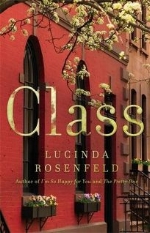
Class     Lucinda Rosenfeld     (2017)

Karen Kipple is a contemporary Brooklynite in her mid-forties, with a listless husband, a third-grader named Ruby, and a job at a nonprofit that feeds hungry children. This setup could be boring, but novelist Lucinda Rosenfeld tracks the story toward the absurd with biting satire and probing questions about progressive politics.

Karen obsesses about everything, measuring her actions, and those of others, against a standard that’s impossible to achieve. For example, she worries about the junk food that Ruby’s classmates eat, but then she overanalyzes: “Along with weight, teeth, and marriage, food had somehow become a dividing line between the social classes, with the Earth Day-esque ideals of the 1960s having acquired snob appeal, and the well-off and well-educated increasingly buying ‘natural’ and ‘fresh’ and casting aspersions on those who didn’t.” (19-20)

So, while Karen gets upset about kids eating junk food, she then internally castigates herself for her classism. And, despite the title of this novel, race looms large in Karen’s obsessions also. The African American kids in Ruby’s school have names that irritate Karen, until she realizes that the purposely antiquated names of the white kids (Prudence, Violet, Silas, Leo, and even Ruby) can be seen as pretentious in a different way.

This tug-of-war within Karen plays out over and over. Karen lives much of her life through Ruby, and she worries constantly about every single interaction that the poor child has with other children. “It alarmed and excited her to think that her daughter was only two degrees of separation away from the kind of people who got evicted.” (87) Karen is both alarmed and excited throughout this novel.

The plot in Class mainly revolves around Karen’s decision to pull Ruby out of the local minority-white public school she’s attending and fraudulently enroll her in a nearby all-white public school. Karen doesn’t even tell her husband about her maneuver. And this act of betrayal of her liberal values is one of a series of outrageous exploits, involving preposterous lies, marital infidelity, and embezzlement. As Karen plunges off a metaphorical cliff, readers may want to grab her by her hair and shake her!

The ancillary characters in Class are stereotypes broadly and often humorously drawn: the non-communicative husband who watches television sports, the obnoxious PTA president, the selfish billionaire. In conversations with them, Karen ranges from timid to frank to confrontational. I found this variability unconvincing, but perhaps Karen vacillates verbally as a reflection of her unease with her social convictions.

I’ve reviewed a number of novels set in New York that wavered on the edge of satire; see one of my posts here. There’s no question that Class is a satire, striking at the shibboleths of the left. It will make you squirm as you think about exactly why you hold the beliefs that you do, no matter where on the political spectrum you sit.

Love at Harvard

The Idiot     Elif Batuman     (2017)

Throughout the 423 pages of this novel, the first-person narrator, Selin, readily admits the many things that she does not know. “I didn’t know what email was until I got to college” is her first sentence, and in the following pages we find that she doesn’t know what a psychedelic poster might be, that she doesn’t know about the wars between the Ottoman Turks and the Hungarians (despite being Turkish American), that she doesn’t know what neural networking is. At age eighteen, Selin has never played squash and never had sex. When the topic of Italian films comes up, she says, “I didn’t know anything about Fellini; my mental image was of a human-sized cat.” (45)

Selin constantly juxtaposes funny lines and hilarious scenes with expression of her serious confusion about becoming a writer, which she accepts as her fate, and about falling in love, which she hasn’t expected. She’s a freshman at Harvard in the fall of 1995, just like the novelist Elif Batuman, and she skewers all of Harvard’s pretentiousness in a most delightful way, while still putting on display the intelligence of her fellow students. Despite her protestations of ignorance on many fronts, Selin is a deep thinker, probing existential questions that only a very bright adolescent would consider.

At the same time, Selin is a naïve and introverted teenager, searching for hidden meaning in her class assignments, her email exchanges with her crush, and her discussions with friends in the cafeteria. It’s not that she feels inadequate for the challenges of a Harvard education—she’s well-read and quick with analysis. But she can spot the gaps in her knowledge.

Author Batuman went on after graduating from Harvard to earn a PhD in Russian literature, so it’s not accidental that she calls her novel The Idiot. Dostoevsky’s 1869 novel of the same title stars Prince Myshkin, who is such a good and decent fellow that he’s deemed stupid by the self-aggrandizing, worldly people around him.

Dostoevsky’s novel ends in tragedy. It’s hard to say how Batuman’s novel ends, and that’s not because I’m avoiding spoilers. I’m a reader who clings to plot structure in novels, so the lack of a strong plot in Batuman’s novel bothered me as I read. But I kept reading because the dialogue is so enjoyable and the depiction of a young woman on the edge of adulthood is so perceptive.

Here is Selin, discovering that men have the advantage in life: “I was overcome by the sudden sense of Ivan’s freedom. I realized for the first time that if you were a guy, if you were some tall guy who looked like Ivan, you could pretty much stop to look at anything you wanted, whenever you felt like it. And because I was walking with him now, for just this moment, I had a special dispensation, I could look at whatever he was looking at, too.” (177)

Batuman’s The Idiot takes us through an entire year in the life of Selin, from her September arrival at Harvard through the following August, when she returns to the United States from Hungary, where she taught English for the summer. At the end, I was left wondering what the second academic year of college would hold for Selin, but I was happy to have shared her account of that first illuminating year.

Living with an Anomaly

Miss Jane     Brad Watson     (2016)

In this delicate yet intense novel, Brad Watson tells the life story of Miss Jane Chisholm, who comes to terms with a serious genital birth defect. Miss Jane was born in rural Mississippi in 1915, so her case is indeed difficult, since there was no medical remedy for her condition at the time. Still, Miss Jane approaches each phase of her life with determination and optimism, despite the disappointments in love and career that are imposed by society’s reaction to her disability.

Watson’s starting point for research on this novel (as he explains on his website) was the life of his own great-aunt, who was born with a genital anomaly that was only vaguely alluded to in his family. Watson finally figured out what his great-aunt’s condition must have been, and in the novel he doesn’t shy away from explaining the physical issues, revealing pieces as the story progresses. These medical facts are usually in dialogues, with the local doctor (who attended Miss Jane’s birth and follows her case), speaking to Jane. Watson pulls the narrative out of the realm of the bizarre into normality, breaking down barriers that separate people because of their physical characteristics.

The reader comes to respect Miss Jane for her courage and to love her for her sweetness. Both as a child and as a woman, she’s beautiful in appearance. Men are attracted to her, and she must make decisions about how to handle their attentions, as she also finds ways to work around her incontinence.

The lush natural surroundings of Miss Jane and her family are described with striking language. For example, here is what Miss Jane’s mother sees as she sits on her porch, worrying about her daughter: “Late fall blackbirds swept in waves to the oaks at the yard’s edge, and their deafening, squawking, creaking calls, the cacophonous tuning of a mad avian symphony, drew the grief-borne anger from her heart, into the air, and swept it way in long, almost soothing moments of something like peace.”

I can’t help comparing Miss Jane, to Middlesex, the 2002 novel by Jeffrey Eugenides, which is a very different story about living life with a genital anomaly. In Miss Jane, the continuing advice of a kindly and knowledgeable doctor softens the suffering that Jane inevitably goes through. In Middlesex, the protagonist lacks this support.

The American South has often been a literary location for sadness, beauty, and extraordinary events under the graceful drooping Spanish moss. You’ll find those qualities in Miss Jane. And be sure to watch for the peacocks, which the author tells us (in the Acknowledgments) were added on the suggestion of his young granddaughter.


After World War II

The Women in the Castle     Jessica Shattuck     (2017)

I had sworn off reading more novels set in World War II, because there are enough global injustices in the current news. But I decided that I’d try The Women in the Castle, because it’s set primarily right after World War II. I knew by page 10 that I was in the hands of an capable writer and that I’d stick with this novel. I read it in one day, gritting my teeth through the flashbacks to horrific scenes from the war.

In the spring of 1945, as the Nazi war machine collapses, millions of people are on the move across the European continent: prisoners of war being released, Russian soldiers running amok, civilian refugees returning to ruined villages or settling in crowded camps for displaced persons. They walk unfathomable distances in all weather, beset by injuries, diseases, assaults, and starvation.

Among the roaming throngs are surviving members of the German Resistance movement. These are the men and women within Germany who did not accept Hitler’s vision for their country and who tried, numerous times but unsuccessfully, to assassinate the Führer. Jessica Shattuck tells the stories of three fictional “widows of the Resistance” as they scrape together the fragments of their lives.

Inside Germany, Marianne von Lingenfels and her three children take shelter in a crumbling ancestral castle of Marianne’s late husband, who was part of an assassination plot that led to gruesome execution for him and his fellow plotters. Marianne has made a vow to look after the families of her husband’s compatriots. She’s able to locate the widows Benita and Ania and their children and bring them to the castle, where they all lead a hardscrabble life.

This is the basis of the surface narrative in The Women in the Castle, and that narrative is full of secrets and mysteries, betrayals and senseless deaths, but also great love and kindness. The characters of the three women are distinct and deeply drawn as the plot moves back and forth in time.

The underlying story is more complex. Shattuck considers what it was like in the late 1930s to be pulled into the fascist maelstrom in Germany through something seemingly benign like the Landjahr Lager, a Nazi agricultural training and service program. She looks at how women survived World War II, particularly women in cities, where there was no access to food once all the shops had been bombed. She asks what political resistance really entailed on an individual level, in battle or in a concentration camp. She posits what it may have been like after the war for German resisters to live next door to returning Nazi soldiers—or worse, members of the SS. She explores the reactions of ordinary Germans to the incessant Nazi propaganda that covered up war atrocities. Here is a description of Ania, one of the widows in the novel:  “She knew of the horrors and she didn’t. She half knew—but there is no word for that. She knew it the way you know something is happening far way in a distant land, something you have no control over: earthquake refugees living in squalid conditions or victims in a foreign war.” (259)

I lived in Munich in 1973, one generation after the end of World War II. By then Munich had been rebuilt from rubble and was an immaculate, prosperous city with all the cultural amenities. But reminders of the war were all around in the form of the maimed bodies of many middle-aged and elderly men. No one ever talked about what had happened to the city or its inhabitants during the war. This silence of avoidance is exactly what Shattuck portrays in The Women in the Castle. With her powerful novel, I think that Shattuck is warning us that we must confront the hard truths of the past, lest we, too, be drawn into the xenophobia and bellicosity of a dictator.

A Cure for Loneliness

Our Souls at Night     Kent Haruf     (2015)

Right in the first chapter of Our Souls at Night we know the premise: One evening in May, elderly widow Addie Moore asks elderly widower Louis Waters if he would come to her house occasionally and spend the night, not for sex but for conversation and companionship. Addie and Louis are neighbors in the fictional small town of Holt, Colorado, and both are intensely lonely. She has a son, and he has a daughter, but these adult children live hours away.

Addie and Louis embark on their conversational adventure, scandalizing the townsfolk but finding joy in each other’s company. Through their dialogue, which forms the core of this book, we learn about their family histories, their disappointments, their secret pleasures. When Addie’s son and daughter-in-law have marital and business troubles, their young son comes to stay with Addie for the summer. Addie and Louis are able to cheer up this forlorn grandchild with unpretentious entertainments, but, alas, the magic of their summer together doesn’t last.

All you punctuation geeks out there should be aware that author Kent Haruf uses no quotation marks in his writing. This practice causes reader confusion once in a while, but I think I understand Haruf’s motives. The text as it appears on the page is exceedingly spare and unadorned, just as the narrative is simple and stripped down. We get the essence of the story, the bare essentials, which nevertheless say plenty about issues like friendship, trust, love, and family duty. Every single word of Our Souls at Night seems carefully chosen to enhance the whole book.

Haruf depicts small-town America deftly in this novel. (At 179 pages, I’d say that it’s more of a novella.) He doesn’t stereotype the characters or sentimentalize their relationships. Rather, he creates complex, fallible people trying to make sense of their lot in life. Addie and Louis carve out their own version of happiness in spite of setbacks; readers can tuck their story away as a tutorial in how to cope with old age and the inevitability of mortality.

This understated jewel of a book is one you should not miss.

Sadly, Kent Haruf died in 2014, shortly after completing Our Souls at Night. His previous novels (all set in Holt, Colorado) include a loose trilogy (Plainsong, Eventide, and Benediction), Where You Once Belonged, and The Tie that Binds, plus the photobook West of Last Chance (with photographer Peter Brown).


Chinese American Metafiction

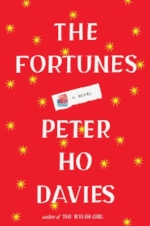
The Fortunes     Peter Ho Davies     (2016)

Peter Ho Davies has crafted a heartbreaking metafictional novel about the experience of being Chinese American. I was skeptical at first about the designation of “novel,” since the dust jacket details four separate sections, each with distinct characters, set in various time periods over the past 150 years. Perhaps, I thought, this is another book of short stories, like Davies’s two previous collections. By the time I’d finished reading The Fortunes, however, I could see that it is a novel, with the sections linked in hundreds of intricate ways. It may even be that the first three sections of the novel are intended as the fictional work of the fictional main character in the fourth section, hence the “metafictional” designation. Got all that?

It plays out in this way. The first section, “Gold: Celestial Railroad,” is about Ah Ling, a half-Chinese, half-white immigrant to California during the building of the railroads in the 1860s. First as a laundry worker and then as servant to Charles Crocker, a railroad baron, Ah Ling is thrust into controversies over Chinese labor on the Central Pacific Railroad. Throughout this section, the longest of the book, Ah Ling struggles with his identity, his relationship to other Chinese Americans, and his place in the emerging society of the American West.

Next, in “Silver: Your Name in Chinese,” we meet Anna May Wong, a Chinese American actor in the early days of Hollywood. Wong is portrayed as holding her own in an industry that blatantly discriminates against Asian Americans, routinely casting white actors to play Asian characters. Wong gets lesser roles as temptresses or discarded mistresses. Off camera she takes on numerous white lovers, both male and female.

Moving ahead in time to 1982, the section titled “Jade: Tell it Slant” recounts the story of Vincent Chin, an unarmed man who was beaten to death with a baseball bat by two Detroit auto workers angered by the rise of Japanese auto manufacturing. They thought Chin, a Chinese American, was Japanese. The narrator in this section is a friend of Chin’s who fled the scene and feels guilty about it even thirty years later. Since I live in southeast Michigan, I’m very familiar with this crime and with the lack of punishment for the perpetrators. Still, I found the grisly descriptions of Chin’s death hard to read. It’s small comfort that the Vincent Chin case brought to the public’s attention the racist attitudes toward Asian Americans in our nation.

Finally, in “Pearl: Disorientation,” we meet Chinese American John Ling Smith in the present day. Smith (who has a white father and a Chinese mother) and his wife (who is Irish American) are in China to pick up a baby they are adopting. We learn that Smith has begun to write a historical novel about the Chinese workers on the transcontinental railroad. He’s also made a start on books about Anna May Wong and the Vincent Chin case, but he hasn’t completed any of these projects. He feels vaguely guilty that he holds a university teaching position.

Aha—this is where the reader sees some metafictional possibilities. Maybe the preceding sections of The Fortunes are actually John Ling Smith’s unfinished attempts to make sense of the Chinese American experience in the United States. The first three sections of the book, after all, feature historical characters, albeit in fictional scenarios. Smith is totally fictional, but his fictional character is grappling with the same issues of racial discrimination and cultural assimilation that Ah Ling and Anna May Wong and Vincent Chin faced.

Davies doesn’t pull any punches in depicting the racist attacks on Chinese Americans, both verbal and physical. I was taken aback by the huge number of offensive epithets, jokes, and fake accents that Asian Americans endure—about the folds of their eyes, the size of their genitals, and the tone of their skin. The most extreme attack is the brutal murder of Vincent Chin.

The connections that Davies creates between the four sections of his novel astonished me at every page. The word “jade” comes up as the color of the water that Chinese immigrants see on their journey across the Pacific Ocean, as the cigarette holder of Anna May Wong, as the elephant charm on a neck chain that Vincent Chin is wearing when he dies, and as the trinkets that adoptive parents buy when they are in China to pick up their babies. Elephants (real and toy) keep appearing, as do bamboo cages and baskets. Railroad cars trundle in and out of the stories. In 1860s California, the bones of dead railroad workers are carefully sent back to China; in circa-2000 China, John Ling Smith marvels at the unearthing and reconstruction of the Terra Cotta Army, part of a necropolis for an ancient Chinese emperor. We’re told that Smith attended college at Caltech, having been rejected by Stanford; the historical figure Leland Stanford, who founded Stanford University, appears in Ah Ling’s story. The linkages go on and on.

Every person interacting with society must grapple at least occasionally with questions of identity, class, and status. Chinese Americans also carry the weight of one of the great cultures in the history of the world. Davies’ characters straddle East and West; read this novel to see how they handle it.  

A Trip Across Texas

News of the World     Paulette Jiles     (2016)

Before the news of the world arrived on little screens, it came in newspapers. But in North Texas in 1870, even newspapers were scarce, and some people couldn’t afford them or didn’t have sufficient reading skills to get through the articles.

Enter Captain Jefferson Kyle Kidd, who makes a meager living by giving public readings from newspapers. At age 71, Captain Kidd is tall and distinguished looking. A veteran of two wars who has also lived through the Civil War, he has the skills to survive traveling around rough and tumble Texas. Native tribes are still violently resisting the incursions of white settlers, and brutal Reconstruction policies have led to anarchy out on the dusty plains and hill lands.

After a newspaper reading in the North Texas town of Wichita Falls, Captain Kidd is asked to take on the task of delivering a ten-year-old orphan to her aunt and uncle, way down in South Texas, near San Antonio. This orphan has been redeemed from the Kiowa Indians, who had abducted her four years previously, when they slaughtered the rest of her family. The Captain is an honest and kindly man, the widowed father of two adult daughters, so he agrees to make the perilous trip.

The girl, who was named Johanna by her biological parents, has been thoroughly acculturated into Kiowa ways. She can’t speak English, but she makes her displeasure at being removed from her Indian family clear with acts of sabotage at the start of the journey. As the Captain and Johanna travel southward, the Captain realizes that the skills Johanna learned while living among warriors can come in handy on the dangerous trails.

This novel could have become a sentimental version of the American journey narrative, so I ventured past Chapter One warily. I was rewarded with Paulette Jiles’s spare prose that beautifully evokes the frontier, and also with her intriguing conjectures about the psychology of victims of abduction, both during and after their captivity. In an author’s note, Jiles directs readers to The Captured, a nonfiction book by Scott Zesch, which recounts the struggles of some of the children actually abducted by Plains Indians during the nineteenth century. I had not been aware of this page of American history.

I was intrigued by Jiles’s representation of the way Captain Kidd teaches Johanna English, with a little German thrown in, since her birth family was German American. As Johanna becomes more and more adept at English, the phonetic transcriptions of the bright child’s pronunciations change. Jiles values words—spoken words, unspoken words, cruel words, kind words, English words, Kiowa words.  

News of the World reminded me very much of the 2014 movie The Homesman, which is set on the Northern Plains in the same era and involves a similar journey. News of the World and The Homesman share a grittiness, and both explore the fragility and complexity of the human mind. Unlike the movie, however, News of the World takes us forward in time in the final chapter, offering a glimpse of the characters’ future, after the denouement of the central story. When I’ve become attached to fictional characters, I want to see how their lives play out, and this last chapter left me fully satisfied.

Family Sagas: Three Reviews

Review #1

Commonwealth     Ann Patchett (2016)

I can accord all the usual accolades to Patchett, who deftly spins a saga covering fifty years of a family that she admits is somewhat like her own—it doesn’t matter exactly how much. Commonwealth is a set of interconnected novelettes about the affairs, divorces, and remarriages of the older generation and the resultant dysfunctions visited upon them and their children in California and Virginia. The characters are wonderfully crafted, the scene-setting is vivid, and the pacing is energetic. But there’s a serious flaw in this book that I simply cannot get past (spoiler coming). One character, who has a clearly known allergy, dies from anaphylaxis. Patchett repeatedly presents Benedryl tablets as the antidote that the character should have ingested, possibly because these tablets have other roles in her story. In fact, the death could have been prevented only if epinephrine (in an EpiPen) had been administered quickly. This is not a footnote in the novel but rather a defining event. Is Commonwealth still worth reading? Yup. But I’ve warned you.

Review #2

The Turner House     Angela Flournoy (2015)

For a comprehensive examination of the decline of the great city of Detroit, read the classic nonfiction text, The Origins of the Urban Crisis:  Race and Inequality in Postwar Detroit by Thomas J. Sugrue. For an intimate portrayal of the effects of that crisis, read The Turner House by Angela Flournoy. I’m pretty familiar with Detroit. Flournoy has captured the city in its gritty bleakness of the early 2000s as well as, through flashbacks, in its manufacturing glory of the mid-twentieth century. Her angle in is the varying fortunes of the African American Turner family, with thirteen children who were born in the better days and are aging in the dying urban landscape. Although the cast of characters is huge, Flournoy keeps the plot manageable by developing primarily the stories of the oldest and youngest of this clan. The house that the Turners grew up in is depicted lovingly, as an organism in decline. The Turners are African Americans, but The Turner House is about working class Detroiters of any race or ethnicity who are trying to maintain family bonds through tough times.

Review #3

The House at the Edge of Night     Catherine Banner (2016)

Like Shakespeare’s island in The Tempest, Catherine Banner’s island of Castellamare is a tiny Mediterranean refuge for shipwrecked souls, a place of implausible coincidences and occasional magic. Banner follows a family on Castellamare throughout the twentieth century and into the twenty-first, starting each section with a local legend that sets the tone for her archetypal, folkloric characters. The titular House at the Edge of Night is a bar and gathering place for the island community. Readers watch as the succeeding generations of Amadeo Esposito’s family take on the management of the bar, through periods of prosperity and depression, war in the surrounding world, and conflict in the village. Although the novel has a dreamlike, wistful quality, Banner treats serious issues such as clan loyalty, sibling discord, political clashes, and the rival demands of career and family. 

Old Money, New Money

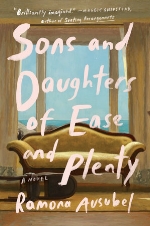
Sons and Daughters of Ease and Plenty   Ramona Ausubel     (2016)

Ramona Ausubel seems to have several goals for her novel Sons and Daughters of Ease and Plenty. She’s trying to explain what it feels like to be a rich kid who’s not comfortable with riches. She’s narrating a deep love between an Old Money kid and a New Money kid, contextualizing them in their families. She throws in a Great American Road Trip. There are some off the wall sub-plots, like the re-enactments of pre-Columbian Native American life. And there are the quirky elements, like the character who’s a giant, and the fawn that happens to die in a suburban back yard at a critical point in the plot.  

Fern and Edgar Keating and their three children are closing out a wonderful summer at their beach house on Martha’s Vineyard, all shimmering seas and sandy toes and billowing sails. Suddenly, they receive news that Fern’s Old Money, on which they live lavishly, is totally gone. Fern and Edgar have always hated the money; Edgar has even written an anti-capitalist novel. But they know of no other way to survive. Each freaks out in a separate way, but the consequence is that they unintentionally leave their nine-year-old daughter and six-year-old twin sons alone in their huge brick Colonial house in Cambridge, Massachusetts, for several days.

If you think that this sounds like the 1990 Christmas movie Home Alone, you’re right. But it’s a little more believable because the year is 1976, when kids walked to school by themselves and wandered their neighborhood by themselves.

The novel shifts back and forth between the 1976 existential family crisis and the period 1965-1970, when Fern and Edgar met, fell in love, and dealt with the Vietnam War. For Americans who came of age during that war, all aspects of life were shaped by the draft notices, the transport planes to Southeast Asia, the flag-draped coffins on the nightly news, the maneuvering of exemptions for a few, the protests, the beleaguered veterans.

Although Ausubel gets much of the Vietnam-era tone right, she falters on the details. As just one example, in 1966, Fern’s brother, Ben, could have had an exemption from the draft for attending college. Everyone knew this, and any male high-school graduate even marginally qualified for college enrolled. Nervous parents, especially wealthy ones, made sure of this. If an author creates a fictional universe, historical fact doesn’t have to be part of the game. But if an author anchors her story in an actual universe, wrong details are jarring.

I appreciate the magic realism in Ausubel’s tale. After all, the wealthy can seem permanently glittered over with fairy dust. But the mysterious appearances of pie slices at many roadside diners can seem forced in a plot that’s grounded in quotidian family life. And Ausubel doesn’t wrap up a number of sub-plot forays. What really happened with that kiss in the darkened girls’ bathroom? Did Edgar go back to the family business or not? Did anybody call Animal Control about that dead fawn in the back yard? 

Ausubel has some lovely metaphors, tossed off seemingly casually. And her descriptors—of window molding or hair style or suit jacket—are apt but always spare enough to keep the plot bounding along. I turned the 306 pages with enthusiasm, anxious to know what happened to Fern and Edgar and the gang. In the end, though, this good novel lacked the full power that I think Ausubel was capable of.  

Manhattan 1952/2016

The Dollhouse     Fiona Davis     (2016)

By chance, I’ve been reading and reviewing a number of novels set in New York City lately. If you’re weary of fictional trips to Manhattan, you may want to skip to another blog post. If you’re up for one more saunter down those fabled sidewalks, here we go.

In The Dollhouse, Fiona Davis jumps back and forth between the years 1952 and 2016 to draw fictional portraits of women who live in the same building in New York City, separated by sixty-four years. The building, depicted on the book’s cover, is real. The Barbizon Hotel for Women, built on the Upper East Side in 1927, was home to generations of young females pursuing careers as editors, models, and secretaries. After the hotel was converted to condos in 2005, one floor was set aside as rent-controlled apartments for long-time residents, and this is where 1952 meets 2016.

Darby McLaughlin is the main 1952 character, fresh out of high school and freshly arrived at the Barbizon from Defiance, Ohio, to attend the famed Katherine Gibbs Secretarial School, with tuition paid by her deceased father’s life insurance proceeds. The innocent and awkward Darby gets caught up in a plot of sex, drugs, and bebop, centering around a sleazy jazz club.

Rose Lewin is the main 2016 character, a former local television news star in her mid-thirties, now working for an Internet news startup. At the beginning of the novel, the sophisticated and savvy Rose is living in her boyfriend’s condo in the Barbizon. She’s soon facing both personal and professional crises, as she decides to research and write about the octogenarian women in the Barbizon, who came of age in a distant, almost mythical, era.

The narrative of The Dollhouse is slow to accelerate. I looked forward to the 2016 chapters as I cringed my way through the 1952 chapters, in which Darby is ridiculed and deceived by her hallmates at the Barbizon. The pace picks up when the modern-day Rose becomes obsessed with the events of 1952 and unlayers a key mystery, using reportorial tactics that she knows are unethical.

Darby and Rose are convincing characters, as are several of the supporting cast. The descriptions of Rose’s boorish young boss, Tyler, are trenchant. In one meeting with Rose, “he held a pen under his nose as if it were a mustache, curled up his lip to support it without any hands.” Tyler performs this maneuver while making misogynist comments about Rose’s writing project. Less successful is the depiction of Jason Wolf, a potential love interest for Rose. Jason appears in the story too fortuitously and is too much of a hunk.

Sylvia Plath keeps popping up in The Dollhouse, too. She actually lived at the Barbizon during the summer of 1953 when she was an intern in New York City, and she refers to the hotel in The Bell Jar. This association becomes a running joke in The Dollhouse, as Rose assures one interviewee after another that she is not writing another story about Plath.

The Barbizon itself has a central role in The Dollhouse, titled for the name that young men in New York presumably gave the building back in the day. It’s possible that Fiona Davis chose her title also as an echo of Ibsen’s The Doll’s House, the controversial 1879 drama about the place of women in the home and in society. Davis wades in to the continuing controversy. Is Rose too dependent on the approval of the men in her life? Does Darby make too many sacrifices for the men (and women) in hers? Are teenaged girls always a little crazy? Can their fathers rescue them with (a) kindness or (b) tough love? Are 2016 women different from 1952 women in substance or only in terminology? And is their place in American society really much different?

A Smart Mom in Seattle

Today Will Be Different     Maria Semple     (2016) 

She’s sassy, she’s manic, she’s self-absorbed. Eleanor Flood is a hot mess as Today Will Be Different opens. She’s resolving that she’ll do better, but the reader knows by about paragraph six that the day coming up will be different in ways that Eleanor does not expect.

I didn’t much like the personality of Eleanor, who’s a fifty-year-old animation artist living the dream in Seattle. Eleanor's supporting cast, however, is appealing. Her surgeon husband is a truly good guy, aptly named Joe. Their eight-year-old son is earnest and caring. The academic whom Eleanor hires to give her private poetry appreciation lessons has his own wacky and touching sub-plot. Even the dog is lovable in a we-put-up-with-his-foibles kind of way.

But Eleanor doesn’t get much sympathy from me. Maybe it’s because she’d prefer to live in Manhattan and is affecting Manhattan introspection and angst. 

The action does adhere pretty well to the Aristotelian unities that the author, Maria Semple, implicitly sets up by starting the novel with Eleanor’s resolutions for this one day in her life. We careen through the streets of Seattle, by car and on foot, as Eleanor abandons her self-improvement quest to instead solve a mystery about her husband. Semple weaves red herrings into this plot and fills in Eleanor’s family story with large sections of flashbacks, some set in New Orleans.  

The color drawings (done by Eric Chase Anderson) in the chapter called “The Flood Girls” are part of this slowly revealed backstory. These illustrations, presented as part of the fictional Eleanor’s art portfolio, fascinated me. I kept turning back to them as Eleanor referred in the text to the people depicted.  Because the character of Eleanor is an artist, this set of drawings didn’t come off as gimmicky.

I had some quibbles with the narrative voice in Today Will Be Different. Most of the book is in first person, with Eleanor narrating. Semple should stick with that so that the reader shares Eleanor’s lack of all the facts as she tries to solve the mystery. But toward the end of the book Semple veers off for scenes with Joe that Eleanor is not privy to. I consider this plot-cheating. I also found the ending of the book a let down, even though I enjoyed much of the ride to get there.

Today Will Be Different has some echoes of Semple’s 2012 novel, Where’d You Go, Bernadette. Both books satirize Seattle, specifically mocking the rich parents who send their children to elite private schools. Both take on the serious topic of how talented women married to talented men struggle to produce creative work when they also have to raise the children. Even if the husbands and the children are charming and supportive, it’s tough. 

Those New York Novels

The Ramblers     Aidan Donnelley Rowley (2016)

(plus brief notes on novels by Adelle Waldman and Cynthia D'Aprix Sweeney)

First, a sidebar.

Maybe I should stop reading these inbred New York City novels. Maybe only New Yorkers can sense where the satire starts. But I read a lot of fiction, and I’ve taught fiction to a lot of college students, so I should be able to discern satire, right? Even if I’m a Midwesterner?

I look back at a couple of other New York novels. I’m pretty certain that Adelle Waldman’s The Love Affairs of Nathaniel P. (2013) is sardonically mocking the callous, self-satisfied male New Yorkers who wreak havoc on the psyches of brilliant, sensitive female New Yorkers. Waldman’s view into this world is morbidly fascinating but morbid nonetheless.

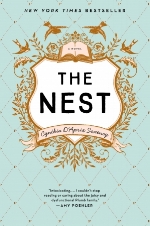
Cynthia D’Aprix Sweeney’s The Nest (2016) is less clear on the satire front. Four siblings fight over their inheritance, which has been greatly depleted by a payout to cover up a crime by one of the brothers. Should I care about the quarrels of these disagreeable, money-grubbing characters, even if the plot is a tight one? Am I supposed to care, or am I supposed to recoil in horror?

This issue is not settled, but let’s move on to the main review.

The Ramblers, by Aidan Donnelley Rowley (2016), brings us three more New Yorkers who have too much money and too many drinks. Admittedly, Clio Marsh was born middle class, but she’s pulled herself up by the proverbial bootstraps to earn a PhD in ornithology. And she lives nearly rent-free as roommate to Smith Anderson, a daughter of the 1% who declutters the Manhattan apartments of her private clients. The third profiled character is Tate Pennington, who has accidentally made a fortune in the tech world and retired to New York to take street photographs and escape his estranged wife in California.

All three are in their mid-30s, yet they prate endlessly about their undergraduate days together at Yale and enter into petty squabbles about the relative advantages of Princeton. Really? So you’ve read Foucault. I’m not impressed, though I think that the author, herself a Yalie, expects her readers to be.

Because the three protagonists are in their mid-thirties, they all long to be in committed relationships. This is a standard feature of the modern New York novel, though it’s usually only the women or the gay men who crave a long-lasting, monogamous marriage. The entire plot of The Ramblers revolves around the achievement of perfect domestic partnerships, but I couldn’t feel much sympathy for these three privileged strivers. They’re stock characters in a flat drama. Clio worries that the revelation of her mother’s mental illness and suicide will derail her affair with a wealthy bachelor fifteen years her senior. Smith won’t distance herself from her malicious father, even though this creepy father browbeat her fiancé into breaking up with her. And Tate salves the wounds made by his unfaithful wife with excessive amounts of alcohol, but he still shoots stunning photos.

The dialogue of the thirty-something women in The Ramblers does have sparkle, but when I hit some scenes with older women or with men (older or not), I found myself stopped mid-page by the inaptness of tone and the cliché-ridden sentences. Wait, I thought, is the author satirizing this character? We’re back to that issue of inadvertent satire again.

If I’m so irritated by these self-aggrandizing characters and their $30 bottles of organic hair conditioner, why do I keep reading New York novels? Why did I ever get past page 50 of The Ramblers? Simple: I have a weakness for the New York part.

For instance, the title of The Ramblers refers to an area in Central Park called The Ramble, a semi-wild nature area in the middle of Manhattan, popular for those seeking outdoor gay sex, which has also become a favored site for birdwatchers. The character Clio leads public birding tours through The Ramble on Sunday mornings and gets written up in the local press. Tate, meanwhile, is a walking guide book to the poetic and architectural history of the city, seeking out the haunts of Stanley Kunitz and Dylan Thomas. Smith’s sister gets married in the cavernous, barrel-vaulted St. Bart’s Episcopal Church, with the reception at the ultra-glamorous Waldorf. The action of the novel takes place during the week of Thanksgiving, so the author can call up glorious late autumn days as well as the edge of silver-bell cheeriness for the upcoming Christmas season. In sum, the NYC of The Ramblers is more vividly portrayed than its inhabitants.

True, for heavy New York atmosphere, you can’t beat author Jay McInerney, and I’ve acknowledged this in a recent blog post reviewing his 2016 novel Bright, Precious Days. I detect satire in some of McInerney’s characters, but he fleshes them out so well and surrounds them with so much New York detail that I tumble right into their lives nonetheless.

And for a weekly dose of New York, I turn to the New Yorker. I can imagine myself at the openings of art exhibits and plays listed at the front and then settle in for some serious journalism, not necessarily about New York, by writers like Adam Gopnik, Joan Acocella, Jill Lepore, Hilton Als, Larissa MacFarquhar, Elizabeth Kolbert, Kalefa Sanneh, Jane Mayer, and Ryan Lizza. Gotta love it.

Tasting the Moon with Chabon

Moonglow     Michael Chabon     (2016)

With a review of a work by Michael Chabon, it’s difficult to avoid gushing out superlatives. Bare superlatives, however, don’t give the readers of the review a taste of the specific delicacies that are on offer in the writing. And Moonglow has many delicious bites.

It’s not a spoiler if you know that the Michael Chabon who is the narrator of Moonglow is fictional and is not the same as the Michael Chabon who is the author of the novel. And Moonglow is truly a novel, though it’s set up as an autobiographical and biographical memoir. Chabon-the-author is expert at inducing you to believe that the fiction he’s creating is really the reconstructed history of his family.

In recent interviews, Chabon-the-author has made it clear that he’s used only brief incidents from his family history as sites from which he has leapt into the fictional worlds of Moonglow. He prefaces the book with a tongue-in-cheek “Author’s Note” in which he disclaims veracity for the “facts” he presents. But as a reader of Moonglow you keep wanting to believe that Chabon-the-narrator is Chabon-the-author, against all this evidence.

The underlying premise of Moonglow is straightforward. In 1989, Chabon-the-narrator sat at the bedside of his dying grandfather as the grandfather spoke about events of his life. He was a daredevil kid in Philadelphia, an engineer with tremendous inventive capacity, an intelligence officer in Europe at the tail end of World War II, an inmate in a minimum security prison in New York State in the 1950s, a snake-hunting retiree in Florida. The grandfather (who never has any other name in the novel) was passionately in love with his wife, a Jewish French refugee ravaged by the Holocaust, whom he met in 1947. The story of this grandmother weaves in and out of the novel about the grandfather.

As with Chabon’s  Pulitzer-winning The Amazing Adventures of Kavalier and Clay (2000), World War II hangs menacingly over the characters. Having wedged his grandfather in to the Allied mop-up operations in Germany in 1945, Chabon-the-author can explore alternate realities that never made it into the history books. What if, for example, a Jewish American officer with extensive knowledge of rocketry were to capture Nazi rocket scientist Wernher von Braun? What if that officer were to uncover the trove of documents revealing the secrets of the V-2 rocket?

Speculative history is a specialty of Chabon-the-author, most notably executed, I think, in The Yiddish Policemen’s Union (2007). In that novel, the alternate history is set up when Jews from around the world establish a homeland in Sitka, Alaska, in the 1940s, and the tale plays out for the next sixty years.

Jewish identity is a key theme for Chabon-the-author, but I see other themes also echoing through his writing: the malleability of fact, the raw beauty of the everyday, the strength of the human spirit in the face of evil (in other people or in the international order). A trademark stylistic device of his that I especially admire is what I call his “extended list,” in which he ranges through all the possibilities of a situation. Here he’s describing sleeping conditions for soldiers in war-torn Europe:

“My grandfather had shared all manner of billets: with dogfaces and officers, in misery and in comfort, in attack and in retreat, and pinned down by snow or German ordnance. He had bedded down under a bearskin in a schloss and in foxholes flecked pink with the tissue of previous occupants. If an hour’s sleep were to be had, he seized it, in the bedrooms or basements of elegant townhouses, in ravaged hotels, on clean straw and straw that crawled with vermin, on featherbeds and canvas webbing slung across the bed of a half-track, on mud, sandbags, and raw pine planks.”

Mimicking the discursive flow of reminiscence, Moonglow see-saws through the life of the grandfather, constantly shifting time and place, occasionally returning to the 1989 scene of the grandson feeding Jello to the dying man. Chabon-the-narrator does not set down his grandfather’s words verbatim but rather casts the episodes he recounts in third person. This technique allows Chabon-the-author to insert astonishing detail. One of my favorite scenes has the grandfather, who does not usually observe religious rites, stopping at a Reform temple on a Friday to pray the kaddish, the prayer of mourning. The congregation is housed in a building that was formerly an International House of Pancakes. As the service goes on, the grandfather feels distant from the other worshipers:

“They might have been strangers in a bus station, solo travelers bound for all points. They might have been separate parties at a pancake house, awash in the syrup emerging from a Wurlitzer organ, played by an old Jew with a Shinola-black pompadour, dressed in a curious tan coverall or jumpsuit and platform saddle shoes.”

Oh, that’s just a taste. You should savor the entire book.

McInerney's Manhattan Excess

Bright, Precious Days     Jay McInerney     (2016)

O, Russell! O, Corrine! O, pet ferret!  Bright, Precious Days, the third installment of the Russell-and-Corrine-story (readable as a standalone), finds them hitting age 50, with a TriBeCa loft that’s too expensive and too small for a family with school-age twins and a pet ferret. And note that TriBeCa always has those internal capital letters, so that you’re looking to the etymology and the map, knowing that Russell and Corrine, having consumed another absurdly extravagant and exotic restaurant meal, are heading home to the Triangle Below Canal Street.

The landmarks of Manhattan are as much characters in McInerney’s novels as the human actors. His New York City dazzles with all the expected urbanity and glitz and pop culture references. His descriptions of the turning of the seasons are particularly striking in their tropes of nostalgia. I’m there, at the top of the Empire State Building, wind in my hair, taking in the view.

I do need my regular dose of Manhattan hauteur and pomposity, if only to reassure myself that I’m content as a boring Midwesterner. McInerney delivers Manhattan full throttle: the wine snobs, the gourmands, the anorexics, the cab drivers, the gala attendees, the trophy wives, the crazed artists, the cocaine snorters. Good Lord, how do people ingest that much cocaine and live to tell the story? Well, some of them don’t live, that’s true.

From the beginning, the reader cringes with the knowledge that Russell’s publishing business is not thriving. Print books were in decline even in the mid-aughts, when the book opens, and although Russell may be the Max Perkins of the twenty-first century, his editing skills don’t translate to business savvy. The reader also has the advantage of knowing that the recession of 2008 is looming.

Corrine—who saw the light, sort of, after 9/11—has taken a job in the nonprofit sector, gleaning discarded vegetables to distribute to the poor, so she doesn’t contribute much income to the family. Corrine’s job does allow McInerney to give us a brief view of the 99% in New York City, with descriptions of the long lines of hungry people waiting to receive a dole of carrots or cabbages.

You don’t have to be an avid reader of mystery novels to guess how the storyline involving Russell’s business will play out in Bright Precious Days. The marital storyline is another matter. R-and-C have been married for twenty-five years, during which time they’ve both repeatedly cheated on and lied to each other. I want to shake them and tell them how selfish they are, how superficial and cliché-ridden their conversations are. I want to tell Corrine that to keep her weight down she should reduce her consumption of alcoholic beverages, not diet on lettuce and canned salmon. R-and-C live up to their surname, “Calloway,” in their adolescent ingenuousness and self-centeredness. The coincidences in the marital storyline strain belief, and the characters are on the edge of becoming caricatures. But I understand many of their flaws and want to know their next steps. I love to despise them.

And I love gazing on that Manhattan excess from afar.