A Cure for Loneliness

Our Souls at Night     Kent Haruf     (2015)

Right in the first chapter of Our Souls at Night we know the premise: One evening in May, elderly widow Addie Moore asks elderly widower Louis Waters if he would come to her house occasionally and spend the night, not for sex but for conversation and companionship. Addie and Louis are neighbors in the fictional small town of Holt, Colorado, and both are intensely lonely. She has a son, and he has a daughter, but these adult children live hours away.

Addie and Louis embark on their conversational adventure, scandalizing the townsfolk but finding joy in each other’s company. Through their dialogue, which forms the core of this book, we learn about their family histories, their disappointments, their secret pleasures. When Addie’s son and daughter-in-law have marital and business troubles, their young son comes to stay with Addie for the summer. Addie and Louis are able to cheer up this forlorn grandchild with unpretentious entertainments, but, alas, the magic of their summer together doesn’t last.

All you punctuation geeks out there should be aware that author Kent Haruf uses no quotation marks in his writing. This practice causes reader confusion once in a while, but I think I understand Haruf’s motives. The text as it appears on the page is exceedingly spare and unadorned, just as the narrative is simple and stripped down. We get the essence of the story, the bare essentials, which nevertheless say plenty about issues like friendship, trust, love, and family duty. Every single word of Our Souls at Night seems carefully chosen to enhance the whole book.

Haruf depicts small-town America deftly in this novel. (At 179 pages, I’d say that it’s more of a novella.) He doesn’t stereotype the characters or sentimentalize their relationships. Rather, he creates complex, fallible people trying to make sense of their lot in life. Addie and Louis carve out their own version of happiness in spite of setbacks; readers can tuck their story away as a tutorial in how to cope with old age and the inevitability of mortality.

This understated jewel of a book is one you should not miss.

Sadly, Kent Haruf died in 2014, shortly after completing Our Souls at Night. His previous novels (all set in Holt, Colorado) include a loose trilogy (Plainsong, Eventide, and Benediction), Where You Once Belonged, and The Tie that Binds, plus the photobook West of Last Chance (with photographer Peter Brown).


Family Sagas: Three Reviews

Review #1

Commonwealth     Ann Patchett (2016)

I can accord all the usual accolades to Patchett, who deftly spins a saga covering fifty years of a family that she admits is somewhat like her own—it doesn’t matter exactly how much. Commonwealth is a set of interconnected novelettes about the affairs, divorces, and remarriages of the older generation and the resultant dysfunctions visited upon them and their children in California and Virginia. The characters are wonderfully crafted, the scene-setting is vivid, and the pacing is energetic. But there’s a serious flaw in this book that I simply cannot get past (spoiler coming). One character, who has a clearly known allergy, dies from anaphylaxis. Patchett repeatedly presents Benedryl tablets as the antidote that the character should have ingested, possibly because these tablets have other roles in her story. In fact, the death could have been prevented only if epinephrine (in an EpiPen) had been administered quickly. This is not a footnote in the novel but rather a defining event. Is Commonwealth still worth reading? Yup. But I’ve warned you.

Review #2

The Turner House     Angela Flournoy (2015)

For a comprehensive examination of the decline of the great city of Detroit, read the classic nonfiction text, The Origins of the Urban Crisis:  Race and Inequality in Postwar Detroit by Thomas J. Sugrue. For an intimate portrayal of the effects of that crisis, read The Turner House by Angela Flournoy. I’m pretty familiar with Detroit. Flournoy has captured the city in its gritty bleakness of the early 2000s as well as, through flashbacks, in its manufacturing glory of the mid-twentieth century. Her angle in is the varying fortunes of the African American Turner family, with thirteen children who were born in the better days and are aging in the dying urban landscape. Although the cast of characters is huge, Flournoy keeps the plot manageable by developing primarily the stories of the oldest and youngest of this clan. The house that the Turners grew up in is depicted lovingly, as an organism in decline. The Turners are African Americans, but The Turner House is about working class Detroiters of any race or ethnicity who are trying to maintain family bonds through tough times.

Review #3

The House at the Edge of Night     Catherine Banner (2016)

Like Shakespeare’s island in The Tempest, Catherine Banner’s island of Castellamare is a tiny Mediterranean refuge for shipwrecked souls, a place of implausible coincidences and occasional magic. Banner follows a family on Castellamare throughout the twentieth century and into the twenty-first, starting each section with a local legend that sets the tone for her archetypal, folkloric characters. The titular House at the Edge of Night is a bar and gathering place for the island community. Readers watch as the succeeding generations of Amadeo Esposito’s family take on the management of the bar, through periods of prosperity and depression, war in the surrounding world, and conflict in the village. Although the novel has a dreamlike, wistful quality, Banner treats serious issues such as clan loyalty, sibling discord, political clashes, and the rival demands of career and family. 

Gentle Swedish Novels

Although the international taste for Nordic Noir is strong, not all the books coming out of Sweden are dark thrillers. The novels reviewed below may not suit you if your taste runs to authors Stieg Larsson (with sleuths Mikael Blomkvist and Lisbeth Salander) and Henning Mankell (with detective Kurt Wallander). I harbor a fascination with Scandinavian culture, so I embrace a wide range of titles from the land of Volvos, fjords, aurora borealis, and IKEA. Here are two gentle offerings from the Swedes.  

Review #1

The Readers of Broken Wheel Recommend     Katarina Bivald     (2016)

Translated from Swedish by Alice Menzies

A stranger comes to town:  it’s an ancient and oft-used storyline, maybe because it has built-in plot development potential. The stranger learns the ways of the town. The town learns the ways of the stranger. The author can add to this mix some conflict, some romance, or some comical misunderstanding. Debut novelist Katarina Bivald takes advantage of all the plot possibilities in The Readers of Broken Wheel Recommend.

Bivald.gif

Sara Lindqvist arrives in Broken Wheel, Iowa, one August day in 2011 to visit her pen pal, Amy Harris. Sara and Amy have in common that they’re voracious readers.  Over a couple of years, Sara has gotten Amy to read Swedish bestsellers like The Girl with the Dragon Tattoo, and Amy has introduced Sara to American classics like To Kill a Mockingbird.  Sara, who’s in her late 20s, has never traveled outside her native Sweden, but when she gets laid off from her job as a bookstore clerk, she decides to use her savings to take an extended trip to Iowa. Sara’s fluent in English, but she’s not prepared for small-town America still in the grips of a major recession. Not to mention that she arrives on the very day of the elderly Amy’s funeral.

The residents of Broken Wheel include all the stock characters. A gay couple owns the saloon, and an unemployed schoolteacher is the local busybody. A semi-reformed alcoholic with a sad family history serves as Sara’s chauffeur. The loud-mouthed, overweight proprietor of the diner keeps Sara fed. Amy’s handsome nephew Tom becomes Sara’s love interest.

Sara has a talent for finding just the right book, from Amy’s extensive collection, for each resident of Broken Wheel. As the Iowans embrace their European waif, the story plays out with the involvement of befuddled US immigration officials. The premise of Bivald’s novel has become more far-fetched since the 2016 American election, when anti-immigrant sentiment in the United States elected Trump, who is especially popular in Iowa. Bivald not only romanticizes rural America but also hits on many clichés.

Still, I don’t want to disparage this book. Bivald’s character Sara has wide-ranging literary tastes. She adores Helen Fielding’s Bridget Jones novels, but she also knows her Jane Austen backward and forward. She’d just as soon pick up a book by Goethe or Annie Proulx as one by Fannie Flagg. I’m more of a book snob than Sara—I draw the line at The Bridges of Madison County. But Sara’s encounter with the Americans of Broken Wheel cheered my heart for a while.

Review #2

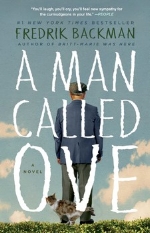
A Man Called Ove     Fredrik Backman (2014)

Translated from Swedish by Henning Koch

Good luck with finding a definitive pronunciation for “Ove.” I pronounce it something like “oo-vuh,” but I don’t speak Swedish.

No matter how the name sounds in your head, Ove is a Swedish curmudgeon in late middle age, and he’s not an endearing one. We meet him making his rounds as self-appointed, and unwelcome, policing agent for his neighborhood. He’s also figuring out how to commit suicide, which is perhaps a nod to that Nordic Noir tradition. The other characters in this novel are pretty much stereotypes: the saintly wife, the vivacious neighbor, the unfeeling government official, the malicious cat.

Backmann.jpg

Over the course of the novel, we gradually get Ove’s life story, and we come to be more sympathetic to him. The ending is not exactly happily-ever-after, but there’s satisfying plot resolution for a number of the characters.

A Man Called Ove and The Readers of Broken Wheel Recommend are not "literary fiction," true. However, they present optimism in the face of difficult circumstances, which many readers may welcome in this troubled world. There’s also in each novel a refreshing societal acceptance of cultural outsiders. I think that both books have some affinity with the work of that prolific Scot Alexander McCall Smith. I read McCall Smith’s books in one sitting, and I always arise feeling a bit better about life.