

Although the international taste for Nordic Noir is strong, not all the books coming out of Sweden are dark thrillers. The novels reviewed below may not suit you if your taste runs to authors Stieg Larsson (with sleuths Mikael Blomkvist and Lisbeth Salander) and Henning Mankell (with detective Kurt Wallander). I harbor a fascination with Scandinavian culture, so I embrace a wide range of titles from the land of Volvos, fjords, aurora borealis, and IKEA. Here are two gentle offerings from the Swedes.
Review #1
The Readers of Broken Wheel Recommend Katarina Bivald (2016)
Translated from Swedish by Alice Menzies
A stranger comes to town: it’s an ancient and oft-used storyline, maybe because it has built-in plot development potential. The stranger learns the ways of the town. The town learns the ways of the stranger. The author can add to this mix some conflict, some romance, or some comical misunderstanding. Debut novelist Katarina Bivald takes advantage of all the plot possibilities in The Readers of Broken Wheel Recommend.

Sara Lindqvist arrives in Broken Wheel, Iowa, one August day in 2011 to visit her pen pal, Amy Harris. Sara and Amy have in common that they’re voracious readers. Over a couple of years, Sara has gotten Amy to read Swedish bestsellers like The Girl with the Dragon Tattoo, and Amy has introduced Sara to American classics like To Kill a Mockingbird. Sara, who’s in her late 20s, has never traveled outside her native Sweden, but when she gets laid off from her job as a bookstore clerk, she decides to use her savings to take an extended trip to Iowa. Sara’s fluent in English, but she’s not prepared for small-town America still in the grips of a major recession. Not to mention that she arrives on the very day of the elderly Amy’s funeral.
The residents of Broken Wheel include all the stock characters. A gay couple owns the saloon, and an unemployed schoolteacher is the local busybody. A semi-reformed alcoholic with a sad family history serves as Sara’s chauffeur. The loud-mouthed, overweight proprietor of the diner keeps Sara fed. Amy’s handsome nephew Tom becomes Sara’s love interest.
Sara has a talent for finding just the right book, from Amy’s extensive collection, for each resident of Broken Wheel. As the Iowans embrace their European waif, the story plays out with the involvement of befuddled US immigration officials. The premise of Bivald’s novel has become more far-fetched since the 2016 American election, when anti-immigrant sentiment in the United States elected Trump, who is especially popular in Iowa. Bivald not only romanticizes rural America but also hits on many clichés.
Still, I don’t want to disparage this book. Bivald’s character Sara has wide-ranging literary tastes. She adores Helen Fielding’s Bridget Jones novels, but she also knows her Jane Austen backward and forward. She’d just as soon pick up a book by Goethe or Annie Proulx as one by Fannie Flagg. I’m more of a book snob than Sara—I draw the line at The Bridges of Madison County. But Sara’s encounter with the Americans of Broken Wheel cheered my heart for a while.
Review #2
A Man Called Ove Fredrik Backman (2014)
Translated from Swedish by Henning Koch
Good luck with finding a definitive pronunciation for “Ove.” I pronounce it something like “oo-vuh,” but I don’t speak Swedish.
No matter how the name sounds in your head, Ove is a Swedish curmudgeon in late middle age, and he’s not an endearing one. We meet him making his rounds as self-appointed, and unwelcome, policing agent for his neighborhood. He’s also figuring out how to commit suicide, which is perhaps a nod to that Nordic Noir tradition. The other characters in this novel are pretty much stereotypes: the saintly wife, the vivacious neighbor, the unfeeling government official, the malicious cat.
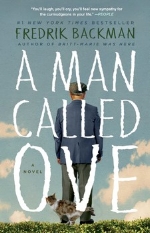
Over the course of the novel, we gradually get Ove’s life story, and we come to be more sympathetic to him. The ending is not exactly happily-ever-after, but there’s satisfying plot resolution for a number of the characters.
A Man Called Ove and The Readers of Broken Wheel Recommend are not "literary fiction," true. However, they present optimism in the face of difficult circumstances, which many readers may welcome in this troubled world. There’s also in each novel a refreshing societal acceptance of cultural outsiders. I think that both books have some affinity with the work of that prolific Scot Alexander McCall Smith. I read McCall Smith’s books in one sitting, and I always arise feeling a bit better about life.
